
The Australian Government is taking strong action on climate change at home and internationally. Australia delivered $3.9 billion in climate finance from 2020 to 2025.
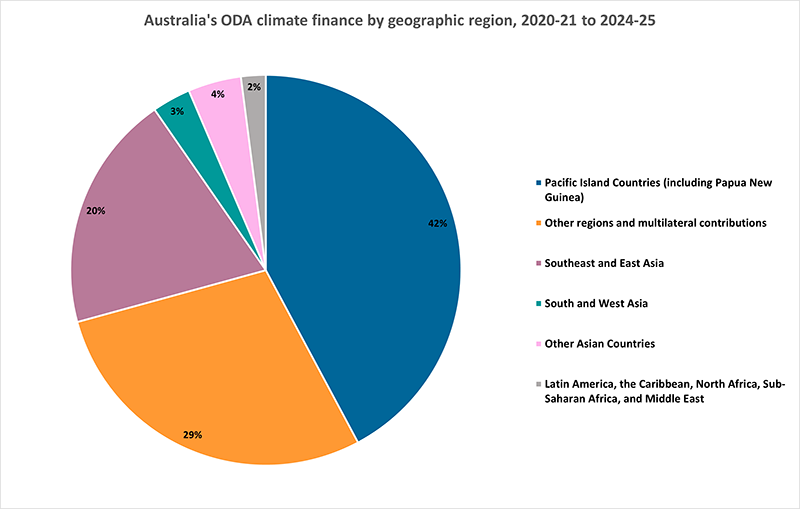
Australia is deploying high quality climate finance that meets the needs of our partners. The Pacific receives the highest proportion of Australia's ODA climate finance, with investments focused on adaptation. In Southeast Asia we draw on innovative financing options to leverage additional finance for mitigation efforts.
We have listened to the Pacific's call for urgent climate action, and are working closely together to address the climate emergency. We met our commitment to provide $1.3 billion in climate finance to the Pacific, the majority for adaptation.
Climate change is at the heart of Australia's International Development Policy, ensuring climate change risks and opportunities are integrated across our development portfolio. The Policy commits to incorporate a climate objective in at least half of all new bilateral and regional investments valued over $3 million from 2024-25. This goal increases to 80 per cent in 2028-29. In 2024-25, 48 per cent (31 out of 65) of all new bilateral and regional investments valued over $3 million had a climate change objective, against the IDP target of 50 per cent. An additional 28 per cent of investments (18 out of 65) took a mainstreaming approach to climate change. While mainstreaming does not fall in scope for the target, 75 per cent of programs actively considered climate change in their investment designs.
Priorities for Australia's development assistance are identified jointly with our partners through Development Partnership Plans, which identify where Australia can add value to a country's national development priorities, including their Nationally Determined Contributions and National Adaptation Plans.
Australia's climate finance mechanisms
The transition to a net zero and climate resilient global economy will require increased climate finance from all sources. We are increasingly using innovative financing mechanisms to attract private investment for effective climate action. Our climate change action prioritises effectiveness, diversity, impact, and inclusion, and is built on partnering to share knowledge and technology, and build capacity. Australia delivers climate finance through a number of mechanisms to optimise impact and scale:
- Grants: Australia delivers the majority of our climate finance through grant-based bilateral and regional development programs. Grants will remain an important mechanism for climate finance delivery, especially for adaptation activities, and for countries at risk of debt distress. Grants can also be effective in catalysing or crowding in private finance.
- Loans: Australia provides loans that support climate outcomes in partner governments and the private sector through the Australian Infrastructure Finance Facility for the Pacific (AIFFP), Southeast Asia Investment Financing Facility (SEAIFF) and Export Finance Australia.
- Australia committed to introducing Climate Resilient Debt Clauses in all new sovereign loan agreements from 2025. When included in sovereign loans, Climate Resilient Debt Clauses help small and vulnerable countries build economic resilience, allowing them to pause debt payments in the event of disasters. This approach supports disaster recovery, reduces the risk of debt distress and enables countries to focus on delivering for their citizens.
- Innovative financing: Australia is working with the private sector to boost the size and impact of our climate finance. We are increasing the use of blended finance mechanisms to mobilise more finance for climate outcomes in the region.
- Australia's blended finance mechanisms, such as the $250 million Australian Development Investments (ADI), a $250 million vehicle catalysing private sector finance to support small and medium business growth in gender and climate focused sectors in the Indo-Pacific, through equity, debt and venture capital.
- The $2 billion Southeast Asia Investment Financing Facility (SEAIFF) managed by Export Finance Australia (EFA) is providing loans, guarantees, equity and insurance for projects that boost Australian trade and investment in Southeast Asia, particularly in clean energy and infrastructure.
- Contributions to multilateral climate funds: Australia delivers climate finance through contributions to climate funds, including the Green Climate Fund ($50 million), Global Environment Facility ($80 million), Pacific Resilience Facility ($100 million) and Fund for Responding to Loss and Damage ($50 million).
- Contributions to multilateral development banks: A portion of Australia's funding contributions to multilateral development banks such as the Asian Development Bank and World Bank supports climate adaptation and mitigation efforts.
Australia is helping countries to access more climate finance from major multilateral funds by embedding climate finance experts in Pacific island countries in partnership with the Climate Finance Access Network. Each advisor provides localised support and capacity building to help Pacific ministries plan for climate investment opportunities, structure finance, and develop a pipeline of high-impact projects that support country-identified needs.
Australia is also at the forefront of efforts to encourage multilateral development banks to increase support for climate change action.
- We supported World Bank reforms to devote 45 per cent of annual financing to climate action by the end of 2024-25.
- We worked with donors to secure more grants through the Asian Development Bank's (ADB) Asian Development Fund 14 replenishment, including an additional USD500 million for Pacific island countries over 2025-2028, with an emphasis on funding for climate adaptation.
Table 1: Australia's Climate Finance Provided and Mobilised 2020-25
| Region and Type of Flow | 2020-21 ($m) | 2021-22 ($m) | 2022-23 ($m) | 2023-24 ($m) | 2024-25 ($m) | Total ($m) |
|---|---|---|---|---|---|---|
| Pacific Islands bilateral and regional (includes PNG) | 166.0 | 223.7 | 265.9 | 334.2 | 304.2 | 1293.9 |
| Southeast and East Asia | 44.4 | 56.5 | 132.4 | 156.2 | 212.8 | 602.3 |
| South and West Asia | 10.9 | 13.2 | 21.3 | 33.1 | 19.4 | 97.9 |
| Other Asia | 13.4 | 33.8 | 10.0 | 9.6 | 68.2 | 135.1 |
| Sub-Saharan Africa | 7.3 | 9.5 | 11.8 | 12.2 | 14.5 | 55.3 |
| North Africa and Middle East | 0.3 | 0.9 | 0.9 | 1.3 | 3.6 | 6.9 |
| Latin America and the Caribbean | 0.0 | 0.1 | 0.1 | 0.1 | 0.0 | 0.3 |
| 'Other': unallocated global programs | 104.0 | 111.4 | 128.7 | 235.9 | 295.6 | 875.6 |
| Sub-total: ODA Climate Finance - Grants and Loans (per ODA Statistical Summary, 'Green Book') | 346.3 | 449.2 | 571.1 | 782.6 | 918.4 | 3067.4 |
| Non-ODA Grants and Loans | 2.4 | 64.8 | 41.6 | 3.3 | 335.1 | 447.2 |
| Private Climate Finance Mobilised | 0.0 | 126.2 | 6.5 | 126.4 | 102.6 | 361.6 |
| Sub-total: Other Climate Finance | 2.4 | 191.0 | 48.0 | 129.7 | 437.7 | 808.8 |
| Total Climate Finance Provided and Mobilised | 348.7 | 640.2 | 619.1 | 912.3 | 1,355.9 | 3,876.2 |
| Cumulative total | 348.7 | 988.9 | 1,608.1 | 2,520.4 | 3,876.2 | - |
Table 2: Australia's Climate Finance to the Pacific 2020-25 (a)
| Region | 2020-21 ($m) | 2021-22 ($m) | 2022-23 ($m) | 2023-24 ($m) | 2024-25 ($m) |
|---|---|---|---|---|---|
| Pacific Islands (includes PNG) | 166.0 | 242.4 | 264.0 | 334.8 | 305.0 |
| Cumulative total | 166.0 | 408.5 | 672.5 | 1,007.3 | 1,312.3 |
(a) Includes ODA and non-ODA finance
Figure 1: Australia’s annual climate finance, 2020-21 to 2024-25
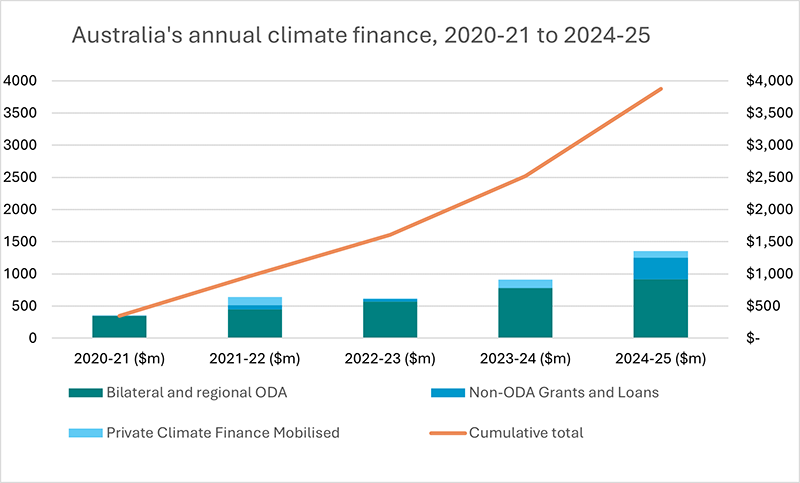
Figure 2: Australia’s total ODA climate finance by geographic region, 2020-21 to 2024-25
Transparent reporting
Australia has a strong track record of transparent reporting on both Australia's emissions and on our climate finance activities. Australia reports its climate finance biennially to the United Nations Framework Convention on Climate Change (UNFCCC) and publishes annual ODA climate finance expenditure through DFAT's ODA Statistical Summary and climate webpages. Development finance for climate and the environment is also reported annually to the Organisation for Economic Cooperation and Development (OECD).
In December 2024, Australia submitted its third Biennial Communication on climate finance to the UNFCCC and first Biennial Transparency Report under the UNFCCC's Enhanced Transparency Framework.