
Foreword
When the Trade 2040 Taskforce first met in 2023, Australia’s trading environment was very different. We were still facing some challenges, but the world was largely in agreement that free and fair trade, and economic openness was the right path.

Three years on, this report comes during one of the most challenging times for global trade since World War II. Growing global tensions and the conflict in the Middle East have shaken the foundations of global trade rules, and shown us what happens when trade cannot flow freely.
The Albanese Labor Government has been working hand in hand with industry, businesses, producers, and our exporters to navigate this uncertain trading environment.
The world may have changed, but Australia’s ability to compete, our thirst for new opportunities, and the drive of our exporters has not. Despite disruptions, the value of Australia’s total trade has increased to a record $1.3 trillion, and we now have trade agreements with about 90 per cent of the world.
But it’s not ‘tools down’, because we know there is more work to be done.
Part of our success comes from putting people and business at the centre of Australia’s trade policy. For the past three years, the Trade 2040 Taskforce – a diverse group of leading government, industry, union and community voices – has been a key part of the Government’s consultative approach.
This report is the culmination of the Trade 2040 Taskforce’s work. In these pages, the Taskforce provides a frank assessment of the challenges and offers strategic guidance for navigating our trading future.
The stakes are high for Australia as a trading nation and the opportunities are enormous.
We can be confident in Australia’s approach, which is guided by five principles: First, free and open markets are essential to Australia’s prosperity. Second, world trade should be governed by rules, not by power alone. Third, we will maximise cooperation with international partners and take a good faith approach to our trade negotiations. Fourth, we won’t leave those affected behind – Australian business, workers or the broader community. And finally, we won’t compromise on our fundamental values and interests.
It has been my pleasure to work with current and former Taskforce members, and I thank them for their leadership and expertise in guiding the development of this report.
Senator the Hon Don Farrell
Minister for Trade and Tourism
Members of the Trade 2040 Taskforce
Members
- Mr Craig Clifford Managing Director, Incat Australia and Incat Chartering
- Ms Swati Dave Member, The Reserve Bank of Australia Governance Board Chair, Advisory Board, Centre for Australia India Relations
- The Hon Dr Craig Emerson Director, Australian APEC Study Centre Royal Melbourne Institute of Technology
- Mr Paul Farrow, National Secretary, The Australian Workers' Union
- Mr Tim Harris Chief Executive Officer, Gigafy
- Ms Catriona Jackson Editor, Pearls and Irritations, John Menadue Public Policy Journal
- Ms Kate Marks Chief Executive Officer, Ausfilm
- Ms Lorraine Maxwell Chief Executive Officer Australian Manufacturing Technology Institute Limited
- Mr Steven Murphy National Secretary Australian Manufacturing Workers’ Union
- Ms Michele O’Neil, President, Australian Council of Trade Unions Member, Net Zero Economy Authority Board
- Mr Rob Scott Managing Director and Chief Executive Officer, Wesfarmers
- Ms Fiona Simson Chair, Australian Centre for International Agricultural Research
- Ms Flavia Tata Nardini Chief Executive Officer and Co-Founder, Fleet Space Technologies
- Ms Cathryn Tilmouth Executive Director Northern Australia, Minerals Council of Australia
Ex-officio members
- Mr Justin Mohamed Ambassador for First Nations People
- Mr Nicholas Moore AO Australia’s Special Envoy for Southeast Asia
Value of international trade and investment to Australia
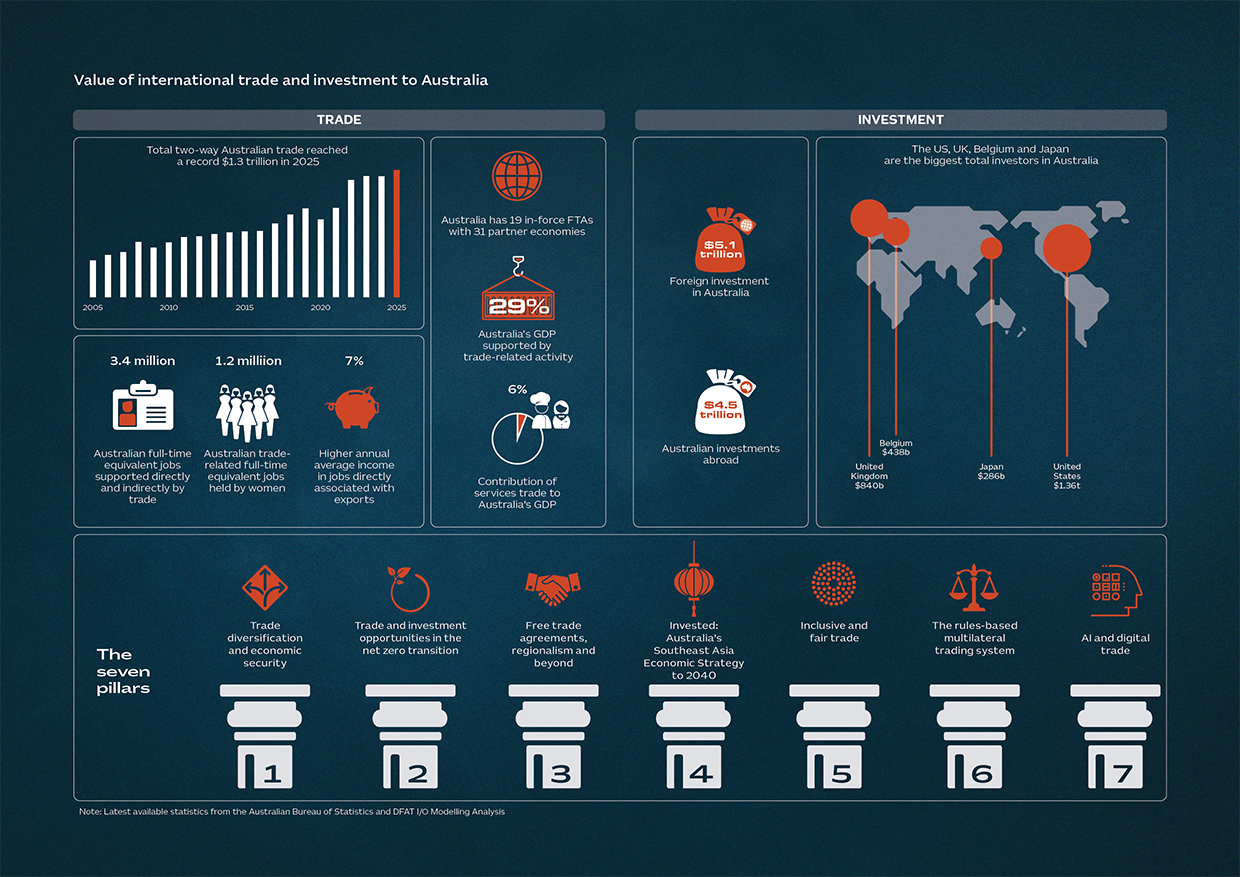
Note: Latest available statistics from the Australian Bureau of Statistics and DFAT I/O Modelling Analysis
Introduction
Australia is facing the most turbulent global trading environment since World War II. Uncertainty will continue to be a core feature into the future as the strategic circumstances for trade have fundamentally changed. While open, rules-based trade has driven Australian prosperity and security for decades, the global trading environment is being reshaped by changes in policy settings. This is due to geostrategic competition, vulnerabilities in global supply chains, economic security concerns, energy transition imperatives and rapid technological change.
The COVID-19 pandemic sparked shortages of critical goods and triggered temporary trade restrictions, exposing vulnerabilities and lack of resilience in many supply chains. Concerns about actual and potential supply chain vulnerabilities, particularly around energy and food security, have increased in the wake of Russia's invasion of Ukraine, the 2026 Middle East conflict and other conflicts that have impacted production facilities and shipping and air routes.
Strategic competition is driving the use of trade and investment tools for increased influence and leverage. The impacts of major power competition and supply chain shocks have heightened awareness of the importance of economic resilience. This has especially been the case for emerging technologies, critical minerals and energy. Countries, including Australia's key partners, are increasingly wary of overreliance on foreign suppliers and the export of sensitive technologies, data and services. There is a growing readiness to intervene on security grounds as a result.
US tariff measures and responses from trading partners have further complicated the functioning of the international trading system. There are growing concerns about global industrial overcapacity – including in sectors such as steel, aluminium, solar products, batteries and electric vehicles. These are driven by the persistent, systemic and at-scale use of non-market policies and practices. This includes pervasive subsidisation and preferential treatment for state-owned enterprises, which are fuelling trade tensions, eroding confidence in the multilateral trading system, and accelerating a shift toward more fragmented and interventionist approaches to global trade.
Two increasingly intertwined transitions – the net zero and technological transformations – are also playing a role in reshaping the global economy, driving competition and, in some cases, further heightening uncertainty.
At the same time, appropriate social and labour policies remain important to support workers and communities to address transition costs sometimes associated with trade.
All of these dynamics are putting the institutions and international rules at the centre of global security and prosperity under strain. The uncertainty and unpredictability they create are also raising the costs of doing business.
As the international trade landscape continues to shift, Australia's ability to anticipate these changes, and effectively respond, is critical. Everyone must work together – governments at all levels, business, unions and civil society – to effectively navigate these changes and safeguard Australia's security and prosperity to 2040.
Pillar 1: Trade diversification and economic security
The challenge
Trade and investment are fundamental contributors to Australia’s economic security and broad-based economic growth. Openness to international trade, supported by the rules-based trading system, has increased Australia’s economic growth and living standards. Australia’s history of openness to foreign investment has also contributed to robust economic prosperity, higher living standards and job creation. These settings have enabled Australian industry to deepen and diversify trading relationships and underscore the nation’s economic security. The benefits of trade and investment have been maximised when supported by appropriate social and labour policies to help workers and communities respond to economic transformation.
The international environment is increasingly difficult and uncertain. Protectionism and the use of non-market policies and practices are on the rise. Risks associated with conflict and security, economic coercion, and excessively concentrated supply chains are growing. At the same time, the decarbonisation imperative is pressing. In response, governments around the world are reappraising open economic and trade settings and considering economic interdependencies from a national security perspective. To address risks associated with overreliance on specific trading partners, governments are building diversified and resilient supply chains. Key producer companies are also identifying risks in the export of their critical technologies, data and services, while consumer countries balance interdependencies and concentration risks from being bound to a technology stack. Economic security measures have included export controls on sensitive technologies, investment screening and mechanisms to prevent foreign interference. Other strategies include diversification to reduce supply chain concentration, and tariffs or other measures to counter unfair practices.
In addition, governments are increasingly seeking to build sovereign capabilities and address certain economic security risks. These include an overreliance on limited supply chains for critical technologies and essential goods, overcapacity, unfair competition and near monopoly concentration of critical minerals and rare earths processing. This new era of industrial policy is designed to develop sovereign manufacturing capacity and build supply chain resilience. Unless carefully designed, government interventions in markets have the potential to undermine rules-based certainty, distort global prices and unnecessarily constrain trade. There is a need to find the right balance between openness and resilience, as well as sovereign capability and efficiency.
Australia’s approach
The concept of economic security frames the increasingly complex intersection between prosperity and national security. Australia's approach focuses on preserving and promoting its wealth, while increasing its ability to withstand shocks, reduce risks and counter national security threats. Australia will work with international partners to build collective economic security while maximising openness. This will include reforming the international rules that underpin Australia's economic strength, implementing targeted interventions to support sovereign capabilities and build resilience, and continuing to diversify trade and investment relationships.
The Government has established a robust suite of domestic economic security mechanisms, including on investment screening, foreign interference and critical infrastructure and technology security. It is working to ensure further coordinated and appropriately targeted policies to protect Australia's economic security. The Government is also working to promote Australia's comparative advantages, including by bolstering its sovereign capabilities through the Future Made in Australia agenda, the National AI Plan (see Pillar 7) and related policies. Connecting global investors with opportunities in sectors where Australia holds significant competitive strengths, such as critical minerals, is central to this effort.
Australia is engaging internationally on economic security including through dialogues with key partners to share best practices, coordinate policy responses, increase transparency of trade-related measures and buttress support for free and fair rules-based trade. This includes cooperation with trading partners to promote Australia's capabilities and national interests, bolstering supply chain resilience and minimising negative spillovers from tariffs and other economic security interventions.
Australia is also working in the multilateral system on broader cooperative efforts to address practices that undermine fair competition. For example, under the Government's Addressing Global Market Competition Initiative, Australia is advancing responses to non-market policies and practices that distort markets and drive excess capacity in the global economy. Australia is building evidence to demonstrate the harmful effects of unfair competition and overcapacity through the WTO and OECD and is advocating for collaborative responses. In 2025, Australia chaired the Global Forum on Steel Excess Capacity. Under our leadership, members of the Forum committed to address the root causes and negative effects of global steel excess capacity through a comprehensive framework for joint action.
The Government is implementing reforms to strengthen our trade remedies system to better prevent harm to Australian industries from unfair trade practices, including dumping. The Government consults closely with Australian industry and unions on Australia’s trade remedies regime, including through the International Trade Remedies Forum. The reforms will modernise legislation to improve the effectiveness, timeliness and accessibility of the trade remedies system to ensure we protect jobs and our industrial base from being eroded by unfair competition.
The Government also continues to diversify and expand Australia's trading relationships and reduce risks of market concentration. Trade diversification remains key to Australia's economic prosperity and security as it provides us with greater choices, certainty and agency.
The Government pursues diversification in a range of ways, including through:
- Expanding and upgrading Australia's Free Trade Agreement (FTA) network (e.g. European Union (EU), Southeast Asia, UK, UAE, India, the Comprehensive and Progressive Agreement for Trans-Pacific Partnership (CPTPP) and the Regional Comprehensive Economic Partnership (RCEP)).
- Other types of innovative trade agreements like the US-Australia Framework for Securing Supply in the Mining and Processing of Critical Minerals and Rare Earths and the Australia-Singapore Green Economy Agreement, which complement efforts to build new supply chains and advance the Future Made in Australia agenda and Critical Minerals Strategy to promote competitive, high-value trade as the global economy transitions to net zero.
- Implementing strategies to boost trade and investment opportunities through Invested: Australia's Southeast Asia Economic Strategy to 2040 and the New Roadmap for Australia's Economic Engagement with India, which identifies priority sectors for expanded cooperation across clean energy, education and skills, agribusiness, creative industries and tourism.
- A patient and calibrated approach to stabilising the bilateral relationship with China – our largest trading partner – which resulted in China removing a range of bilateral impediments worth about $20 billion for Australian exports.
- Deploying strategic finance (through Export Finance Australia (EFA) and other Specialist Investment Vehicles) for investments that deliver on the Government's economic security objectives, including fuel and fertiliser security.
- Supporting market diversification through the trade promotion and facilitation support provided by Austrade to exporters.
- Bringing together senior business leaders from key trading partners to strengthen trade and investment ties, such as the Australia-India CEO Forum.
- Investing in the rules-based multilateral trading system with the World Trade Organization (WTO) at its core, supported by efforts at Asia-Pacific Economic Cooperation (APEC), the Organisation for Economic Co-operation and Development (OECD) and G20.
The Government has put in place a range of measures to help Australian businesses impacted by US tariffs and other challenges diversify into new export markets. This has included the Accessing New Markets Initiative, a $55 million two-year surge program administered by Austrade. This will deliver trade promotion activities to help Australian businesses take advantage of new export opportunities and build their resilience. The Trade Resilience Service delivers practical intelligence, insights and advice to support Australian businesses to navigate increased supply chain volatility. The Government is expanding the Go Global Toolkit, which is a one-stop online shop for Australian businesses to access up-to-date information on key export markets and diversification opportunities, with personalised information tailored to individual business needs. The Export Market Development Grants program also provides grants to Australian small- and medium-sized enterprises (SMEs) and their representative bodies to market and promote their goods and services globally as well as undertake export training.
Cooperation with trading partners has also been critical to ensuring Australia's energy security and fuel supplies during the 2026 Middle East regional conflict. The Strait of Hormuz closure heightened awareness of the risk of supply chain dependency and disruption to our energy and wider economic security.
Australia has been working with regional partners, including Singapore, to mitigate this risk. For example, in April 2026 Australia and Singapore concluded a Protocol on Economic Resilience and Essential Supplies to the Singapore-Australia Free Trade Agreement (SAFTA). The Protocol delivers on a Joint Statement on Economic Resilience and Essential Supplies by Prime Minister Albanese and Singapore's Prime Minister Lawrence Wong, in which they committed to support the flow of essential supplies between our countries. The Protocol reflects the priority Australia and Singapore accord each other with respect to trade in essential supplies including petroleum oils, such as diesel, and liquefied natural gas.
Taskforce perspectives
Recent trade disruption shaped by industrial strategy, national security and the urgency to secure supply chains in critical minerals, clean energy, semiconductors and space technologies creates both opportunity and pressure for Australian exporters. The uncertainty generated by trade disruption means that many countries are looking for new partners for trade and investment, including in key supply chain projects. There is increased international interest in collaboration with Australia and Australian businesses. Investing in strategic cooperation with trusted partners could help Australian industries unlock greater financing, build skills and drive innovation.
Australia should seek to capitalise on these opportunities and take advantage of demand for new partners. As a stable and like-minded partner, Australia can anchor resilient supply chains for the US and other partners. For example, the new Australia and US critical minerals agreement is a positive step. Clarity and speed in implementation are needed so Australian companies can genuinely participate in linked value chains. Australia could be disadvantaged if trade measures by key partners pull talent, capital and production away from Australia.
Diversification remains the right approach in this time of disruption. The Government should continue existing activities that help achieve economic security and address excessive market concentration through promoting diversification of Australia's trade and investment overseas. This includes implementing initiatives in response to Invested: Australia's Southeast Asia Economic Strategy to 2040, implementing the Future Made in Australia package, the Australia-India Economic Roadmap, and the Accessing New Markets Initiative.
The Government should also look to secure long-term strategic partnerships with emerging growth regions, especially South America, Asia and the Middle East, building on the strong relationships already established with key players in these regions. Gulf nations, particularly Saudi Arabia and the UAE, have a strong appetite for partnership with Australia in space technology, critical minerals and clean energy – areas where we have competitive advantages. The Government could consider a Gulf engagement strategy to unlock trade and investment in this region at greater scale.
Successful diversification requires domestic policies that drive innovation, support competitiveness and facilitate exports and investment (including by breaking down barriers to entry, and support the creation and sustainment of a skilled workforce. The competitiveness of Australian companies and industries will be a foundational driver of Australia's economic resilience and prosperity to 2040. Establishing the right policy settings to drive competitiveness – including on tax, skilled workers, procurement, energy, water, data and to ensure quick approval processes – is important to attract foreign investment. Foreign investment will be critical to support the business growth necessary to drive exports, and to expand Australia's capability across strategic value chains as a partner of choice, such as critical minerals processing.
Access to finance is particularly critical to trade diversification, especially for SMEs, and would strengthen sectors in which Australia has an advantage, such as high-tech, high-value, low-emissions production. Strategic, coordinated action to improve access to venture and growth capital as well as export finance would enable innovation and give Australian businesses the tools and confidence to seek new market opportunities. In particular, all Australian Government funding vehicles should coordinate closely for greatest impact.
Improving knowledge of potential overseas markets and building business literacy in the Australian business community, including through utilisation of private sector champions in Australia and the Austrade network of trade advisers, will also be key to diversification efforts. Domestic business would benefit from stronger links and collaboration with Australian businesses and business chambers operating overseas which have networks and knowledge which could be leveraged.
The Government should assist businesses seeking to diversify by sharing detailed market knowledge on a broad range of trading partners, including the experiences of Australian businesses already in those markets. Doing so would aid businesses to navigate new markets and understand risks. Businesses vary in terms of their target markets, and they should be supported by government to go where they want to do business. A focus on Southeast Asia is important, but other markets should not be excluded - not all Australian businesses will want to focus on Southeast Asia.
Strengthening export support for business by addressing trade and regulatory pathways that are inconsistent or challenging to navigate would help to unlock the significant demand for critical minerals, exploration technology and space-based data in the Middle East, India and Latin America. Export acceleration efforts should focus on companies in the $20-200 million revenue range that are ready to scale into Tier One global markets. Creation of bilateral fast lanes for technology trials with partners such as the US, Canada, Japan, Saudi Arabia and India could also assist.
Other ways the Government can support business include speeding up the pathway from research and development to commercial scale. Global markets are accelerating and Australia needs programs that help companies scale domestic manufacturing to avoid innovation flowing offshore.
The creation of more coordinated government and industry partnerships would be useful, particularly in high technology export sectors which move quickly, and for companies developing solutions for climate, energy and resource challenges which need support to navigate foreign procurement systems, certification, space regulation and defence pathways. The Accessing New Markets Initiative is a good example of how the Government can provide collaborative, agile and practical support to Australian businesses, but further Government support may be needed if global trade disruption continues to increase.
The Government should ensure strong industry and jobs policies can be implemented. The Government should also review Australia's anti-dumping system, to ensure it is adequately protecting Australian industry, does not place us at a disadvantage to major trading partners and addresses the effects of non-market practices and overcapacity. While most Australian industries currently report minimal impact from US tariffs, the risk of other countries that are more affected dumping products in Australia remains high and should be carefully managed.
The Government should continue working with trading partners to promote resilient supply chains that reflect Australia's capabilities, values and national interests. Australia's efforts to strengthen economic resilience should include a focus on labour, environment and human rights. Resilient supply chains require freedom from modern slavery and should promote decent work and freedom of association.
Pillar 2: Trade and investment opportunities in the net zero transition
The challenge
Governments around the world are investing in their countries' industrial bases, manufacturing capability and economic sovereignty to capture the benefits of and support the net zero transition. An International Monetary Fund working paper found 2,500 subsidy interventions in 2023, with the major economies (US, EU and China) accounting for almost half of these interventions.1 Many of these are green industrial policies, such as subsidies, green procurement policies and clean technology incentives to support the net zero transition, drive innovation, and enhance competitiveness in new and emerging sectors. These green industrial policies are reshaping global competition and placing additional pressure on the rules-based trading system.
International competition for access to clean tech and the specialised skills and investment necessary for the transition is intense. China is the world's largest manufacturer of renewable technologies and has significant competitive advantages in clean tech supply chains built over two decades. The US rollback of support for clean energy and low-emissions production has opened space for other nations. The UK, India, the EU, Japan and the ROK and others are transitioning and decarbonising energy systems, including to bolster energy security. These shifts are reshaping trading prospects for Australia.
There are significant opportunities for Australia in the net zero transition. But there is also the risk of being left behind if we do not act quickly or being left out if we do not augment our traditional energy exports as long-term demand patterns shift. Trade policy has an important role in supporting the expansion of industries where Australia has comparative advantages, turning our renewable energy potential into a new source of economic growth, and supporting an orderly path to net zero.
The right policy settings will be crucial. Government at all levels, business and the communities will need to work together to build the necessary new export industries and workforces, attract necessary investment and boost green trade flows. No country will be able to achieve the net zero transition alone – it will require cooperation with international partners.
Australia's approach
As a trade-reliant, climate vulnerable country and a major global energy supplier, Australia's interest lies in a trade policy that will drive, in tandem, prosperity and sustainability. Reforms to global trade rules and finding new ways to cooperate on trade and climate policy cooperation will be essential.
The Government's Future Made in Australia agenda includes a broad suite of initiatives to boost investment and grow domestic manufacturing. This will enable Australia to leverage its strengths and realise opportunities through the net zero transition. These initiatives are focused on sectors that can contribute to the global transition and supply chain resilience. They aim to create the conditions needed to unlock private investment that will drive industrial development. Priority sectors include critical minerals, hydrogen processing and refining, green metals, low carbon liquid fuels and clean energy manufacturing.
Critical mineral inputs underpin the energy transition, high tech manufacturing, AI, and digital and defence technologies. The Government is supporting the sector through the $5 billion Critical Minerals Facility on its National Interest Account, administered by EFA. The facility can provide financing support to eligible projects that are aligned with Australia's Critical Minerals Strategy and the national interest. The facility helps crowd in private sector investment and likeminded partner finance to projects that will grow our critical minerals sector. It includes $1 billion for transactions under the Critical Minerals Strategic Reserve, which secures supply of select critical minerals (initially antimony, gallium and rare earths elements) for Australia and key international partners. The reserve helps address supply chain vulnerabilities, mitigate against market distortions and build a sustainable domestic critical minerals industry.
International trade and foreign capital will also be essential to achieve Australia's domestic 2035 emissions reduction target. The Government's Net Zero Plan (released in September 2025) acknowledged that strong trading arrangements with partner countries will help attract investment in clean energy industries and improve access to technologies and inputs required for the transition.
There will be an important role for targeted trade and investment partnerships that bolster Australia's position in global clean energy markets, including for products made with renewable energy. This includes:
- Continuing to work with key energy partners like Japan and the ROK to support their energy security and transition to net zero.
- The sustainability of Australia's iron ore trade through the Australia-China Policy Dialogue on Steel Decarbonisation.
- A range of international renewable energy partnerships that cover R&D and market development.
The Government will also further enhance the Singapore-Australia Green Economy Agreement by collaborating on priority sectors in our economy, including green industries, maritime decarbonisation and low carbon liquid fuels. A key initiative under this Agreement is the Go Green Co-Innovation Program, which has funded 16 collaborative projects to accelerate the development of innovative green technologies, products and services. Early projects have already delivered market-ready outcomes, including the production of low-carbon feedstock from waste oils and non-edible crops for sustainable aviation fuel.
The Government’s suite of investment prospectuses, including the Australian Green Economy Prospectus and the Critical Minerals Prospectus, promote Australian industry capabilities, companies and investment-ready critical mineral projects to international partners.
Australia's network of FTAs with key trading partners means our exporters already have favourable market access in most instances. The Government will keep working to ensure these arrangements are as strong as possible and promote new forms of cooperation to reflect Australia's energy transition interests, including through periodic reviews (such as the Southeast Asia FTA modernisation initiative).
The Government is also engaging in green trade and investment opportunities, and clean energy supply chains through multilateral and regional institutions and groupings such as the WTO, OECD, Indo-Pacific Economic Framework (IPEF) and APEC. This includes:
- Advocating for liberalisation of trade in environmental goods and services.
- Addressing the environmental impact of agricultural and other subsidies.
- Supporting Australia to navigate new international climate measures such as border carbon adjustments.
- And opportunities for increasing circular economy approaches in trade.
The Government will seek points of view from industry, investors, academia and others to promote a uniquely Australian approach for stronger alignment between our trade policy and climate-related ambitions. This will include establishing advisory channels comprising leading figures in relevant fields to inform government considerations. This will help ensure government agencies are focused on the issues of greatest importance such as how the transition to net zero will reshape Australia's trading relationships, drivers of economic growth, and our role as an energy supplier.
Australia will also use its leadership role at COP31. This will enable it to advance international cooperation on green trade and investment by promoting open markets, interoperable standards and transparent carbon accounting that support trade in low emissions goods, services and technologies. This will help to attract global capital, deepen clean economy partnerships, strengthen resilient clean energy supply chains and position Australian exporters to compete in emerging green markets.
Taskforce perspectives
Green industry is a rapidly expanding market, and Australia must act quickly to realise opportunities. Instability in energy policy weakens domestic industry and foreign investors' confidence to engage in this sector. The Government should seek to attract foreign investment by maintaining an environment that is open, transparent and provides certainty to investors, while also managing foreign investment risks. The "single front door" for major investors under Future Made in Australia should be implemented.
The Future Made in Australia policy is a significant opportunity to help promote our economic security, competitive advantage and sovereign capability, including in green industries. Coherence and clarity in relation to government decision-making as well as domestic regulatory, legal and social environments, give foreign investors greater confidence to form partnerships in Australia.
Policy clarity in this area assists both Australian businesses and overseas investors seeking to enter the green economy market. This includes providing insights into government decision-making to improve business understanding of how to obtain relevant approvals and improving timeliness of approval processes. Efficient approval processes are key to Australia becoming a green energy leader, and the Government could consider other markets' models to improve its decision-making processes.
Australia should capitalise on our experience and strength in exporting energy by supporting the development of green energy for export, as well as its use in manufacturing green products for export, including green steel. The Government should support businesses that seek to combine high tech/high-value production in Australia with operations overseas. The Government should develop relevant accreditation processes for green products to facilitate their export. The Government should continue to extend diplomatic support to Australian companies seeking to establish green energy exports/green manufacturing projects (e.g. green steel, hydrogen production) in the region in order to provide the necessary stability and certainty in key trading relationships to move ahead.
State-backed overcapacity is having real effects on global markets, particularly in energy technology, electric vehicle supply chains, shipbuilding, magnets and components used in space and geophysics. It is extremely difficult for Australian firms to compete on price against markets where capital is subsidised and risk is absorbed by the state. This means Australia should focus on niche, high value, IP driven segments, and sectors where we have existing capabilities to build on. It reinforces the importance of transparency, reliability and ethical production standards as core differentiators. Stronger investment incentives and export finance support would help level the playing field.
As the Government invests in targeted sovereign capability in sectors critical to the green transition and our economic security, it should continue to reform and strengthen Australia's anti-dumping and trade remedies regime to help ensure those investments are not undermined by unfair competition.
It will therefore be important to work with trading partners to support global rules on unfair trade practices, addressing trade-distorting subsidies and unfair competition to ensure a more level playing field in the global market, including for industries important to the net zero transition. Australia's role in the Global Forum on Steel Excess Capacity is important, and the same type of collaborative framework may be valuable for other sectors such as battery inputs and rare earth processing equipment.
The Government should continue its work to collaborate with trading partners to negotiate benchmarks for trade in high quality and ethically produced critical minerals and continue implementation of key initiatives under the Australia-Singapore Green Economy Agreement and the IPEF Clean Economy Agreement. The Government should also consider revisiting and updating FTAs in the context of green trade and investment. These efforts would help drive diversification of our export mix and help achieve Australia's renewable energy superpower ambitions.
As a country with significant green electricity, Australia could benefit from carbon border adjustment mechanisms, as we would theoretically have an advantage over other countries with less power from green sources. The Government should work with businesses to avoid unintended consequences for global trade flows and our own industries, particularly those where there are no commercially viable low carbon alternatives. The Government should also work closely with key trading partners to ensure that individual countries' carbon border adjustment mechanisms provide ways to demonstrate the green credentials of our exports and don't result in a barrier to trade.
Pillar 3: Free trade agreements, regionalism and beyond
The challenge
With the multilateral trading system under significant pressure, there is renewed energy in regionalism. Australia's FTA network includes four key regional agreements – the ASEAN-Australia-New Zealand FTA (AANZFTA), CPTPP, RCEP and the Pacific Agreement on Closer Economic Relations Plus (PACER). Regional forums like APEC also play a key role in promoting economic cooperation and integration. With the Indo-Pacific being the world's fastest growing region, there is even more opportunity for Australia to drive greater openness, strengthen stability and create new trade rules with our regional partners.
Some of the biggest trade and investment gains with FTA partners are likely to come from better implementation and utilisation of Australia's existing FTAs, and modernisation and enhancement of these FTAs. Access to reliable data is essential to effective FTA implementation and improved utilisation, supporting the Government to deliver and monitor trade policy outcomes, while enabling businesses to identify and access available benefits Modernisation and enhancement efforts will need to be lifted and sustained to ensure these FTAs keep pace with competitors.
Modernisation and enhancement provide opportunities to address outstanding goods, services and investment issues including those related to digital trade, competition policy and the net zero transition. They can also offer the opportunity to include provisions on environment, labour, gender equality and First Nations interests in agreements.
There are many regions and economies with which we are yet to negotiate FTAs, and they offer diversification opportunities for our goods, services and investors. These include some countries in the Americas, Middle East, Asia and Africa. However, further work is required to identify and prioritise Australia's next generation of FTAs.
Australia's FTAs will need to be modernised to ensure they meet business needs as the global trading landscape shifts. Our FTAs play an important role in addressing challenges associated with the increasing prevalence of industrial policy tools, non-market policies and practices and excess capacity, non-tariff barriers, rising protectionism and supply chain security. New, innovative international partnerships and arrangements may also be needed on particular issues or sectors to address modern challenges, complementing our FTA network.
Australia's approach
Australia's FTAs support national prosperity and economic security. Australian workers, businesses and consumers benefit from FTAs through lower prices and new export opportunities. The Government has used FTAs to strengthen Australia's economic security by diversifying and building resilience into our supply chains. Our FTAs also project economic values and trade‑openness to the region and our trading partners. Trade has proven to be an effective vehicle for delivering a sustained reduction in poverty, particularly in the Indo-Pacific.
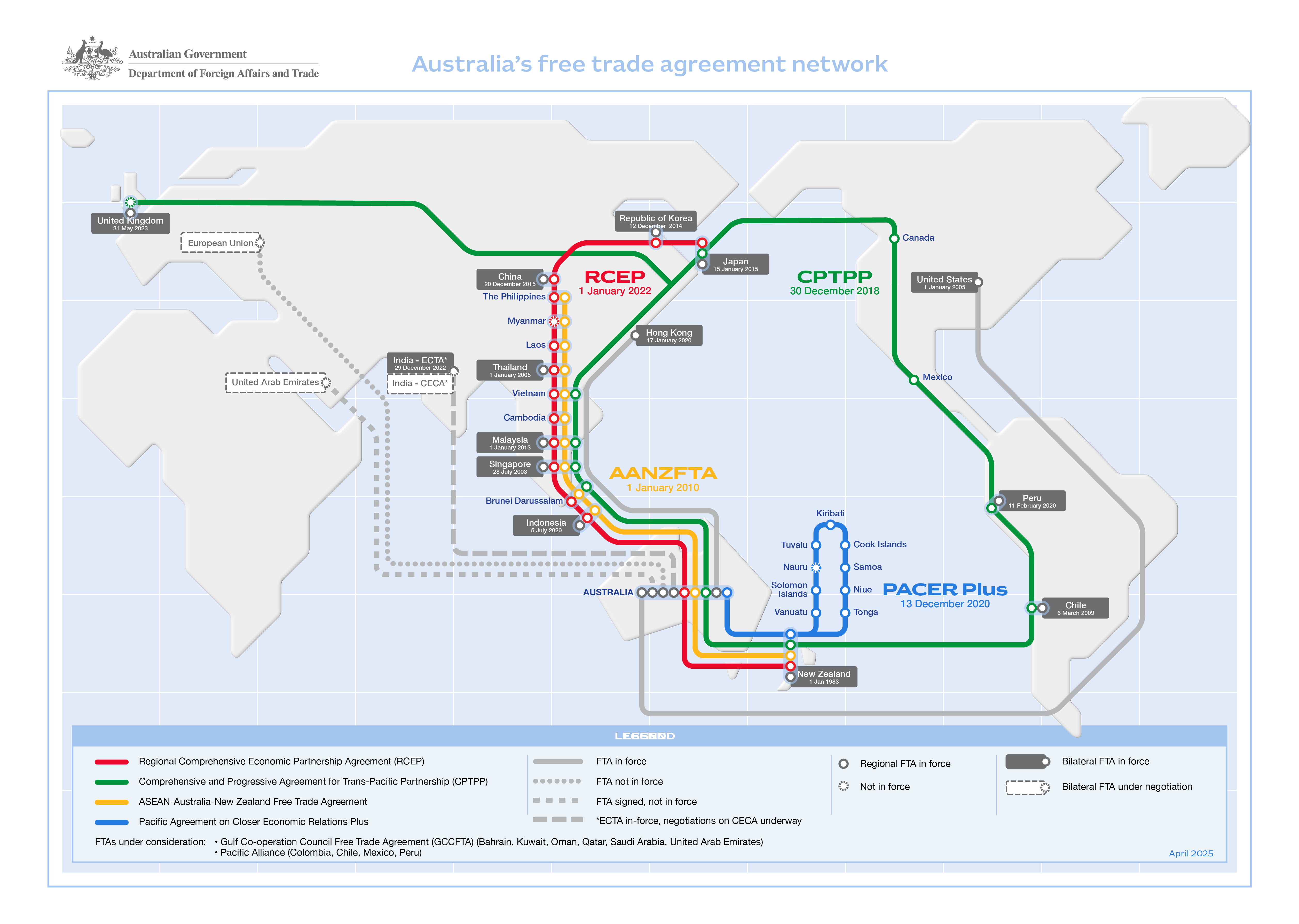
Australia now has FTAs with economies that cover almost 79 per cent of our total trade, with 19 in-force FTAs covering 31 partner economies. Once the FTA with the EU enters into force, coverage will increase to 88 per cent of Australia's trade.
Since 2022, four new agreements have entered into force - RCEP (January 2022), the Australia-India Economic Cooperation and Trade Agreement (ECTA) (December 2022), the Australia-United Kingdom Free Trade Agreement (May 2023) and the Australia-UAE Comprehensive Economic Partnership Agreement (CEPA) (October 2025).
Australia and the EU concluded negotiations for a comprehensive, balanced and commercially meaningful FTA in March 2026. This will result in 97.8 per cent of Australian exports entering the EU duty free on entry into force, rising to 98 per cent after seven years.
The Government has upgraded AANZFTA and continues to negotiate on a Comprehensive Economic Cooperation Agreement with India to build on outcomes under the ECTA.
Australia, along with other members, is also considering multiple accession requests from aspirants to the CPTPP and RCEP. Promoting accessions by applicants that are ready to meet these agreements' standards helps to reinforce the importance of economic integration and rules-based trade in our region. Accessions will help foster a stable and predictable trading environment in our region, while also providing trade diversification opportunities through new or improved market access outcomes.
Chairing CPTPP in 2025 allowed Australia to pursue initiatives aimed at increasing, facilitating and spreading the benefits of trade to ensure support for inclusive and sustainable growth. Pursuing these concepts in the CPTPP and considering new trade rules in future reviews of RCEP and AANZFTA will help Australia continue modernising its trade arrangements at the regional level.
PACER Plus continues to create commercial connections in the Pacific for Australian businesses. It commits all parties to economic cooperation and development, with a key objective of supporting Pacific Island countries to participate in and benefit from regional and global trade.
Australia works closely with trading partners to ensure they fully implement their commitments under the FTAs and address existing non-tariff barriers impacting our goods, services and investments. This ensures our FTAs address contemporary priorities and challenges while supporting trade diversification across the region. It also ensures our FTAs continue to meet the needs of business and workers, and pursue a modernisation and enhancement agenda.
With this in mind, Australia is progressing General Reviews of existing FTAs with China, Indonesia and Malaysia. The Government, in consultation with the Trade 2040 Taskforce and trade and investment-affected stakeholders, is also identifying opportunities to modernise existing FTAs with Southeast Asian countries.
Australia develops innovative, issue-specific international trade arrangements with key partners in response to emerging and evolving trade priorities, including the Australia-Singapore Green Economy Agreement, the US-Australia Framework for Securing Supply in the Mining and Processing of Critical Minerals and Rare Earths, Pax Silica and the Protocol on Economic Resilience and Essential Supplies to the SAFTA.
Taskforce perspectives
To further build on the FTA network through to 2040 – and deliver for Australian businesses and the community – the Government should strengthen implementation and utilisation of our existing bilateral and regional FTAs, while also acting to update and expand them, where it serves Australian interests.
Increased transparency and broadened stakeholder consultations on FTA negotiations, including with affected industries and trade unions, is important. Trade agreements should also be subject to independent socio-economic assessments.
The Government should continue assisting business to understand existing FTAs, including by maintaining and enhancing the online FTA Portal and the Go Global Toolkit. More timely, direct and practical advice on how to access FTA benefits, especially with small to medium enterprises, will increase Australian business’ engagement. The Government should also help businesses to better understand overseas markets and associated risks as articulated in Pillar 1.
The Government should review existing FTAs with a view to prioritising FTAs that are more than 10 years old and those without binding labour rights chapters. An upgrade of the agreement with Indonesia should be prioritised, to take advantage of the untapped potential in that market. Priorities that should be pursued as part of FTA updates and expansions include: enforcement of intellectual property rights; enforceable labour rights; removal of investor-state dispute settlement clauses; enforcement of standards; identifying and capturing new and emerging issues, such as in the digital and green economies; and removing restrictions on the government regulating in the public interest.
The Government should complete the Australia-India Comprehensive Economic Cooperation Agreement (IA-CECA), provided the final agreement is in Australia’s national interest. The agreement with the EU will have outsized economic effects and demonstrate Australia’s leadership on free trade at a time when tariffs and other trade restrictive measures threaten to undermine it. Australia should continue to work with RCEP and CPTPP parties to broaden the membership and deepen the content of these agreements. The Government should also continue to support regional trade agreements, including by concluding and implementing agreements under the IPEF and continuing to enhance regional economic integration through APEC.
Many Australian sectors, such as the screen industry, have their own industry specific, country to country arrangements and MOUs with global partners, and could benefit from modernising longstanding agreements and formalising new partnerships.
Pillar 4: Invested: Australia's Southeast Asia Economic Strategy to 2040
The challenge
Southeast Asia presents major economic opportunities for Australian business in coming decades. In 2024, Southeast Asia's combined real GDP of around US$3.9 trillion was larger than the economies of the UK, France or Canada, and more than twice the size of the Australian economy. The region's growth is set to continue, with compound annual GDP growth projected at around 4 per cent until 2040, while developed economies are likely to average GDP growth of 1 to 2 per cent.
However, Australia's trade and investment with Southeast Asia have not kept pace with the region's economic growth. Southeast Asia's share of Australia's total trade over the last 20 years has remained constant at around 15 per cent.2 Singapore, Malaysia, and Indonesia were top ten trading partners for Australia in 2025. Australia's foreign investment stock in the region is underweight (in 2025, 2.38 per cent of Australia's total investment stock was in Southeast Asia).3 Recent global trade disruption reinforces the importance of Australia's engagement with Southeast Asia to bolster its collective economic resilience and prosperity.
Australia's approach
The Australian Government commissioned Special Envoy for Southeast Asia, Nicholas Moore AO, to develop Invested: Australia's Southeast Asia Economic Strategy to 2040 (Invested). Invested was launched by Prime Minister Albanese in September 2023 and sets out a practical pathway to increase two-way trade and investment with Southeast Asia.
Invested examines 10 key sectors offering the most potential for growth: agriculture and food; resources; green energy transition; infrastructure; education and skills; visitor economy; healthcare; digital economy, professional and financial services; and creative industries. It identifies four categories of actions required to realise the commercial potential between Australia and Southeast Asia: raising awareness; removing blockages; building capability; and deepening investment. Under these categories, Invested presents 75 crosscutting and sectoral recommendations to lift two-way trade and investment.
Invested is a long-term strategy and results take time. The Government is committed to maximising the benefits of our economic ties with Southeast Asia from now until 2040. In 2025, two-way trade increased by $3.5 billion to a record high of $195.7 billion, and two-way investment with Southeast Asia increased by $6.2 billion to $296.2 billion.4
The Australian Government is delivering action to advance Invested recommendations and deepen trade and investment ties with Southeast Asia, including:
- Established Investment Deal Teams across the region, bringing together the expertise of DFAT, Austrade and EFA, to help Australian investors explore and enter Southeast Asian markets, which to date have supported over $1 billion in new Australian investment into the region and identified a pipeline of opportunities for Australian investors.
- Established a Southeast Asia Investment Financing Facility (SEAIFF), administered by EFA, to provide up to $2 billion in loans, guarantees, equity and insurance for projects to catalyse Australian trade and investment in Southeast Asia. To date, three investments have been made that will help unlock private capital for key public infrastructure and clean energy projects across the region and created opportunities for Australian investors and business. EFA has built greater awareness of its financing tools, including its Commercial Account and the Government's SEAIFF. In 2024-25, EFA signed more than double the number of transactions in Southeast Asia than it did in 2023-24. EFA's total finance to the region grew by 40 per cent to $529 million in 2024-25, and Southeast Asia accounted for a quarter of all EFA transactions in 2024-25.
- Appointed 10 Business Champions from the Australian private sector, who are raising awareness of opportunities in Southeast Asia and encouraging Australian business to do more in the region.
- Established the Australia-Southeast Asia Business Exchange to deliver targeted business missions to the region in priority sectors, after-visit support for Australian companies, programs to raise Australian businesses' awareness of opportunities in Southeast Asia, and marketing campaigns to promote Australian goods and services in the region.
- Twenty-four business and investment missions have visited 10 countries in the region, with participation from more than 600 businesspeople.
- Enhanced visa access by extending the Business Visitor visa to five years and provided access to the Frequent Traveller Scheme for ASEAN Member States (except Myanmar).
- Continued to review Australia's existing FTAs with the region to identify potential improvements.
- Established a new 'Investor Front Door' to make it simpler for investors with major, transformational investment proposals to invest in Australia. The pilot for this initiative was launched in September 2025.
- Established Landing Pads in Jakarta and Ho Chi Minh City – building on the success of Singapore – to support Australian tech scale-ups to enter or expand in Southeast Asia. To date, our Landing Pads have supported over 230 Australian companies across 16 programs.
- Established an ASEAN-Australia Centre to strengthen business, education, cultural and community connections.
- Established more Aus4ASEAN Scholarships and new Fellowships.
The Government is also expanding engagement with ASEAN Member States to support regional resilience, prosperity and economic security. This includes collaborating on 1.5 track dialogues on economic security and resilience, as well as high-level discussions and statements regarding mutual energy security in the context of the 2026 Middle East regional conflict.
In addition to the Protocol on Economic Resilience and Essential Supplies to the SAFTA (Pillar 1), Australia concluded an economic resilience MOU with Singapore as part of the Comprehensive Strategic Partnership 2.0 that will support bilateral cooperation on resilience.
In April 2026, Prime Minister Albanese issued a joint statement with His Majesty Sultan Haji Hassanal Bolkiah reaffirming Australia and Brunei's commitment to strengthen energy and food security, and to notify and consult each other on any disruptions with ramifications on the trade of energy and food related supplies. In the same month, Prime Minister Albanese issued a joint statement with Prime Minister of Malaysia, the Hon Anwar Ibrahim, affirming a shared commitment to open, rules-based trade in energy products, and a commitment to exchange views on energy trade-related matters on a 'no surprises' basis.
Taskforce perspectives
Addressing this challenge will require a whole-of-nation effort across Commonwealth and state and territory governments, universities, the private sector, not-for-profits and communities. Government and non-government organisations should continue working together, including through the initiatives already announced by the Government to implement Invested, and by considering the remaining recommendations, to enable us to maximise the potential of the economic opportunities in Southeast Asia, from now until 2040 and beyond.
It is important to build literacy about the Southeast Asia region, particularly in the business community. Diaspora communities in Australia and Australian diasporas in our region are an under-utilised resource for establishing connections and sharing expertise. There are existing networks that could be leveraged for peer-to-peer business exchange, for example international alumni of Australian universities and Australian business chambers overseas. Policies and partnerships that encourage this exchange of human capital and relationship building will continue to serve Australia's interests. Government interaction with the region (including via international student networks and diplomatic missions) is important to increase business and investor confidence in the region.
Consistent with Invested's recommendations, the Government should work with Southeast Asian partners to strengthen their respective legal and policy frameworks on workplace health and safety, environmental standards and modern slavery. This could be done via technical assistance on issues where Australia has strong expertise, and through encouraging regular dialogues on WHS, labour rights and/or environment. IPEF's Labour Rights Advisory Board is a good model. The Government could develop practical resources to help businesses manage governance concerns in Southeast Asian markets. This work would also contribute to Australia's goal of strengthening supply chain resilience.
The Government should take further steps to help businesses deploy talent in the region and improve awareness of local operating environments. Advocacy for streamlined work permits and visa arrangements with Southeast Asian partners, including through FTA negotiations, reviews and committees, could help address visa processing challenges. The Government could also develop guidance for Australian businesses on entity establishment and capital movement requirements in priority markets. Direct flights to more Southeast Asian cities from major Australian airports would be valuable.
The Southeast Asian region’s underlying growth remains strong and bilateral trade is likely to continue growing at above Australian GDP levels. However, it will be important for the Government to continue to have a role in encouraging greater Australian outbound investment in the region. Given the potential of Southeast Asia to support infrastructure investment, Australia should also seek to attract investment from that region into our housing sector to assist with a key domestic priority.
Pillar 5: Inclusive and fair trade
The challenge
Trade and investment must deliver benefits for all Australians. Ensuring Australia's trade policy has diverse, equitable and inclusive input is critical to delivering practical benefits for all Australians in the lead up to 2040. The more the benefits of trade can be realised by all elements of Australian society, the greater the economic returns for the country. For example, the 2024 First Nations Businesses Succeeding Internationally report shows First Nations goods exporters typically generate almost nine times more in turnover and employ over seven times more full-time equivalent workers than non-exporting businesses.
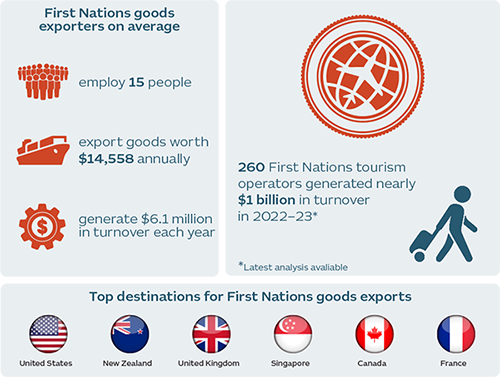
Note: Statistics drawn from the 2024 First Nations Businesses Succeeding Internationally report.
Strengthening gender equality in export exposed industry sectors also has the potential to increase Australia's economic prosperity. However, women-led businesses are less likely to engage in international trade which limits the opportunities for growth and for these benefits to be realised. As revealed in the recent State and Territory Data Analysis Project, female workers employed by businesses producing goods for export reported a median annual income for each job held that was almost double that of women employed by firms not exporting any goods (in FY2022-23). Globally, it is estimated that gross domestic product per capita would increase by almost 20 per cent if gender gaps in employment can be closed.5
Diverse voices are needed to shape equitable and inclusive trade and investment policies that reflect the priorities of those that have been traditionally marginalised or discriminated against, such as First Nations peoples and women. Trade agreements can deliver new opportunities and revenue streams for exporters of goods and services and promote investment for those groups. Trade agreements can also provide technical assistance to promote participation by those groups in trade.
Even though openness to international trade and foreign investment is widely regarded as a driver of economic growth, some low- and middle-income countries perceive the multilateral trading regime as being dominated by the agenda of more developed countries. These countries can view the inclusion of commitments on labour, gender equality and First Nations as an additional burden that hinders their economic development. It is important to demonstrate how advancing inclusive trade globally can enhance regional prosperity and create opportunities, including for Australian businesses, through supporting greater access to regional markets and more diversified supply chains.
Continued community support for these initiatives will be important. To support the inclusive trade agenda, evidence-based policy driven by disaggregated trade data is key. Australia is enhancing its data collection and analysis on trade. Stronger effort is required to better understand how trade interacts with, and can benefit, First Nations peoples, women and people with a disability, among other traditionally marginalised groups.
Australia's approach
The Government is committed to a trade and investment agenda that delivers benefits for all Australians, including realising opportunities for groups such as First Nations. Fairness and equity drive the Government's economic policy, including trade policy. Diverse voices are needed in the trade policy process, particularly to amplify voices that have been traditionally marginalised. The Government has taken early action to step up engagement on inclusive trade, including the appointment of Australia's inaugural Ambassador for First Nations People and the establishment of bodies like the Trade 2040 Taskforce. Through this Taskforce, the Government has provided a consultative approach for greater inclusion at the heart of trade policy. The Government is committed to embedding an enduring mechanism that will continue to inform Australia's trade agenda into the future.
Recent FTAs already provide meaningful benefits and protections for historically marginalised groups, including First Nations businesses and interests, and women. The Australia-EU FTA includes practical trade and investment outcomes for First Nations Australians, including in art, energy and resources, and agri-food systems. The Australia-United Kingdom FTA (A-UK FTA) provides benefits to Indigenous business, for example, through commitments to establish procedures for artists to receive royalties when their artworks are resold in the UK. In the Australian scheme, the highest proportion of eligible resale occurs among Indigenous art wholesalers, meaning increased revenue for Australian First Nations artists who sell their works into the UK. The A-UK FTA supports the promotion of businesses owned or led by women accessing markets, technology, financial services, and business and leadership networks. It also establishes a Trade and Gender Equality Dialogue that provides an opportunity for information exchanges to support implementation and monitoring of the commitments on gender equality in trade.
The Australia-UAE CEPA, features the first standalone chapter on First Nations trade and investment in any Australian FTA. The CEPA First Nations Action Plan, released November 2025, will strengthen cultural and economic ties between First Nations Australians and UAE stakeholders. It will also support First Nations' export success in the region and elevate First Nations perspectives in the bilateral investment relationship. The CEPA also commits to advancing gender equality and supporting women's economic participation through technical assistance, capacity-building, and cooperation to remove barriers for women-led businesses in trade and investment.
The theme during Australia's 2025 Chair year of the CPTPP was Delivering Sustainable Trade and Resilient Growth. Ministers agreed to develop new cooperative provisions or a possible new chapter on trade and women's economic empowerment, complemented by gender mainstreaming across the CPTPP. This delivers on Australia's International Gender Equality Strategy, which prioritises promoting women's economic equality and inclusive trade.
In particular, the Government has taken steps to better embed First Nations interests and perspectives in Australia's trade and investment activities. This includes establishing the pilot First Nations Trade and Investment Advisory Group to ensure First Nations' views inform trade policy and FTA negotiations; integrating First Nations content and experiences in Austrade's trade and investment programs, such as introducing a First Nations category in the Australian Export Awards from 2025; and working domestically with state and territory governments through the National Statement on First Nations Trade and Investment to better coordinate supporting improved outcomes for First Nations businesses. The Government is also investing in better understanding how First Nations businesses contribute internationally, highlighted by the 2024 First Nations Business Succeeding Internationally report, released in partnership with Supply Nation. This report showcased the significant role of First Nations exporters, importers and tourism businesses in creating jobs and driving the nation's growth.
Australia is also taking a leadership role in championing First Nations trade and investment in key multilateral trade fora. This leadership has resulted in recent achievements such as the successful conclusion of the World Intellectual Property Organization's Treaty on Intellectual Property, Genetic Resources and Associated Traditional Knowledge. Implementing the new treaty will provide increased transparency in the patent system regarding the use of Australian First Nations peoples' genetic resources and associated traditional knowledge. It is an important step in fostering collaboration to unlock economic opportunities and supporting Aboriginal and Torres Strait Islander peoples to benefit from their unique and diverse export offerings.
Minister Farrell also co-hosted the first Ministerial dialogue on Indigenous Trade at APEC in November 2023. Australia is a founding member of the Indigenous Peoples Economic and Trade Cooperation Arrangement, the first multilateral forum explicitly dedicated to Indigenous trade and boasting a unique Indigenous-led governance structure. Australia is also working to embed the principles of inclusion and equality in international trade frameworks, including by joining the Inclusive Trade Action Group and the Global Trade and Gender Arrangement.
This complements Australia's leadership on inclusive trade at the WTO, including supporting outcomes on women's economic empowerment at WTO Ministerial Conferences (the first of which was agreed in 2017), and being a founding member of the WTO's Informal Working Group on Trade and Gender when it was established in 2020. Australia's Ambassador to the WTO has recently assumed the role of co-chair of the grouping, which brings together 130 WTO members to intensify efforts to increase women's participation in global trade. On other issues relating to inclusive trade, where there are not dedicated groupings to progress outcomes, Australia works closely with likeminded partners to raise awareness, for example, by supporting panels of Indigenous representatives to highlight their perspectives at the WTO's annual Public Forums.
Aid-for-Trade supports developing and least developed countries to participate in and benefit from international trade. Australia's Aid-for-Trade programs make a valuable contribution to regional prosperity by helping developing countries overcome trade-related barriers and integrate into global markets. Through investments in infrastructure, trade facilitation and capacity-building, Australia's support enables partner nations to diversify their economies, improve competitiveness and create jobs.
Taskforce perspectives
Australia's approach to trade and investment policy must be inclusive in order to maintain public support for trade and investment. This requires active stakeholder engagement and genuine partnership. The Government should support meaningful and ongoing dialogue and consultation. This engagement should bring together a wide range of interests across Australian society. This could involve implementing the Joint Standing Committee on Trade and Investment Growth's recent recommendation that Australia establish an advisory committee that would bring together a wide range of interests from across Australian society to help inform future free trade negotiations. Some Taskforce members consider FTA consultation processes and inclusive trade policies should be embedded in legislation to help maintain public support for trade.
The Government should take a principles-based approach to advancing inclusiveness as part of negotiating agreements with trading partners. This approach recognises that not all trading partners hold the same inclusive values that Australia does. A principles-based approach could include pursuing provisions on labour standards, competition policy, gender equality and First Nations' interests as standard practice in new and upgraded FTAs. The UAE CEPA First Nations Action Plan is a good example that has helped secure practical outcomes for First Nations exporters.
On gender equality, the Government should use APEC and plurilateral trade efforts at the WTO and elsewhere to incubate and pilot work to promote gender equality in a manner that maximises participation by a range of regional partners. Promoting access to finance for women is particularly important to boosting women's participation in trade. Agencies and organisations that disperse capital should be actively considering how to boost support for female traders.
Noting the practical outcomes that flow to First Nations businesses from exporting, the Government should mainstream First Nations perspectives, participation and priorities in the implementation of key economic strategies and partnerships, such as Invested: Australia's Southeast Asia Economic Strategy to 2040. Changing markets create opportunities for First Nations trade which the Government should embrace, including in relation to the energy transition. In addition, investors in Australia should be encouraged to support Australia's policy of inclusiveness, for example in relation to local content and opportunities for First Nations people. This approach would strengthen the social licence of investors operating in Australia.
The Government should prioritise policies and activities that remove barriers, enhance inclusive participation and support equitable uptake of trade and investment opportunities and benefits. Activities could include capacity-building programs for specific groups seeking to establish themselves in markets, particularly women. Economic development programs in remote areas with the involvement of unions would boost opportunities for First Nations people to participate in trade.
Pillar 6: The rules-based multilateral trading system
The challenge
The WTO remains vital to Australia, as a nation that relies on international rules-based trade for its prosperity and security. The WTO is the only forum for setting global trade rules that help promote open trade, protect economies from unfair trading practices, and ensure businesses operate in a predictable, fair and transparent global trading environment. The WTO's dispute settlement system allows all members, regardless of economic weight or size, to hold other countries to account when rules have not been respected – for example, Australia successfully used the dispute settlement system to respond to and resolve China's duties on Australian barley and wine, and restrictions on the sale of Australian wine in Canada.
However, the WTO is under significant pressure. Cumbersome decision-making processes have blocked efforts to update the rules, and they no longer adequately reflect the interests of members or modern trade realities. The WTO's non-discrimination principles are being challenged, and the WTO's dispute settlement system is not fully functioning. As a result, the enforceability of global trade rules is under threat. There is an urgent need for reform, otherwise the WTO risks falling into irrelevance. The WTO's 14th Ministerial Conference (MC14) illustrated the depth of the problems the WTO is facing. Members are increasingly unable to reach a consensus on commercially or systemically important issues. However, MC14 also demonstrated the WTO can still deliver practical outcomes, particularly through plurilateral approaches6.
While some elements of the WTO are functioning sub-optimally, it remains the only global mechanism to promote fair and transparent trading practices.
Australia's approach
The Government is committed to preserving the integrity and effectiveness of the rules-based multilateral trading system and is actively working with a broad range of partners to set the WTO on a path to improving the way it makes decisions, agrees to new rules and enforces commitments. This is essential to improve the WTO's operations, enabling it to address modern trading realities, reflect the interests of its membership and equip it to underpin prosperity into the future.
Discussions at the WTO have successfully resulted in new multilateral agreements, including the 2022 Agreement on Fisheries Subsidies, which prohibits certain harmful subsides that contribute to the depletion of global fish stocks. The Government is committed to working with members to find ways to address other important gaps in the WTO's rulebook, including to level the playing field in agricultural trade, and address the persistent, systemic and at scale use of non-market policies and practices.
However, with multilateral rulemaking slow to progress, the Government is forging ahead with willing WTO members to develop new trade rules on important issues plurilaterally, which others can join when ready. Alongside Singapore and Japan, Australia led the development of new rules governing digital trade, which participating members agreed to bring into force through interim arrangements on 28 March 2026.
Australia continues to advocate for improved mechanisms to ensure the enforceability of WTO rules. While dispute settlement reform discussions are ongoing, Australia is working with like-minded partners to expand membership of the Multi-Party Interim Appeal Arbitration Arrangement (MPIA), which provides an interim mechanism to resolve trade disputes. Sixty-one WTO members now participate in the MPIA, including many of Australia's top trading partners, collectively accounting for around 62 per cent of Australia's exports.
Australia uses its seat at the tables of the G20, APEC, OECD and other international organisations that undertake standard-setting work, including through the United Nations, to advocate for free, open and rules-based global trade.
Taskforce perspectives
The Government should continue investing in the rules-based multilateral trading system, underpinned by the WTO. The Government should continue work to back, reinforce and expand global trade rules through the WTO, including in relation to agriculture, fisheries subsidies, industrial policy and digital trade. Further trade liberalisation is key to the vitality of the rules and the institutions upholding them. The Government should work with partners to reform or update, where necessary, WTO rules, such as the essential security exception, including to discourage their misuse.
The Government should continue engaging other WTO members to identify pathways forward, including on key aspects of WTO reform such as consensus. Convening a group of up to 40 like‑minded middle powers would help strengthen Australia's advocacy for reform – which is vital to maintaining the health of the WTO – and responses to challenges in the WTO, such as plurilateral initiatives. Plurilateral rule-making should continue to be used to make progress where multilateral negotiations cannot. It is important to find pathways to incorporate plurilaterals into the WTO architecture.
We should support developing countries in our region to benefit from implementing their WTO obligations while also reforming the organisation to better support implementation and enforcement of rules.
In the absence of a functioning WTO Appellate Body, the Government should find ways to ensure access to binding dispute resolution, including through expanding membership of the MPIA.
The multilateral trading system can and should protect Australia's economic interests and values – and we should stick to our principles. Free trade is not necessarily cost free. Worker labour rights should be a part of WTO discussions. The Government should also prioritise environmental sustainability and climate change, including advocating against environmentally harmful subsidies.
The Government should also continue to use the G20, APEC and OECD to support free, open and rules-based global trade.
Pillar 7: AI and digital trade
The challenge
Artificial intelligence (AI) is having a profound transformative impact on the global economy and global trade – boosting productivity, changing the nature of work, and evolving how and what we trade. The global uptake of AI is faster than any previous general-purpose technology we have seen.
In some larger economies, AI-related investment has already become a key driver of GDP growth and economic resilience. It is fast becoming a strategic asset that underpins global influence and drives socio-economic progress – a centrepiece of geostrategic competition. AI is accelerating the integration of economies while simultaneously introducing new types of potential barriers.
There are two components to the AI revolution – the uptake of AI tools and the creation of AI-related goods and services. It is estimated that adoption of AI tools across Australia could increase labour productivity growth by up to 1 percentage point a year.7 However, AI will significantly impact work and the workforce in ways not yet contemplated. The effects of AI on employment and productivity will vary by industry and workplace, making proactive planning and meaningful consultation with workers essential. Maintaining social licence through the careful and transparent management of these challenges will be critical for effective AI adoption domestically. Ensuring all Australian workers can benefit from advancements in AI will be essential, particularly those in regional or remote areas and workers in roles identified as higher risk of AI driven disruption.
To realise its full potential, Australia will also need to build sovereign domestic AI capability. Given our comparative advantage in land, renewable energy, critical minerals, existing software expertise and our stable political and regulatory environment, Australia is well-placed to secure a position in global AI value chains and become a regional hub for AI innovation and exports.
AI is already re-shaping what we trade. AI tools and applications are cutting edge cross-border service exports with global reach, being taken up by consumers, businesses and governments alike to boost efficiency and innovation, particularly in health, education, cultural and creative industries, financial and professional services sectors. According to the Reserve Bank of Australia’s 2025 survey of medium-large Australian firms, about two-thirds of firms have adopted AI in some form. Countries and businesses are making choices about which AI ecosystem to build on to develop their own AI expertise and services. Underpinning it all is data – the new fuel needed to run these ecosystems. Cross-border trade in datasets is central to AI ambitions. The export of AI applications and compute to the region are significant opportunities for Australia, leveraging its geographic proximity, internationally trusted brand and demonstrated capability in delivering complex, high-value software services.
But AI is not all in the cloud – the compute power and data centres needed to run advanced AI models and data-intensive applications still require physical infrastructure. This creates opportunities for Australian exporters to supply the critical minerals that underpin AI -enabling hardware and infrastructure as well as distribute the compute power generated by onshore data centres. Trade in AI-enabling goods – semiconductors, servers and telecommunications equipment – accounted for more than 43 per cent of global trade growth in the first half of 2025, constituting around 15 per cent of total global imports and exports.8 Trade restrictions on some of these critical goods are also on the rise, potentially complicating the ambitions of countries dependent on their import.
AI will also change how we trade. It has the potential to boost the value of trade flow by as much as 40 per cent by 2040 by simplifying and streamlining processes, better targeting demand and supply, and helping business to navigate international regulations.9 In this way, AI may take trade facilitation to another level – assisting businesses to make decisions about the optimal markets to source inputs and skills from, manufacture in, and sell to at any given time taking into account changing restrictions and requirements across the globe. Yet there is a risk that increasing use of agentic AI could drive further disaggregation of already complex global supply chains as systems optimise for efficiency, placing pressure on existing border management arrangements.
Competition for investment in AI-related sectors is accelerating as countries seek to embed AI in their economies and carve out their place in AI supply chains. However, many countries and businesses do not have the resources to secure the appropriate infrastructure, computing power, and vast amounts of high-quality data needed to deploy AI systems. Governments are stepping in to back sovereign capability by investing in data centres, critical infrastructure and innovation to support the development of AI systems.
Harnessing trade and investment to realise AI's potential is not without significant risk. There are questions around data governance and provenance, cyber security, access to the significant energy and water resource demands of onshore data centres, privacy protection and the extent of reliance on foreign technology. There are concerns around the impact of AI on First Nations knowledge, such as cultural appropriation, cultural flattening and digital exclusion. Similar risks exist around intellectual property, such as copyright protection, trademarks and patents.
Capitalising on the opportunities and managing the risks posed by AI will rely not only on appropriate domestic settings but also on international engagement with trusted partners. Australia will need to find balance between collaboration and competition with trusted partners to ensure we maximise the benefits of AI for Australian business and make Australia an attractive destination for AI-related investment on our terms, while also keeping Australians safe.
Having the right trade and investment settings will be critical. Disjointed data governance rules, unnecessary red tape restricting AI-enabling goods and services, and divergent national regulations will hamper large-scale AI deployment opportunities for countries like Australia. Establishing fit-for-purpose trade rules on market access and data, and global standards aligned with Australia’s interests will ensure Australia has access to the AI-related goods, services, data and talent required to realise our AI ambitions, including developing an appropriate data centre and compute footprint capable of servicing our region.
Australia's approach
Through the 2025 National AI Plan, Australia is working to capture the opportunities presented by AI, ensure the benefits are shared across all Australians and keep Australians safe. Australia is well positioned to establish sovereign AI capability and embed ourselves within global AI supply chains with abundant land and renewable energy potential to power data centres, a highly skilled and digitally literate workforce, leadership in quantum computing, and capacity to supply key raw materials for electronic hardware.
As international partnerships will be vital to realising the Government's National AI Plan, DFAT is leading the development of an Australian Government Strategy for International Engagement and Regional Leadership on AI. This Strategy will seek to align Australia's foreign and domestic policy settings, advancing export and market access opportunities for Australian innovators and business, and helping to attract targeted foreign investment through enhanced international collaboration and partnerships. It will be important to carefully calibrate Australia's partnerships given the growing geostrategic competition around AI.
Australia is already attracting large investments relating to AI, with over $700 million in private investment in 2024 alone demonstrating growing investor confidence.10 The Government will continue to support future AI investment, including by connecting Australian businesses with international investors and building trust and facilitating partnerships with key trading partners to drive greater investment in Australia’s AI ecosystem. Through the Government’s Investor Front Door, we are identifying and addressing barriers to approvals that could impact investment, including in AI. In March 2026, the Government also released its ‘Expectations of data centres and AI infrastructure developers’, which set the foundation for social licence for data centres to operate in Australia. These expectations are intended to make it easier to invest in Australia, enabling faster progress for projects that are aligned with Australia’s priorities including energy and water sustainability.
Getting regulation of cross-border data flows right will be critical to attracting investment in data centres and AI infrastructure, as well as to developing Australian-made AI expertise and services. To be attractive as an AI investment destination and to develop AI exports that secure spots in global supply chains, companies in Australia need to access data and services delivered digitally from all over the world and be confident that their data will be secure. The Government is consulting the Copyright and Artificial Intelligence Reference Group to better prepare for future copyright challenges emerging from AI, while also negotiating international digital trade rules that reduce barriers to digital trade while also safeguarding legitimate public policy objectives. Australia has long sought rules to enable this, including through WTO negotiations to establish the first set of rules for global cross-border e-commerce, by advocating for the WTO moratorium on the imposition of customs duties on electronic transmissions, and across Australia's FTAs.
The Government is also seeking to advance cooperation in regional and multilateral fora to facilitate trade in AI products and shore up access to markets and data to support AI development and deployment in Australia. Australia's FTAs have potential to play a vital role in securing market access for AI-related goods, services, skills and enabling inputs – such as semiconductors, cloud services, training data and specialised skills – which will be vital for the onshore development of AI-enabling infrastructure such as data centres.
In parallel, the Government is exploring agreements with a range of partners on AI-related issues and other critical technologies, including the Comprehensive Strategic Partnership with Singapore, the Australia-UK Cyber and Critical Technology Partnership, the Technology Prosperity Deal with the US and the US-led Pax Silica initiative. Partnerships on critical minerals, such as the Australia–US Critical Minerals Partnership are also important. These partnerships have the potential to create strong foundations for deeper cooperation on AI development, assurance and governance, expand opportunities for Australian business, and attract investment.
In addition, the Government is engaging with international partners on standards and technical regulations to ensure that AI can be a trusted tool. However, the opacity of AI can make regulation challenging. The risk of fragmented regulatory policies across borders can create unnecessary barriers for business. The Government will continue to work with key international partners to encourage transparency and interoperability of regulations around AI to reduce barriers to trade and support diversified and stable supply chains in critical AI related inputs and services.
Taskforce perspectives
AI presents a substantial opportunity for Australia to drive greater economic growth and long-term prosperity over the coming decades. Government, businesses and consumers need to be alert to the risks of AI, but there is significant potential loss if we do not take up the opportunities of AI as a nation. We should ensure that trade and investment in AI-related goods and services not only drives economic growth but also delivers tangible benefits for all Australian workers, including the creation of new safe, secure, and well-paid jobs as well as opportunities for skills development and professional advancement, so that the gains from AI are equitably shared.
Australia has competitive advantages that could help it become a regional AI hub. Australia is politically stable and less vulnerable to geopolitical shocks than some competitors. Our strategically important location helps to facilitate commercial and government partnerships with Asia. As a member of the Five Eyes intelligence alliance, Australia is a viable option for the storage and processing of other members' sensitive data. We have robust governance, legal and regulatory frameworks, including on privacy. We have a strong and growing renewable energy sector to support energy intensive AI infrastructure like data centres, as well as abundant space and critical minerals. The Government should build a strong international AI brand around these advantages.
Competing to attract large scale capital investment in Australia will be key to unlocking our AI potential. To help AI companies make investment decisions, the Government should identify areas where it wants to build on our existing comparative advantages – such as critical minerals – and other areas where we are looking to develop an advantage. The Government should be proactive in advocating its vision to potential investors and incentivise local AI companies to remain and reinvest in Australia. It should support and encourage AI investors in forming international partnerships, which can foster international AI cooperation and position Australia within international AI value chains. It will also be important to incentivise local AI companies and their capital to remain in Australia given the risk of capital and talent leakage to major AI hubs globally.
Australia needs to get its domestic policy settings right to make the most of AI trade and investment opportunities. Australia's AI policies should also be human-centred. The Government should take proactive steps to strengthen workforce readiness for AI to prepare for the rapid transformation of domestic industries and ensuing labour market disruptions, including the possibility of large-scale job displacements. Meaningful consultations should take place to enable open discussions on the impacts of global AI, including potential job losses in certain sectors and job creation in others. Immigration policy settings should help bring high-quality AI talent to Australia, which will also support the development of local AI skills and AI adoption. A small number of highly skilled international workers on short term visas could train Australian teams and have a considerable impact on our AI capability.
Policy settings on renewable energy, land, water, data, cloud computing, strategic procurement and regional planning should be carefully calibrated to support AI trade and investment that serves Australians interests. Getting these settings right will enable swifter adoption of AI and digital trade technology and position Australia as an attractive investment partner. This should be pursued in a way that strengthens Australia's competitiveness while ensuring the benefits are broadly shared through reliable and affordable access to essential services and infrastructure.
Furthermore, Australia's regulatory settings will need to be strengthened to respond to the development of the digital economy, including around data use to ensure transparency, data protection and the prevention of discrimination and undue interference.
We need to find the right balance between privacy and intellectual property rights to enable innovation and appropriate protections, particularly for First Nations IP and the cultural and creative industries. The Government should consider important issues relating to obtaining permission for AI to use or learn from copyrighted material, as well as attribution and payment, particularly in relation to generative AI.
The Government should consider opportunities for Australia with the space-AI nexus. Satellite infrastructure underpins much of the data, connectivity and monitoring capability that AI systems depend on, particularly across remote Australia and the Indo-Pacific. There is a case for continued investment in sovereign space capability as a component of Australia's AI strategy.
Australian industries may also need support to adapt to AI over time. In particular, the Government should consider options for helping smaller businesses to use and benefit from AI. Over time, AI has the potential to streamline trade administration processes, IP applications and environmental approvals for businesses of all sizes, reducing costs and making it easier for them to participate in international trade.
While establishing appropriate AI guardrails will be important, Australia should avoid over-regulation which could stifle innovation and creativity. Cybersecurity protections should be cutting-edge – and evolve with technology – but support local AI companies' efforts to develop quickly. Australian regulators should put in place targeted responses to emerging AI risks.
The Government should build and maintain public support for AI. To do so, it should communicate openly about its positive and negative impacts, including potential job losses in certain sectors, but also where new jobs may be created. Transparency, collaboration and good planning will be key, including to share the benefits of AI more equitably. The Government can help show industry the way in managing AI-related workforce disruption. All levels of government need to bring communities along on plans to build data centres, particularly given their energy and water demands, and maximise sustainable Australian job opportunities associated with building and supporting AI infrastructure. Social licence also relies on sufficient cybersecurity and privacy settings being in place, and on appropriate treatment of intellectual property.
Trade agreements have a role to play in supporting AI use and innovation in Australia. In particular, digital trade chapters in Australian FTAs contain useful provisions supporting AI including on the free flow of data. The Government should look to build on these agreements by deepening AI-related strategic partnerships with key counterparts. New types of cooperative, collaborative arrangements with international parties could help support the development of AI-related skills needed in Australia, ensure our policy settings are interoperable, ensure appropriate security and privacy settings, and establish our place in global AI supply chains. This would complement partnerships large Australian businesses establish with trusted international tech and AI companies.
At the same time, the Government should ensure that digital trade and investment provisions in international agreements preserve sufficient policy and regulatory space to support decent work, including measures to protect rights and privacy, appropriately regulate cross-border data flows, and require local data storage or presence where appropriate.
Equally important, the Government should actively participate in shaping global rules and standards surrounding AI, including on trade and investment, to ensure they align with Australia's interests. Australia should also play a leadership role in our region to support the adoption of AI and enhance participation to help drive economic development for the wider public benefit.
Acknowledgement of Country
We acknowledge the Traditional Custodians of country throughout Australia and their continuing connection to land, waters and community.
We pay our respects to Elders past, present and emerging.
1 Simon Evenett, Adam Jakubik, Fernando Martin, Michele Ruta, 'The Return of Industrial Policy in Data' (WP24/1), International Monetary Fund, January 2024.
2 Australian Bureau of Statistics (May 2025), International Trade in Goods and Services, ABS Website.
3 Australian Bureau of Statistics, International Investment Position, Australia: Supplementary Statistics, ABS website (Reference 2025).
4 Australian Bureau of Statistics (2025), International Investment Position, Australia: Supplementary Statistics, ABS website.
5 Steven Pennings, 'A Gender Employment Gap Index (GEGI)' (Policy Research Working Paper 9942), World Bank Group, February 2022
6 An agreement or activity on trade entered into voluntarily by more than two but not all WTO Members, for example to establish rules between the parties.
7 Yeaman, Hammoud and Jerogin, CBA Economic Insights, Global Economic and Markets Research, 9 February 2026
8 WTO Global Trade Outlook and Statistics (October 2025)
9 2025 WTO World Trade Report
10 National AI Plan, 2025
Text version of Value of international trade and investment to Australia infographic
Trade
- Total two-way Australian trade reached a record $1.3 trillion in 2025
- 3.4 million Australian full-time equivalent jobs are supported directly and indirectly by trade
- 1.2 million trade-related full-time equivalent jobs are held by women
- 7% higher annual average income in jobs directly associated with exports
- Australia has 19 FTAs with 31 partner economies
- 29% of Australia's GDP is supported by trade-related activity
- Services trade contributes 6% of Australia’s GDP
Investment
- Foreign investment in Australia is $5.1 trillion
- Australian investments abroad is $4.5 trillion
- The US, UK, Belgium and Japan are the biggest total investors in Australia
- United Kingdom: $840b
- Belgium: $438b
- Japan: $286b
- United States: $1.36t
The seven pillars
- Pillar 1: Trade diversification and economic security
- Pillar 2: Trade and investment opportunities in the net zero transition
- Pillar 3: Free trade agreements, regionalism and beyond
- Pillar 4: Invested: Australia's Southeast Asia Economic Strategy to 2040
- Pillar 5: Inclusive and fair trade
- Pillar 6: The rules-based multilateral trading system
- Pillar 7: AI and digital
Text version of First Nations statics
First Nations good exporters on average:
- employ 15 people
- export goods worth $14,558 annually
- generate $6.1 million in turnover each year
260 First Nations tourism operators generated nearly $1 billion in turnover in 2022-23*
Top destinations for First Nations goods exports
- United States
- New Zealand
- United Kingdom
- Singapore
- Canada
- France