
2026-27 regional allocation [budget estimate]
$120.4 million
2026-27 total Australian ODA [budget estimate]
$374.9 million
2025-26 total ODA to Southeast Asia regional [budget estimate]
$334.0 million
2024-25 total ODA to Southeast Asia regional [actual]
$337.3 million
Southeast Asia is central to Australia's future. We contribute to one of the world's fastest growing regions through partnerships that support economic resilience, energy transition and climate adaptation, resilient communities and skills development.
Increased funding for Southeast Asia in 2026-27 will allow us to provide flexible support to Southeast Asian partners' emerging needs, including as they develop responses to the energy crisis, and deliver on commitments made at the 2024 ASEAN Australia Summit.
Australia is committed to working together with the Association of Southeast Asian Nations (ASEAN) under our Comprehensive Strategic Partnership, implemented through the Plan of Action [PDF], and the countries of the Mekong subregion through the Mekong-Australia Program to pursue a region that is peaceful, stable and prosperous. Working with ASEAN Member States, and through regional initiatives, complements Australia's substantial bilateral relationships with the countries of Southeast Asia.
Major thematic programs delivered in multiple countries in Southeast Asia include Partnerships for Infrastructure (P4I), Investing in Women, and the Southeast Asia and Australia Government Partnerships program (SEAG2G). We are also expanding scholarship, fellowship and short course offerings to support the next generation of regional leaders.
Joint Objectives of the Australian Southeast Asia Regional Development Partnership
The overarching goal of the Australia – Southeast Asia regional development partnership is a region that is peaceful, stable and prosperous. We support a region where ASEAN and ASEAN-led institutions hold the centre and play a leading role in implementing the ASEAN Outlook on the Indo-Pacific. We also support transboundary, thematic and subregional development partnerships that promote the resilience of Southeast Asia.
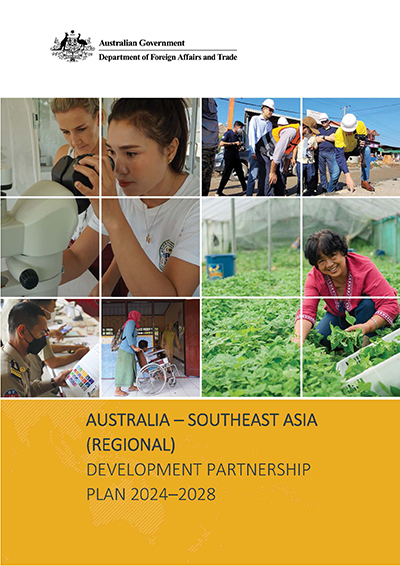
The Australia Southeast Asia Regional Development Partnership Plan 2024-2028 (DPP) translates into action the development priorities Australia shares with Southeast Asia. The DPP sets out agreed objectives, how we will work together to deliver shared outcomes, and how progress will be monitored.
Objective 1 – Inclusive regional economic growth and integration
Driving inclusive economic growth is a top priority for all Southeast Asian countries and ASEAN. In line with Invested: Australia's Southeast Economic Strategy to 2040, we work with Southeast Asia to strengthen our economic cooperation for mutual benefit, through ODA and non-ODA investments, across government, regional organisations and the private sector. We support improvements in economic policy and the business enabling environment, investment in the development of quality, sustainable and inclusive infrastructure and increased economic opportunity for women, people with disabilities and marginalised groups.
Objective 2 – Enhanced regional and community resilience
Australia supports stronger and more effective regional architecture by engaging closely with ASEAN and Mekong subregion institutions and initiatives. We cooperate on regional security and stability, including on transnational crime, safe migration, health security and maritime security. Our support to enhance education and skills, and advance gender equality and disability equity contributes to strengthened human development and community resilience.
Objective 3 – Greater regional action on climate change and energy transition
Australia is well placed to work with the region on its clean energy transition and respond to demand for the required policies, expertise and technologies. We focus on climate change and disaster risk reduction across our Southeast Asia regional programs. We support implementation of the ASEAN Strategy for Carbon Neutrality and ASEAN Plan of Action for Energy Cooperation (APAEC) 2016–2025. Regional priorities include the ASEAN Power Grid, renewable energy development, and regional energy policy and planning, as well as the work of the ASEAN Centre for Energy and establishment of the ASEAN Centre for Climate Change. Through the Southeast Asia and Australia Government Partnerships program (SEAG2G, 2024-28) Australian and Southeast Asian government agencies are building and sustaining relationships and support for policy and technical capability on climate and energy. Our long-standing investments in resilient infrastructure, water and food security, especially in the Mekong region, support climate adaption and reduce peoples' vulnerability to the impacts of climate change and disasters.
Climate Change
Southeast Asia faces rising sea levels, heat waves, floods, droughts and increasingly intense and unpredictable weather events and natural hazards. Climate change and disasters are exacerbating pre-existing vulnerabilities and have the potential to affect populations at scale, reversing development gains and requiring significant recovery efforts.
Addressing climate change and the clean energy transition is a key component of Australia's diplomatic, economic and development relationships in Southeast Asia.
We help accelerate the region's clean energy transition, including through the equitable uptake of technologies that contribute to mitigation and advance progress toward net zero emissions.
Through a portfolio of blended finance mechanisms – including Australian Development Investments (ADI), Australian Climate Finance Partnership and the Private Infrastructure Development Group (PIDG) – we are advancing recommendations of Invested: Australia's Southeast Asia Economic strategy to 2040. These mechanisms can mobilise Australian investors into Southeast Asia by derisking innovative financial structures that support climate mitigation and adaptation, and gender lens investing.
We help Southeast Asia partners attract quality finance, including from Australia, to support the region's significant clean energy financing needs. The first investment under Australia's non-ODA $2 billion Southeast Asia Investment Financing Facility is a $77 million investment in Singapore's Financing Asia's Transition Partnership (FAST-P), complemented by a further $100 million through Export Finance Australia. Through FAST-P, capital is being deployed for clean energy projects across the region, including hydropower in Indonesia, solar and battery storage in the Philippines, and other renewable projects across the region.
Gender Equality, Disability and Social Inclusion (GEDSI)
In Southeast Asia, women and girls, people with disabilities and marginalised populations often have reduced access to economic opportunities and are disproportionately in vulnerable employment. Recognition of the importance of gender equality, disability equity and social inclusion to sustainable development in Southeast Asia is increasing.
We increase economic opportunity for women, people with disability and marginalised groups, sharing the benefits of prosperity. Programs such as Investing in Women place women at the forefront of economic development, supporting them to participate fully as employees and entrepreneurs by reducing or removing structural barriers, including harmful gender norms.
Continued engagement in Southeast Asia through Women's World Banking drives financial inclusion. We will support efforts to scale gender-lens investing and consider options to incorporate a stronger focus on disability and social inclusion.
Australia engages Southeast Asia partners to better understand what works to prevent and end gender-based violence through the Southeast Asia Gender-based Violence Prevention Platform. We work with partners to make schools safer for girls and address harmful gender norms.