
2024: Celebrating 10 years of KAFTA
The Korea-Australia Free Trade Agreement (KAFTA) has significantly liberalised trade with Australia’s fourth largest trading partner and strengthened the bilateral trade and investment relationship. Since entry into force in 2014, two-way trade has more than doubled from $33 billion in 2013 to $71 billion in 2023. The Republic of Korea is Australia’s third largest export market with exports including coal, natural gas, iron ore, crude petroleum and beef. Australia ranked fourth as an import destination for Korea in 2023.
Celebrating 10 years of KAFTA fact sheet [PDF 565 KB]
2024: Sixth Meeting of the Korea-Australia Free Trade Agreement Joint Committee
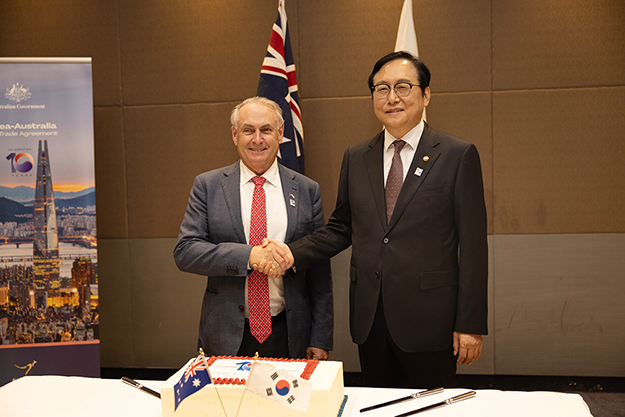
Alongside the Sixth KAFTA Joint Committee meeting, on 3 September 2024 in Perth, Western Australia, Senator the Hon Don Farrell, Minister for Trade and Tourism and his Korean counterpart, Dr Cheong Inkyo, Minister for Trade, celebrated the 10-year anniversary of KAFTA's entry into force.
The milestone was an opportunity to promote the ongoing benefits of KAFTA and discuss ways to strengthen the partnership.
Ministers discussed opportunities to fully utilise KAFTA to address new and emerging issues of bilateral interest including in digital trade, green economy and energy and critical minerals.
Australia and the Republic of Korea agreed on a Summary of Outcomes for the Sixth Joint Committee.
Summary of outcomes
- The sixth meeting of the Korea-Australia Free Trade Agreement (KAFTA) Joint Committee was held on 3 September 2024 in Perth. The meeting was Co-Chaired by the Hon Don Farrell, Minister for Trade and Tourism, Australia and Dr Cheong Inkyo, Trade Minister for the Republic of Korea (ROK).
- The Co-Chairs welcomed the opportunity to hold the Joint Committee meeting and affirmed the importance of the Australia-ROK economic relationship. The Co-Chairs acknowledged the 10-year anniversary of KAFTA's entry into force, commending the significant growth in two-way trade between the countries, and the mutual benefits derived from the success of the agreement over the past decade.
- The Co-Chairs recognised the collaborative efforts of officials from both countries in implementing KAFTA and the importance of encouraging Australian and ROK businesses to maximise opportunities under the Agreement. The Joint Committee discussed the forward agenda for KAFTA and committed to ensuring the Agreement continues to generate opportunities for trade and investment. The Co-Chairs agreed to progress work on exchanging administrative import clearance data for the measurement of FTA utilisation rates.
- The Joint Committee acknowledged Australia's request to discuss improvements in goods market access under KAFTA. Co-Chair Minister Farrell noted opportunities for market access improvements on a range of Australian agricultural products, which would align with access provided to the ROK's other FTA partners and would demonstrate that KAFTA is a modern and comprehensive agreement that continues to provide benefits for businesses on both sides. Co-Chair Minister Cheong noted that at this stage ROK takes a careful approach in dealing with market access issues due to serious concerns raised by domestic stakeholders.
- The Joint Committee agreed to convene a meeting of the Working Group on Professional Services in 2025. The Australian Co-Chair noted the crucial role of professional services in underpinning trade across all sectors in both countries' economies.
- The Co-Chairs commended the positive engagement under the Committee on Energy and Mineral Resources Cooperation which met in October 2023. The Co-Chairs acknowledged that the two countries are strong and complementary energy and resource partners and agreed to sustain momentum on energy cooperation.
- The Co-Chairs discussed Australia's screen content requirements on streaming services. Co-Chair Minister Cheong raised Australia's screen content requirements on streaming services and requested that the relevant regulatory framework be established consistent with KAFTA. Co-Chair Minister Farrell updated ROK on the policy, including that Australia was ensuring the design of the policy was consistent with KAFTA.
- The Co-Chairs welcomed increased dialogue and cooperation bilaterally on emerging areas such as digital trade, green economy and opportunities relating to the new Future Made in Australia package. The Co-Chairs discussed how these areas could be strengthened through existing and new cooperation channels.
- The Co-Chairs acknowledged the continuing and remarkable growth in international e-commerce as part of global trade flows and the importance of high ambition digital trade rules. The Co-Chairs discussed the Agreement on Electronic Commerce negotiated in the WTO, and released in July 2024, and underlined the importance of common global rules on digital trade.
- The Joint Committee commended the strong collaboration on regional trade rules and advancing our mutual trade and economic interests, including through the Regional Comprehensive Economic Partnership Agreement and the Indo-Pacific Economic Framework. The Co-Chairs agreed to continue cooperation on shaping rules and standards that are consistent with KAFTA and that reflect Australia and the ROK's shared values and economic interests.
2022: Fifth Meeting of the Korea-Australia Free Trade Agreement Joint Committee
The fifth meeting of the Korea-Australia Free Trade Agreement (KAFTA) Joint Committee was convened virtually on 5 April 2022.
Summary of outcomes
- The fifth meeting of the Korea-Australia Free Trade Agreement (KAFTA) Joint Committee was convened virtually on 5 April 2022. The meeting was Co-Chaired by the Hon Dan Tehan, Minister for Trade, Tourism and Investment, Australia and Mr Yeo, Han-koo, Minister for Trade, the Republic of Korea (ROK).
- The Co-Chairs welcomed the state visit by His Excellency Moon Jae-in, President of the ROK to Australia in December 2021 to meet with the Hon Scott Morrison MP, Prime Minister of Australia. The Co-Chairs reaffirmed the commitments made by Leaders to continue enhancing existing strong economic ties through KAFTA and cooperation on strategic goals.
- The Joint Committee recognised our collaboration on regional trade rules, including with RCEP’s entry into force earlier this year for both our economies, consideration of CPTPP accession and discussions on the Indo-Pacific Economic Framework. The Co-Chairs agreed to continue cooperation on shaping rules and standards that are consistent with KAFTA and that reflect Australia and the ROK’s shared values and economic interests.
- The Co-Chairs welcomed increased dialogue and cooperation bilaterally on emerging areas such as digital trade, green economy and supply chains. The Co-Chairs discussed how these issues could be strengthened through existing and new cooperation channels. Australian Co-Chair Minister Tehan proposed an upgrade of KAFTA to reflect our shared priorities into the future.
- The Joint Committee commended the strong two-way KAFTA tariff preference utilisation rate of 96 per cent for trade in goods in 2020. The committee recognised the importance of encouraging Australian and ROK businesses to maximise opportunities under KAFTA.
- The Joint Committee noted the collaborative work of officials in both countries to support KAFTA's effective implementation. The Joint Committee reviewed the report from the last meeting of the Committee on Agricultural Cooperation held on 13 April 2021 and the Committee on Energy and Mineral Resources Cooperation held on 8-9 July 2021 and agreed to continue exploring areas of cooperation.
- The Joint Committee discussed Australia’s request for flexible implementation of the beef safeguard measure by the ROK, the revisiting of the seasonal tariff arrangements to better reflect production seasons, and Australia’s dairy export competitiveness.
- The Co-Chairs commended the establishment of new cooperation mechanisms for carbon capture, use and storage (CCUS), critical minerals, hydrogen and other low emissions technologies on the occasion of the summit visit in December 2021 to pursue mutual interests.
- The Joint Committee noted that planning was underway to convene a meeting of the Working Group on Professional Services (WGPS) in the third quarter of 2022. The Australian and ROK Co-Chairs both noted the potential for further efforts through the WGPS to improve the mutual recognition of qualifications and support the mobility of professional service providers.
- The Co-Chairs discussed the progress of Product Specific Rules (PSR) Transposition work and agreed to ensure that PSRs will be updated to reflect HS 2022.
- The Co-Chairs discussed the ROK’s domestic processes to formally apply to join the Comprehensive and Progressive Agreement for Trans-Pacific Partnership (CPTPP). ROK Co-Chair Minister Yeo stated that the ROK would be interested in applying once all domestic processes were completed. Australian Co-Chair Minister Tehan re-affirmed that Australia welcomed the ROK’s interest in accession to the CPTPP and said that a review of KAFTA could be used to pave the way for the ROK’s CPTPP accession process.
- The Joint Committee discussed the forward agenda. The Co-Chairs recognised the importance of bilateral collaboration amidst an evolving trade environment, especially in the Indo-Pacific region, and committed to explore opportunities and continue cooperation in strategic areas including the green economy, supply chains, agriculture such as food security, climate change, preventing disease, and digital trade.
2020: Fourth Meeting of the Korea-Australia Free Trade Agreement Joint Committee
The fourth meeting of the Korea-Australia Free Trade Agreement (KAFTA) Joint Committee took place virtually on 9 December 2020.
Summary of outcomes
- The fourth meeting of the Korea-Australia Free Trade Agreement (KAFTA) Joint Committee took place virtually on 9 December 2020. The meeting was co-chaired by Ms Elisabeth Bowes, First Assistant Secretary, Regional Trade Agreements Division, the Department of Foreign Affairs and Trade of Australia and Mr Kyungsik Lee, Director General for FTA Negotiations, Ministry of Trade, Industry and Energy of the Republic of Korea (ROK).
- The Co-Chairs discussed the role of business-led growth in driving the global economy out of the COVID-19 pandemic recession and welcomed the continued smooth implementation of KAFTA since its entry into force on 12 December 2014.
- The Joint Committee welcomed the increased two-way KAFTA preference utilisation rate of over 96[1] per cent for trade in goods in 2019 and highlighted the value of data sharing in support of trade advocacy. The Co-Chairs noted the continuing benefits of encouraging Australian and Korean businesses to maximise opportunities under the Agreement.
- The Joint Committee noted the collaborative work of both countries to support KAFTA's effective implementation, despite the disruptions caused by the COVID-19 pandemic. The Joint Committee agreed to maintain a pragmatic approach to managing the committees and working groups established under the Agreement during these unprecedented times.
- The Co-Chairs reviewed the progress of the work program agreed at the third meeting of the Joint Committee in February 2019 and noted the report of the Committee on Energy and Mineral Resources Cooperation which convened in Canberra in November 2019 and brought together 60 delegates from Australian and Korean Government agencies and industry bodies.
- The Australian and Korean Co-Chairs reviewed the progress of the HS Transposition work and agreed to ensure its completion as soon as possible.
- The Joint Committee discussed Australia’s request for flexible implementation of the beef safeguard measure by Korea to promote agricultural trade under KAFTA.
- The Co-Chairs noted the update provided by the Korean delegation on the implementation of the ROK’s Phase Three legal services liberalisation under KAFTA and Australia welcomed the resulting improved access to Korean legal services market.
- Both Parties welcomed further consultations between officials on the application of the United Nations Commission on International Trade Law (UNCITRAL) Transparency Rules to arbitrations initiated under Section B of Chapter 11 (Investment).
- The Joint Committee noted the updates to Australia's Trusted Trader Program and Korea’s Authorized Economic Operator Program.
- The Australian and Korean Co-Chairs both noted the potential for further efforts through the Working Group on Professional Services to improve the mutual recognition of qualifications and support the mobility of professional service providers.
- The Joint Committee noted that planning is underway to hold the Committee on Agricultural Cooperation, the Committee on Energy and Mineral Resources Cooperation and the Working Group on Professional Services in 2021. Both sides also agreed to hold the Committee on Trade in Goods, as well as ensure progress in the HS transposition work, in 2021.
- The fifth Joint Committee meeting will be held on a date to be mutually determined.
[1]The KAFTA utilisation rate published by the Korea Customs Service (of over 82.8 per cent) does not include post-importation preference claims under KAFTA.
2019: Third Meeting of the Korea-Australia Free Trade Agreement Joint Committee
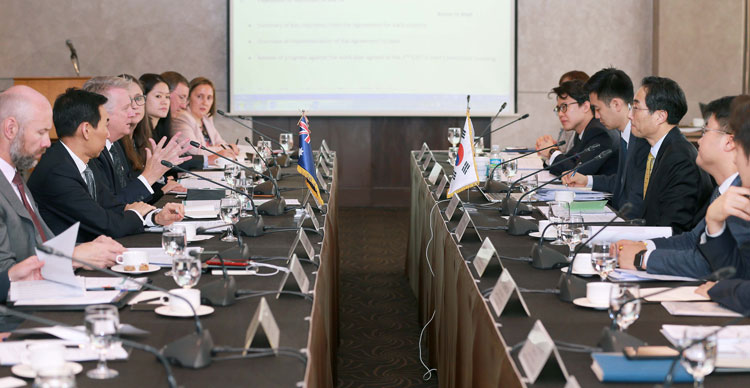
The third meeting of the Korea-Australia Free Trade Agreement (KAFTA) Joint Committee was convened in Seoul, Republic of Korea, on 15 February 2019.
Summary of outcomes
- The third meeting of the Korea-Australia Free Trade Agreement (KAFTA) Joint Committee was convened in Seoul, Republic of Korea, on 15 February 2019. The meeting was co-chaired by Mr. Kijune Kim, Director General for FTA Negotiation from the Ministry of Trade, Industry and Energy, and Mr. Todd Mercer, Assistant Secretary from the Department of Foreign Affairs and Trade.
- The Co-Chairs discussed the outcomes of KAFTA since its entry into force in December 2014, highlighted KAFTA's contribution to increasing economic integration, and welcomed growth in two-way goods and services trade. The parties noted the continuing benefits of encouraging Australian and Korean businesses to maximise opportunities under the Agreement.
- The Joint Committee noted the collaborative work of officials in both countries to support KAFTA's effective implementation. The Co-Chairs reviewed progress against the work plan agreed at the previous meeting, and noted the reports of the Committees on Financial Services, Trade in Goods, and Rules of Origin and Trade Facilitation, as well as the Working Group on Professional Services, each of which had convened since the last KAFTA Joint Committee.
- The Joint Committee welcomed the increased two-way KAFTA preference utilisation rate of over 92 per cent for trade in goods in 2017. It acknowledged the important work by officials towards the effective annual exchange of data on trade flows under KAFTA, and highlighted the value of the data in supporting trade advocacy.
- Recent developments in Australia to help enhance efforts to address non-tariff measures (NTMs) were discussed. The Australian delegation provided information on the implementation of Australia's Trusted Trader Program and Temporary Skills Shortage Visas (Sub-class 482).
- The Joint Committee noted Australia's continued interest in flexible implementation by Korea of the beef safeguard measure under KAFTA, and Korea's interest in Australia's implementation of anti-dumping measures.
- The Australian and Korean Co-Chairs both noted the potential for further efforts through the Working Group on Professional Services to improve the mutual recognition of qualifications and support the mobility of professional service providers. Continued consultations in this area were encouraged.
- The Joint Committee noted Australia's continued interest in the ROK's Foreign Legal Consultants Act, promoting the implementation of the ROK's Phase Three legal services liberalisation obligations under KAFTA, and facilitating improved access to the Korean legal services market.
- Both Parties welcomed further consultations between officials on the application of the United Nations Commission on International Trade Law (UNCITRAL) Transparency Rules to arbitrations initiated under Section B of Chapter 11 (Investment).
- The Joint Committee highlighted the smooth implementation of KAFTA to date, and agreed that the Joint Committee maintain a pragmatic approach to managing the committees and working groups established under the Agreement.
- The Joint Committee agreed to make every effort to hold the Committee on Agricultural Cooperation in 2019. The Joint Committee also encouraged the Committee on Energy and Mineral Resources Cooperation and the Working Group on Professional Services to make every effort to meet in 2019.
- The next Joint Committee meeting will be held on a date to be mutually determined.