
Australia and Southeast Asia share a commitment to gender equality and the rights of people with disability, reflected in key regional frameworks such as the ASEAN Gender Mainstreaming Strategic Framework 2021-2025 (2023). All ASEAN member states are party to the Conventions on the Elimination of All Forms of Discrimination Against Women and the Rights of People with Disabilities.
In line with Australia's International Gender Equality Strategy and International Disability Equity and Rights Strategy, we are committed to working with ASEAN and partners across the region including governments, private sector and civil society to advance gender equality and realisation of the rights of people with disability.
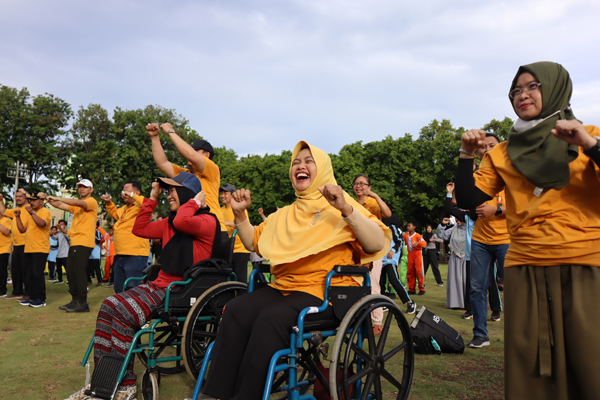
The need for effective and accountable action on disability equity is more crucial than ever. Examples of our partnerships in the region include the Basic Education Quality and Access in Lao PDR program, which supports the Lao Ministry of Education to promote disability equity and rights through the new primary school curriculum.
Australia has launched Stronger Movements, Stronger Futures, a $50 million flagship initiative over six years (2025–2031) – Australia's largest‑ever investment in the disability rights movement. It provides core and capacity-building support to disability rights organisations, including the ASEAN Disability Forum, strengthening OPD leadership, advocacy and participation in decision-making.
To achieve sustainable development, we must deliver on our commitment to leave no one behind. Recognition of the importance of gender equality, disability equity and social inclusion to sustainable development in Southeast Asia is increasing.
By increasing women’s workforce participation, leadership, and access to finance and skills, Southeast Asia can strengthen productivity, drive inclusive growth, and unlock new trade and investment opportunities. Programs such as Investing in Women (2023-2027; up to $80 million) place women at the forefront of economic development, supporting them to participate fully as employees and entrepreneurs by reducing or removing structural barriers, including harmful gender norms, and access to investment capital. This program is accelerating women's economic equality in Southeast Asia, through increased and equitable opportunities in the private sector.
Australia engages Southeast Asia partners to better understand what works to prevent and end gender-based violence. The Southeast Asia Gender-Based Violence (GBV) Prevention Platform ($20.5 million, 2024 – 2029), is improving coordinated and collaborative efforts to prevent GBV in Southeast Asia. It brings together partner governments, civil society, non-government organisations, regional bodies and international organisations to share and build locally-led evidence-based advocacy, dialogue, policy, and collaborative action to prevent GBV in all its forms. Australia also funds the UN Joint Programme on GBV Prevention in Southeast Asia (USD5 million, 2024-2029) delivered by UN Women and the United Nations Population Fund (UNFPA) to support and work with the Platform to prevent all forms of GBV across the region.
The Empowered and Equal Futures for Girls program ($7.04 million, 2023–27), delivered by UNICEF, helps make schools safer for girls, challenges harmful gender norms, and equips students with the skills they need to stay in school and find work in the future.
Through the Mekong-Australia Partnership, we work to promote gender responsive procurement with UN Women ($9.97 million, 2024-29) and protect the livelihoods of remote upland communities in Cambodia, Laos, and Vietnam with CARE ($10 million, 2024-29). Continued engagement in Southeast Asia through Women's World Banking drives financial inclusion and resilience for women in Indonesia, Cambodia and Vietnam in partnership with financial services providers, policy makers and regulators.
UN Women's Asia-Pacific Gender Action Lab initiative – in ASEAN and in Indonesia, Philippines, Cambodia and Malaysia – convenes private sector and government actors to design and implement solutions to accelerate gender-responsive business practices.
We will support efforts to scale gender-lens investing and consider options to incorporate a stronger focus on disability and social inclusion.
More information about the Australian Government's commitment to disability equity and gender equality.