In the coastal communities of East Nusa Tenggara in Indonesia, tidal flooding, extreme waves, coastal erosion and cyclonic storms are common.
Through the Generation Ready (GENRE) project, implemented by Save the Children with partner CIS Timor and supported by the Australian Government through the ANCP, students at 17 schools are taking part in climate change consultations, tree planting, disaster simulations and activities designed to help them identify risks in and around their schools. The project has also generated strong community engagement, reaching 6,336 people in its first year, well above its original target of 2,506. This includes 2,377 people participating in 17 school-community climate events, alongside 32 local businesses.
For 11-year-old Nona*, that included mapping potential hazards around her school. She learnt to identify which classrooms were safer during heavy rain and strong winds, and why sheltering under trees during storms could put her at risk.
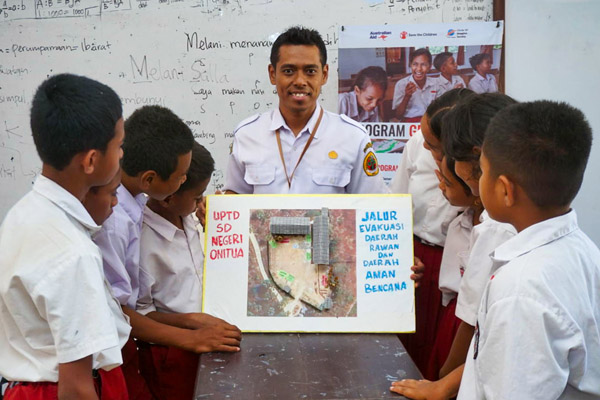
The project also helped teachers strengthen their knowledge of climate change adaptation and disaster preparedness. Danny,* a Grade 6 teacher with 16 years’ experience, says opportunities for teachers in rural communities to update their knowledge can be limited. Through GENRE, he helped develop climate and disaster preparedness learning materials and supported disaster risk assessments, emergency procedures, climate festivals and disaster simulations for students. The child-inclusive disaster preparedness drills and simulations, involved children making models of their communities to map hazards and vulnerabilities, including escape routes. The students also tested school evacuation and preparedness plans, practiced evacuation procedures, including support for children with disabilities.
After training as a Media Maker Lab facilitator as part of the project, Danny* also found new ways to make complex climate and disaster preparedness concepts easier for children to understand. Students were encouraged to explore and communicate what they had learnt through drawings, paintings, poems and short stories.
He says students now have a better understanding of climate change and disaster preparedness and are more aware of their surroundings.
*Not his/her real name.