

In 2015, exports of services accounted for 20.7 per cent of Australia's
total exports following a 9 per cent expansion in the sector over the year
to $65.4 billion. This continues the sector's growth trend of the past five
years.
Australia's Services Exports 2005 to 2015
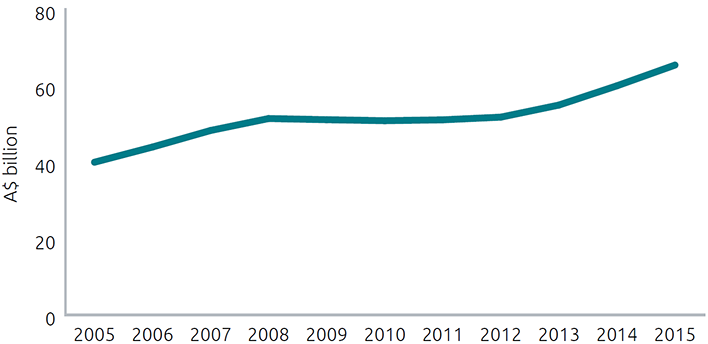
Based on ABS catalogues 5302.0 & 5368.0.
Expanding services exports is a key trade policy focus for the
Government. As the economy transitions from the mining
boom to the ideas boom, services will be a central element
of Australia's transition to a broader-based growth model,
one that delivers more diversified sources of growth, higher
levels of productivity and job creation.– Steven Ciobo, Minister for Trade, Tourism and Investment
Australia's Services Exports(a) 2015
| A$ million | % share | % change | |
|---|---|---|---|
| Manufactured services on physical inputs owned by others | 14 | 0.0 | -22.2 |
| Maintenance & repair | 90 | 0.1 | 52.5 |
| Transport | 6,756 | 10.3 | 2.4 |
| Passenger(b) | 2,635 | 4.0 | 9.5 |
| Freight | 247 | 0.4 | -12.1 |
| Other | 2,674 | 4.1 | 3.0 |
| Postal & courier services | 1,200 | 1.8 | -8.5 |
| Travel | 38,431 | 58.8 | 10.2 |
| Business | 4,468 | 6.8 | 5.8 |
| Personal | 33,963 | 52.0 | 10.8 |
| Education-related | 18,659 | 28.6 | 9.5 |
| Other personal(c) | 15,304 | 23.4 | 12.4 |
| Other | 20,063 | 30.7 | 9.2 |
| Construction | 183 | 0.3 | 5.2 |
| Insurance & pension | 549 | 0.8 | 2.4 |
| Financial | 3,746 | 5.7 | 18.6 |
| Intellectual property charges | 1,045 | 1.6 | 10.2 |
| Telecommunications, computer & information | 3,053 | 4.7 | 18.7 |
| Other business services | 9,541 | 14.6 | 5.7 |
| Personal, cultural and recreational | 931 | 1.4 | -4.3 |
| Government services | 1,015 | 1.6 | 2.3 |
| Total services exports | 65,354 | 9.0 |
(a) Balance of payments basis.
(b) Passenger services include air transport-related agency fees & commissions.
(c) Inbound tourism for mainly recreational purposes.
Based on ABS catalogues 5302.0 & 5368.0.
Tourism
In 2015, the tourism industry was our largest services industry export.
The number of international visitors to Australia increased by 8.2 per cent
to 7.4 million, pushing up tourism industry exports by 18 per cent to
$36.6 billion.
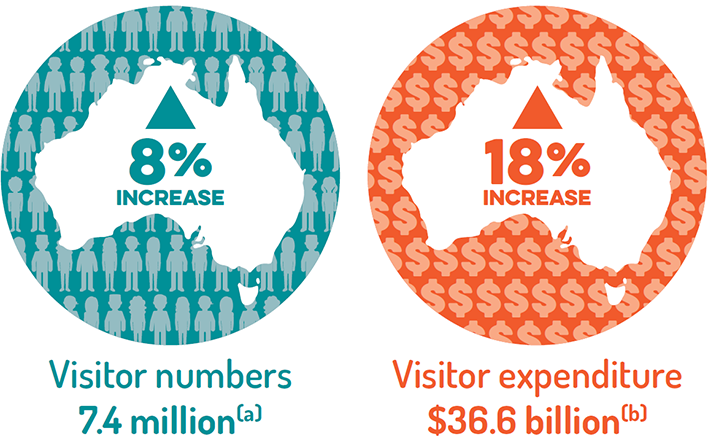
(a) Department of Immigration and Border Protection.
(b) Tourism Research Australia.
In 2014-15:
- overall, tourism's contribution to GDP rose 5.3 per cent to $47.5 billion
(3 per cent of national GDP) - tourism industry exports rose nine per cent to $30.7 billion
(9.6 per cent of total Australian exports) - tourism directly employed 580,800 people or five per cent of
Australia's total employment and indirectly employed another
341,000 - tourism directly and indirectly accounted for one in 13 jobs
in Australia.
Source: Tourism Research Australia Tourism Satellite Account 2014-15.
Australia's International Visitors 2015
| Rank | Country | Number of visitors ('000) |
% change on 2014 |
|---|---|---|---|
| 1 | New Zealand | 1,309 | 5.5 |
| 2 | China | 1,023 | 21.9 |
| 3 | United Kingdom | 688 | 5.6 |
| 4 | United States | 610 | 10.3 |
| 5 | Singapore | 396 | 6.3 |
| 6 | Malaysia | 339 | 4.4 |
| 7 | Japan | 336 | 2.8 |
| 8 | India | 233 | 18.6 |
| 9 | Republic of Korea | 230 | 12.8 |
| 10 | Hong Kong(a) | 220 | 8.9 |
(a) Special Administrative Region of China.
Source: Department of Immigration and Border Protection.
Australia's Top 10 International Visitor Expenditure Sources 2015
| Rank | Country | Total trip spend ($million) | % change on 2014 |
|---|---|---|---|
| 1 | China | 8,268 | 44.7 |
| 2 | United Kingdom | 3,802 | 12.4 |
| 3 | United States | 3,411 | 22.3 |
| 4 | New Zealand | 2,642 | 8.3 |
| 5 | Singapore | 1,383 | 20.0 |
| 6 | Republic of Korea | 1,345 | 18.0 |
| 7 | Japan | 1,332 | -2.4 |
| 8 | Hong Kong(a) | 1,207 | 23.4 |
| 9 | Malaysia | 1,149 | 7.3 |
| 10 | India | 1,136 | 38.0 |
(a) Special Administrative Region of China.
Source: Tourism Research Australia International visitors in Australia, December 2015.
Intellectual Property
In 2015, Australian royalties for intellectual property services reached
$1.3 billion in exports and $6.3 billion in imports, with Australia being a net
exporter of IP to non-OECD countries. Australia supports international
arrangements for the effective and balanced protection and use of
intellectual property.