
Brief Outline of the Nuclear Fuel Cycle
Currently there are almost 440 nuclear power reactors in
operation in over 30 countries worldwide. In many cases they supply a substantial proportion of national
electricity requirementssee Table 2
on page 66.
Reactor types
The majority of the worlds power reactors are of the light
water type (LWRslight water reactors), where ordinary water acts
as both moderator, slowing down neutrons to efficient speeds for nuclear
fission to occur, and coolant, transferring heat from the nuclear reaction to
steam generators for producing electricity.
Because ordinary water is an inefficient moderator, LWRs
must be operated on enriched uranium, that is, uranium in which the proportion
of the fissile isotope U-235 has been increased from the level in natural
uranium, 0.71%, usually to between 3 and 5%. Some reactor types can be operated on natural uranium, by using more efficient
moderators, such as heavy water, which has a proportion of the heavier hydrogen
isotope deuterium, and graphite. Typical examples of this type of reactor are the Canadian CANDU, which
is moderated and cooled by heavy water, and gas-cooled graphite-moderated
reactors such as the UK Magnox.
Fuel cycle stages
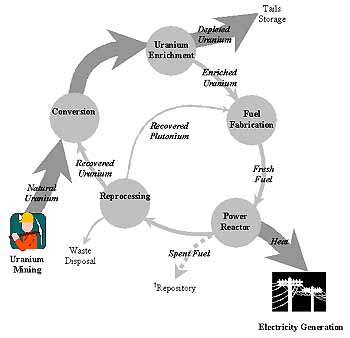
Following miningand milling of uranium and production of uranium ore concentrates
(yellowcake), the stages of the light water fuel cycle are as follows (see
Fig 1):
- Conversion: natural uranium is formed into a gaseous
compound, uranium hexafluoride (UF6), prior to enrichment; - Enrichment: a process by which the proportion of the
U-235 content is increased. The main
technologies in use are gaseous diffusion and centrifuge. The product is described as low enriched
uranium (LEU), containing between 3 and 5% U-235; - Fabrication: manufacture of LEU into uranium oxide fuel
pellets, which are assembled into fuel rods and then fuel elements for use in a
reactor; - Reactors: a power reactor uses the heat from a
controlled nuclear chain reaction to drive a turbine to generate
electricity. Typically the turbine(s)
is driven by steam. In the case of
pressurised water reactors as well as liquid metal-cooled reactors and some
gas-cooled reactors, steam for the turbines is produced in a secondary
circuit. There are some
high-temperature gas-cooled reactors where the generating turbine is
gas-driven. - In a typical LWR fuel elements are used over 34
operating cycles each of 1218 months (i.e. the reactor might be unloaded every
12 months, with a third of the core being replaced each time); - Reprocessing: spent fuel is dissolved for the
separation of highly radioactive fission products, and for the recovery of
plutonium and uranium. Uranium can be
re-enriched for further reactor use. Plutonium is mixed with uranium to produce MOX (mixed oxide) fuel and
used both in LWRs and potentially in fast breeder or fast neutron reactors.
Partly because depressed uranium prices are impacting on the economics of
reprocessing, a number of countries have committed to, or are considering, the
once-through cycle, where spent fuel will be disposed of without reprocessing.
Figure 10 Civil Nuclear Fuel Cycle-Outline
Some countries choose to
dispose of their spent fuel in repositories instead of recycling it.
Military fuel cycle
There are five acknowledged nuclear-weapon states (the US,
Russia, the UK, France and China) and three threshold states, two of which
have conducted nuclear explosive tests (India and Pakistan) and one which is
suspected of having a nuclear weapon capability (Israel). In all cases the military nuclear programs
developed ahead of civil power programs. Military programs involve the production of special grades of nuclear
material, substantially different to the material used in civil programs.
Nuclear weapons are based on the following nuclear
materials:
Plutonium
Plutonium is formed through the irradiation of uranium in a
reactor. The uranium-238 isotope
absorbs a neutron, leading to the formation of plutonium-239. Longer irradiation times lead to the
formation of higher plutonium isotopes, Pu-240, Pu-241 and Pu-242.
Weapons-grade plutonium predominantly comprises the
isotope Pu-239 and contains no more than 7% of the isotope Pu-240. Pu-240 (and the higher isotope Pu-242) are
undesirable for weapons purposes because their rate of spontaneous fission
causes pre-initiation (a premature chain reaction). By contrast, reactor-grade plutoniumfrom the normal operation of a LWR contains
high levels of Pu-240, typically around 25%.
Because of the need to minimise the Pu-240 content,
weapons-grade plutonium is produced in dedicated plutonium production reactors,
usually natural uranium-fuelled, graphite-moderated, where irradiated fuel can
be removed after short irradiation times (i.e. at low burn-up levels).
Uranium
Weapons-grade
uranium is very highly enriched, to 90% or more U-235. This compares with normal civil enrichmentlevels of around 35% U-235.
High enrichment levels are produced in enrichment plants specially
designed and operated for this purpose.
Fuel Cycles (figures are approximate)">
of Quality (Isotopic Composition) of Materials in Civil and Military Nuclear
Fuel Cycles (figures are approximate)
Material
Civil
Military
Plutonium
60% 239Pu
93% 239Pu
Uranium
4%
235U
90% 235U
The US, Russia, the UK and France have announced that they
have ceased production of fissile material for nuclear weapons purposes, and
China is believed to have done so. Australia is a strong supporter of a Fissile Material Cut-off Treaty
(FMCT) under which this situation will be formalised,
and extended to India, Israel and Pakistan. The FMCT will prohibit production of fissile material for weapons
purposes, and will provide for verification on relevant facilities and
material.
Generation at 31 December 2000
Country
Operating
Capacity
% of Total
Reactors
under Construction
Reactors
(GWe)
Electricity in 2000
Number
(GWe)
*USA
104
97.4
19.8
*France
59
63.1
76.4
*Japan
53
43.5
33.8
3
3.2
*Germany
19
21.1
30.6
Russia
29
19.8
15.0
3
2.8
*ROK
16
13.0
40.7
4
3.8
*UK
35
13.0
21.9
Ukraine
13
11.2
47.3
4
3.8
*Canada
14
10.0
11.8
*Sweden
11
9.4
39.0
*Spain
9
7.5
27.6
*Belgium
7
5.7
56.7
Taiwan, China
6
4.9
23.6
2
2.6
Bulgaria
6
3.5
45.0
*Switzerland
5
3.2
38.0
*Finland
4
2.7
32.2
Czech Republic
5
2.6
18.5
1
0.9
India
14
2.5
3.1
Lithuania
2
2.4
73.7
2
2.4
Slovak Republic
6
2.4
53.4
2
0.8
China
3
2.2
1.2
8
6.4
Brazil
2
1.9
1.5
South Africa
2
1.8
6.6
Hungary
4
1.8
42.1
*Mexico
2
1.4
3.9
Argentina
2
0.9
7.3
1
0.7
Romania
1
0.7
10.9
1
0.7
Slovenia
1
0.7
37.4
*Netherlands
1
0.4
4.0
Armenia
1
0.4
33.0
Pakistan
2
0.4
1.7
World total
438
351.3
(est) 16.0
31
27.8
*Eligible
to use Australian uranium. Countries
eligible to use Australian uranium operate 339 power reactors, accounting for
around 83% of world nuclear generating capacity.