
This chapter provides information for the diplomatic corps on Australia's airport environment, including how to obtain airside passes, and other conditions for visits and travel by foreign dignitaries.
Certain foreign visitors may be eligible for Airport Facilitation by the Australian government, please refer to Chapter 15.
14.1 The Australian airport environment
Australia has a comprehensive network of airports ranging from major hubs through to small, regional or specialised airports across all states and territories. The information in this chapter applies to the following Australian airports: Adelaide, Brisbane, Cairns, Canberra, Darwin, Gold Coast, Hobart, Melbourne, Perth and Sydney.
14.1.1 Regulatory Framework and Airport Management
Australian airports are managed through a combination of federal government oversight and regulation, state and local government management, in conjunction with private ownership.
Among the various stakeholders involved in airport management with relevance to the diplomatic corps, the following are some of the key agencies:
- The Department of Infrastructure, Transport, Regional Development, Communications, Sports and the Arts oversees the aviation sector, to provide security, regulatory and other aviation related functions, including administering the Airports Act 1996 and associated regulations.
- Civil Aviation Safety Authority (CASA) oversees the Civil Aviation Act 1988 which governs aviation security.
- Department of Home Affairs overseas the Aviation Transport Security Act 2004, as a framework to mitigate risk by establishing minimum security requirements for civil aviation in Australia including the Aviation Transport Security Regulations 2005.
- Australian Border Force (ABF) is Australia's border management agency. It undertakes immigration and customs clearance at international airports in accordance with the Migration Act 1958 and the Customs Act 1901, while facilitating legitimate trade and travel.
- Airport security at domestic airports is provided by various private companies, contracted by individual airport operators, operating under regulations set by the Department of Home Affairs.
- The Australian Federal Police (AFP) provides specialised policing at major Australian airports, under a comprehensive legislative framework.
- The Department of the Prime Minister and Cabinet (PMC) and Department of Foreign Affairs and Trade (DFAT) coordinate certain privileges extended under the Vienna Convention on Diplomatic Relations 1961 to representatives of sending States and their families in transit (see Chapter 15) and Guest of Government visits (see Chapter 16). The delivery of these privileges at airports remains the remit of ABF and Home Affairs, as per relevant regulations. PMC and DFAT have limited scope of responsibility in relation to airports.
14.2 Airport access for missions
14.2.1 Airside access for the diplomatic corps
Airside access at Australian airports is subject to strict security and regulatory controls, and any access is subject to operational requirements on the day. Diplomatic and consulate representatives are not permitted unescorted access to restricted areas of Australian airports. Diplomatic and consular representatives may access public areas of airports, including domestic arrivals and departures gates, after clearing security screening, and arrivals and departures halls of international airports.
Diplomatic ‘white’ Aviation Security Identification Card pass
Diplomatic and consular representatives may apply for an Aviation Security Identification Card (ASIC) pass that will allow escorted access to restricted areas of airports for business needs.
The ASIC pass is a form of identification issued to individuals who need escorted access to secure areas of an airport. The ‘white’ ASIC pass is designated for the diplomatic corps. DFAT suggests Heads of Missions, Consul Generals and other mission staff who would likely be involved in regular visits apply for a white ASIC pass.
Please note that this pass does not allow for unescorted access nor guarantee airside access, but facilitates airlines and other airport authorities to escort ASIC pass holders airside.
How to apply
The 'white' ASIC pass is issued by authorised bodies in Australia and not by an Australian Government agency. The authorised bodies page provides a list of authorised bodies. Missions must pay the application fee directly to the relevant authorised body.
The 'white' ASIC pass provides escorted access at specific airports; missions should indicate which airports they require access on the application form. Questions regarding ASICs passes should be directed to AusCheck.
DFAT Protocol Branch (PRB) will provide a TPN to support applications for white ASICs card. Please email protocol.branch@dfat.gov.au with your request for a TPN, including correct identification details to support your AusCheck application.
ASIC passes are not required for public areas of airports including arrivals and departure areas of domestic airports.
14.2.2 Non-commercial aircraft and off-terminal clearance
Arrival/departure for any non-commercial aircraft (such as state, private or other chartered flights) are arranged by the aircraft's ground handling agents in Australia, at the mission’s own cost. PMC may provide support for certain eligible visitors – please refer to Chapter 15 and 16.
Any request from the engaged ground handling agent to the ABF for off-terminal clearance is to be discussed with and agreed/approved by ABF ahead of travel. These requests will be considered by the relevant region on a case-by-case basis and ABF, in consultation with DAFF, will determine what level of support they can provide based on their operational priorities. Please note that DFAT does not manage off terminal clearances; the requesting mission is responsible for all engagement with ABF.
Department of Defence manages diplomatic clearance applications for State aircraft entering Australian sovereign territory – missions should contact Defence directly. Refer to Diplomatic clearances – aircraft and ships.
14.3 Visiting foreign dignitaries
Australia does not have designated diplomatic immigration queues at Australian international airport for use by the diplomatic community. Visitors with ePassports may use fast-tracked SmartGate lines, which offer an expedited function compared to other lines.
The Australian Government offers airport facilitation as a diplomatic privilege for certain eligible international visitors (such as head of state, heads of government, foreign and trade ministers), please see Chapter 15.
Missions seeking to provide a service for other visiting dignitaries may like to consider utilising a commercial supplier of ‘VIP meet and greet’ services which operate at many Australian airports (see section 14.3.4 below).
14.3.1 Official visits with DFAT
Geographic or thematic desks at DFAT may assist with arranging commercial solutions for official visits organised by DFAT, including attendance at DFAT-organised major events, conferences or summits. Missions should engage with the desk as per Chapter 16 of the Protocol Guidelines to incorporate airport management as part of overall visit planning.
DFAT Protocol Branch manages airport facilitation assistance for the following diplomatic functions:
- Head of Canberra-based diplomatic mission on first arrival and final departure
- Non-resident head of diplomatic mission on arrival and departure for credentials presentation.
Please contact protocol.branch@dfat.gov.au for further details.
14.3.2 Official visits with other Commonwealth agencies
For official travel by ministers of foreign national governments, Commonwealth agencies should engage ABF early in the visit planning process for major events, conferences or summits. Missions should engage directly with the relevant sponsoring/inviting Commonwealth agency as part of visit planning; missions should not engage with ABF directly.
Guest of Defence visits are managed by the Department of Defence. Foreign military facilitation is subject to ABF’s operational capacity and all enquiries regarding military facilitation should be directed to the Department of Defence at dvam.visits@defence.gov.au.
For Parliamentary presiding officers (Speaker or President of a House of Parliament or equivalent) or Guest of the Australian Parliament, missions should email a request to the International and Parliamentary Relations Office of the Parliament of Australia at ipro@aph.gov.au.
For relevant portfolio ministers, missions should email a request to the Department of Climate Change, Energy, the Environment and Water – Protocol Support – at protocol@dcceew.gov.au
14.3.3 Guest of Government
Department of the Prime Minister and Cabinet (PM&C) manages airport facilitation under Australia's Guest of Government (GoG) visits programme (and see Chapter 16). Missions should engage directly with PM&C.
14.3.4 Commercial VIP 'meet and greet' services
Missions, DFAT desks or other agencies may consider using a commercial VIP ‘meet and greet’ service for visiting dignitaries. These services provide convenient, efficient and personalised service for visiting dignitaries to be escorted through the airport and immigration process and can be tailored for the specific visit.
The VIP ‘meet and greet’ service may provide the following services, and should be considered by the mission/desk as part of initial visit planning:
On arrival
- The designated commercial representative awaits the dignitary at the disembarkation gate and escorts them to the immigration processing point for priority processing.*
- After passing immigration, the representative escorts the dignitary to collect luggage.
- The representative escorts the dignitary to the public area or awaiting mission cars.
On departure
- The designated commercial representative meets the dignitary after check-in and escorts them through security to the passport processing point for ABF priority processing*.
- The commercial representative then escorts the dignitary to the airline lounge or the gate.
*Subject to the priority processing being pre-arranged with, and approved by, the ABF in advance of the travel.
Commercial service providers may also be able to escort a consular/diplomatic representative airside on request (usually requiring white ASIC pass). They may also provide additional services such as VIP room booking, private transport, transit or other services on request.
A range of commercial suppliers exist at Australian airports. Costs vary for these services, depending on the airport, size of delegation, and options requested. All costs for commercial facilitation rest with the requesting mission.
14.3.5 Airport VIP rooms
VIP rooms can provide a private location for a delegation to wait immigration processing. Missions may seek to book VIP rooms directly with airports (where available). VIP rooms are for international arrival only, fees may apply and are at mission's own cost. VIP rooms are available at the following airports;
| VIP room booking | |
|---|---|
| International terminal, Sydney Kingsford Smith Airport | ops@syd.com.au Web: VIP rooms (sydneyairport.com.au) |
| International terminal, Melbourne Tullamarine Airport | Monday to Friday during business hours: Peter.Ververis@melair.com.au After hours and on weekends (for urgent requests that cannot wait until business hours): IOCManagers@melair.com.au |
| International terminal, Brisbane Airport | itb.reception@bne.com.au |
| International terminal, Perth Airport | vipfacilitation@perthairport.com.au |
| International terminal, Gold Coast Airport | dutymanager@gcal.com.au |
| International terminal, Cairns Airport | duty.manager@cairnsairport.com.au |
14.3.6 Parking at airports
Airports in Australia are privately owned. Except at Canberra airport (see below) there are no special arrangements for access to airport parking for missions and posts.
Motorcade arrangements for high-level visits
For high‑level visits, diplomatic missions are responsible for making all airport vehicle and motorcade arrangements. This includes liaising directly with the relevant airport authority to identify suitable pick‑up and drop‑off locations that can accommodate official vehicles and motorcades. Missions are also required to consult separately with the Australian Federal Police (AFP) to ensure the proposed arrangements are appropriate from a security perspective.
Canberra Airport
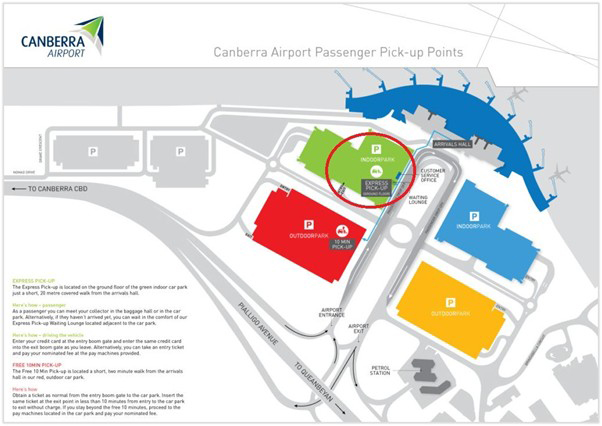
Canberra Airport has an ‘Express Passenger Pick-Up' parking area. The parking area is located on the ground floor of the green covered carpark and is about 20 metres from the arrivals hall. A waiting room is attached to the car park, which drivers and other staff may use. Canberra Airport has designated five vehicle parking bays for exclusive use of the diplomatic corps in this car park. There are no time limited when parking in the Express passenger pick-up area however there is a parking fee.
The open-air car park at Canberra Airport is available for up to 10 minutes without charge. Information on both of these parking options can be found on the Canberra Airport website.
14.4 International arrival and departure processes at Australian airports
Foreign visitors are required to comply with aviation security screening and immigration, customs and quarantine requirements. See Chapter 15 for screening exemptions for certain eligible visitors.
14.4.1 Aviation security screening
Australia's obligations under international and domestic law to protect senior foreign visitors from harassment or impairment of dignity do not displace its responsibility to ensure the safety and security of airports and airline passengers.
Under Australian legislation, Australian airports are required to implement strict security screening procedures in the interests of public safety. These procedures apply to all airline passengers and others entering airport secure zones. Details of Australian security screening processes can be found on the Home Affairs website.
While every effort is made to undertake security screening courteously and respectfully, a certain level of intrusion is unavoidable in complying with these legal requirements. All baggage and personal effects are subjected to X-ray screening to ensure weapons and other prohibited items do not enter airport secure zones or an aircraft cabin.
Screening of the person involves walking through a detector. If an alarm sounds, the person must undergo further screening, which can include the re-screening of personal items, the use of a hand-held metal detector or a physical pat-down by a screening officer of the same gender. Private screening – away from public scrutiny – may be available for a pat-down on request.
Airline passengers and others may be randomly selected at security and international departure points to undergo additional screening via body scanning equipment. Under the relevant regulations, selection must not be based on a person's gender, ethnicity or employment.
Airline passengers and others may also be randomly selected to undergo explosive trace detection (ETD) screening.
14.4.2 Incoming Passenger Cards
All travellers are required to provide a completed Incoming Passenger Card (IPC) to a clearance officer on arrival. The Incoming Passenger Card is a legal document, and requires personal particulars and a declaration of goods being conveyed. Please read thoroughly and answer the questions truthfully. If in doubt, always declare it.
The Australian Travel Declaration (a digital alternative to the paper IPC) is also being trialled on select Qantas flights.
14.4.3 Visa requirements
All foreign visitors, including guest of government, must hold a valid visa to enter Australia. Missions should contact the Department of Home Affairs for any visa queries.
14.4.4 Customs and biosecurity requirements
All travellers must comply with Australia’s border entry requirements, including import restrictions and/or prohibitions. Foreign dignitaries are not exempt and may be required to undergo further assessment, at the direction of ABF and/or DAFF/Biosecurity officers, to address any outstanding questions surrounding goods being imported.
For further information, go to:
- Travelling to Australia
- Going through the border – navigate to information and guidance on arrival and departure requirements
- Bringing items into Australia – A guide to what you can and can't bring into Australia.
- Department of Agriculture, Fisheries and Forestry, which is responsible for biosecurity matters
14.5 Additional or accompanying personnel
14.5.1 Accompanying security personnel
Australian authorities provide comprehensive protective security arrangements for Internationally Protected Persons, including heads of state, heads of government, guests of government and other VIPs against whom an assessed security threat exists. This includes the use of close protection police officers and the implementation of appropriate transport, accommodation and venue security arrangements.
It is a long-standing policy of the Australian Government that foreign security personnel accompanying foreign dignitaries on visits to Australia are not permitted to carry firearms. This policy is based on the very high standard of protective security arrangements provided by Australian authorities. Foreign security personnel are also not permitted to import or carry prohibited items which include ballistic vests, or any other type of weapon, including batons, tasers, handcuffs and sprays. Any security personnel accompanying a foreign dignitary may be subjected to electronic security screening and may also be required to allow Australian officials to inspect their bags. In the event that a weapon or prohibited item is detected, it may be seized. Any person who breaches Australian law through the undeclared importation, carriage or use of prohibited items may be liable to prosecution.
14.5.2 Hand-held radios
If foreign security personnel wish to bring hand-held radios into Australia, approval must be sought in advance for the proposed frequencies. The request, containing full details of the equipment, should be submitted to the Australian Federal Police for approval: email - visitsecurity@afp.gov.au.
14.5.3 Accompanying media - equipment
Media entities may be eligible for concessional duty and tax relief as part of Australia’s temporary importation procedure, whereby certain goods may be temporarily imported into Australia for a period of up to 12 months without the payment of duty or taxes, and provided certain conditions and criteria are met.
The nature of the goods, what they will be used for while they are in Australia and who is importing the goods will determine whether the goods will qualify. Goods that qualify as temporary imports may be imported either:
- under carnet – where a security is lodged with an overseas carnet-issuing body.
- under security – where a security is lodged with ABF.
To avoid delays on arrival, temporary importation arrangements should be organised well in advance of travel. A Licensed Customs Broker, or other agent, should be engaged to assist with the necessary arrival and departure arrangements and/or reporting requirements. There are entities that can complete the end-to-end reporting, including initially assessing eligibility for concessional treatment, advising on any permit requirements, lodging import/export declarations, completing reporting requirements and applying for a Security ID (if required for temporary importation).
14.5.4 Diplomatic couriers
All requests for diplomatic courier access should be directed to protocol.branch@dfat.gov.au
14.6 Key contacts
- Department of Foreign Affairs and Trade – Protocol Branch: protocol.branch@dfat.gov.au
- Australian Federal Police : +61 2 5126 0000
- Department of Home Affairs: 131 881 or +61 2 6196 0196 (from outside Australia)
- Australian Border Force: 131 881 or +61 2 6196 0196 (from outside Australia)
- Department of Agriculture, Fisheries and Forestry: 1800 900 090 or +61 3 8318 6700 (from outside Australia); National office: +61 2 6272 3933
- Department of Defence: dvam.visits@defence.gov.au
- International and Parliamentary Relations Office – Parliament of Australia: ipro@aph.gov.au
- Department of Climate Change, Energy, the Environment and Water – Protocol Support – protocol@dcceew.gov.au