
International Women's Day (IWD) is an opportunity to reflect on how far women around the world have come, and how far there is to go before they can enjoy equality in all aspects of their lives. This year, Australia is joining with UN Women Australia to advocate economic empowerment for all.
Around the world, many women still struggle to access education, basic financial services and other opportunities that would allow them to prosper. More than 500 million women can't read, 35 million girls cannot go to school and 75 per cent of the world's women cannot access bank loans to begin to build economic security for themselves and their families.
The International Labour Organization estimates that the Asia-Pacific region is losing US$42 billion to US$47 billion annually because of women's limited access to employment opportunities. This is money that could flow on to improve the health of children, to housing, to education, to feeding communities, to help fight poverty and create stability.
The Australian aid program supports women's empowerment in many different ways but none more important than through education and economic independence.
Giving women more control over their lives is one of the most effective ways to fight poverty. Australian funding is having a direct impact on improving women's lives including through increasing household incomes, agricultural productivity and lifting nutritional levels.
Women's World Banking
In 2011, Australia began a new partnership with Women's World Banking (WWB). WWB is an example of an innovative cooperation between governments, donors and the private sector around the world to improve women's access to financial services, in support of the goals of gender equality and financial inclusion. To achieve this, WWB is designing innovative financial services, including savings for girls, rural finance, micro-health insurance, remittances and financial education to reach poor women through microfinance institutions.
Committed to education in Afghanistan
Australia is committed to increasing education opportunities for women in Afghanistan where school enrolments have increased since 2001 to more than seven million children–and more than 2.5 million of these are girls. Prior to this, there were very few opportunities for girls to get even basic primary education.
Improving food security in East Timor
In East Timor, the Seeds of Life program has been running since 2001. While this is a program about food security and improving crop yield, it's also about empowering women–women like Martina Boavida, who is a farmer in East Timor's Baucau district, and a mother of seven. She planted sweet potato for household consumption after receiving stems through Seeds of Life in 2006, and used the cuttings to multiply her crop.
Martina now has 1.5ha under cultivation, and earns $2000 each year by selling her surplus crop. Martina says that sweet potatoes are good for her family to eat, and the surplus means she can afford to buy beef and chicken to improve her children's diet, as well as pay for their school fees.
Strengthening the future for women and girls in PNG
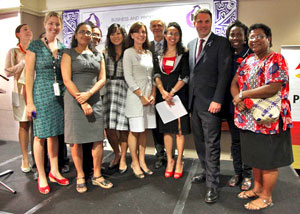
Mr Marles with the Australian High Commissioner, Ian Kemish, President of the Buiness and Professional Women's Association of PNG, Susil Nelson, and AusAID staff.
Photo: AusAID
In Papua New Guinea, the Australian Parliamentary Secretary for Pacific Island Affairs Richard Marles highlighted the importance of empowering women at an International Women's Day Breakfast.
Mr Marles said Australia and the PNG Government and people are working together to strengthen the future for women and girls.
He said maternal and child health and fighting violence against women were priorities for the Australian aid program in PNG.
'We are also working to build women's capacity through education–because education is the single most effective investment we can make to girls, to women, to communities, countries and the world.'
Improving livelihoods in Burma Australia's support through the Livelihoods and Food Security Trust (LIFT) Fund in Burma has helped an estimated 222,000 households–and around 550,000 women and girls have shared directly in the benefits. They have been given access to decision-making roles within their communities through farmers' groups, village development committees and microfinance groups. They have been trained in management, livelihood, and vocational skills. They have used microfinance to build successful enterprises in fishing, livestock and gardening activities.
More information
[External websites]
UN Women
UN Women Australia
UN Women, 56th Session of the Commission on the Status of Women
IWD 2012 Video Message from Prime Minister Julia Gillard
IWD 2012 Video Message from Australia's Global Ambassador for Women and Girls
Media Release
Publications
Violence against Women in Melanesia and Timor-Leste
Gender Thematic Strategy