
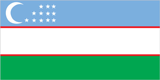
Overview
Situated at the geographic centre of Central Asia, Uzbekistan is one of only two doubly landlocked countries in the world. It covers 448,978 square kilometres and borders Kazakhstan, Turkmenistan, Tajikistan, the Kyrgyz Republic and Afghanistan. Its first post-independence census recorded a population of 39 million in 2026.
Much of the territory of present-day Uzbekistan was annexed by the Russian Empire during the 19th century. Uzbekistan became a Soviet republic in 1924 and gained independence following the dissolution of the Union of Soviet Socialist Republics (USSR) on 31 August 1991. It is a secular state with a majority Muslim population (with adherence to Sunni Islam estimated at 88 to 96 per cent, depending on the source). Russian Orthodoxy forms the largest of the minority religions.
Uzbek, a Turkic language, is the country's official language. Russian is also widely used and Tajik, a variant of Persian, is spoken by minorities particularly in Bukhara and Samarkand. Tashkent, Uzbekistan’s capital, was extensively rebuilt after a major earthquake in 1966 and is today a modern city characterised by a mix of contemporary and Soviet-era architecture.
Political overview
Uzbekistan is a presidential republic in which power remains concentrated in the presidency. The country's first president, Islam Karimov, led Uzbekistan from independence until his death in 2016, pursuing a largely isolationist agenda. President Karimov's unexpected death resulted in Uzbekistan's first and only leadership transition. His successor, President Shavkat Mirziyoyev, has implemented a program of economic reform under a 'Uzbekistan – 2030' strategy, including liberalisation measures aimed at improving the country’s investment climate.
In the October 2021 presidential election, President Mirziyoyev won 80.1 per cent of the votes cast. Following a constitutional referendum in April 2023, the presidential term was extended from five to seven years, and term limits were reset. President Mirziyoyev subsequently called a snap election on 9 July 2023, which he won, securing a new seven-year term. Uzbekistan's constitution provides for a bicameral parliament called the Supreme Assembly or Oliy Majlis. The upper house is elected by regional councils and appointed by the President, while the lower house is popularly elected. There are no significant opposition parties or pressure groups operating in Uzbekistan.
Despite economic reforms, Uzbekistan remains an authoritarian state where, according to Human Rights Watch, political opposition, activists and civil society figures face ‘persecution, interrogation and dismissals'’. Transparency International ranked Uzbekistan 124 out of 182 countries on its 2025 Corruption Perceptions Index.
Uzbekistan is a member of the United Nations, Commonwealth of Independent States, Organisation for Security Cooperation in Europe, Shanghai Cooperation Organisation, the Organization of Turkic States and the Organisation of Islamic Cooperation.
Economic overview
According to the World Bank, as of 2025, Uzbekistan’s GDP per capita was USD $3,968 and according to the Asian Development Bank, 5.8 per cent of its population lived below the poverty line.
Uzbekistan's economic reforms have supported strong economic growth and increased foreign investment since 2016. Supported by a young and growing population and significant reserves of critical minerals, gold, uranium and natural gas, Uzbekistan has attracted investment across mining, agriculture, manufacturing and technology. Government policy increasingly emphasises domestic processing and value-adding industries.
Uzbekistan's major export markets are Russia (12.9 per cent), Kazakhstan (4.6 per cent), Afghanistan (4.4 per cent) and Türkiye (4 per cent). Its major import sources are China (33.4 per cent), Russia (20.3 per cent), Kazakhstan (8.2 per cent) and the Republic of Korea (4.4 per cent). Remittances from Uzbek workers abroad equated to 14% of the economy in 2025.
Australia's relationship with Uzbekistan
Australia and Uzbekistan enjoy a modest bilateral relationship. Two-way goods and services trade with Uzbekistan in 2025 was worth $110.8 million. Australia's exports to Uzbekistan, worth $71.7 million, consisted primarily of education-related travel, coal, recreational travel, business travel and mechanical equipment. Australia's imports from Uzbekistan, worth $39.1 million, consisted mostly of recreational travel, business related travel, fruits and nuts.
The Australian Ambassador to Russia holds non-resident accreditation to Uzbekistan from Moscow. Uzbekistan's Ambassador to Australia holds non-resident accreditation from Singapore. Senior Officials Talks were held in 2017, 2015, 2012 and 2009, attended by Uzbek and Australian representatives in Canberra and Tashkent.
The Uzbek community in Australia is small. According to the Australian Bureau of Statistics, as of 2025, 2,900 Australian residents reported Uzbekistan as their place of birth. In 2026, 442 people from Uzbekistan were enrolled for study in Australian educational institutions.