
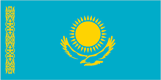
General
Kazakhstan, the ninth-largest country in the world, borders the Russian Federation, China, Turkmenistan, Uzbekistan and the Kyrgyz Republic. It covers 2.7 million square kilometres and had a population of approximately 20.3 million people in 2025. In 1998, the capital was moved from the south-eastern city of Almaty to the northern city of Astana.
Ethnic Kazakhs make up approximately 71.5 per cent of the population, alongside Russian, Uzbek and other minority communities. While Kazakhstan is a secular country, approximately 70 per cent of the population is Muslim, predominantly Sunni, and 17 per cent Christian. Kazakh is the official state language; however Russian is widely used in government, business and public life.
Much of the territory of present-day Kazakhstan was annexed by the Russian Empire over the course of the 18th and 19th centuries. It became an autonomous Soviet republic in 1920 and gained independence following the dissolution of Union of Soviet Socialist Republics (USSR) on 16 December 1991.
Political overview
President Kassym-Jomart Tokayev succeeded Kazakhstan's first President, Nursultan Abishuly Nazarbayev, on 20 March 2019. Under the initial transition arrangement, Tokayev held the presidency while Nazarbayev retained leadership of the ruling party and his position as Chair of the Security Council.
Protests triggered by rising fuel prices in January 2022 escalated into nationwide unrest, prompting the deployment of forces from the Russia-led Collective Security Treaty Organization (CSTO). The violence resulted in at least 238 deaths and was followed by limited independent investigation and accountability. President Tokayev has since consolidated authority and launched a series of political and constitutional reforms under a 'New Kazakhstan' agenda.
Kazakhstan remains a presidential republic where power rests almost entirely with the President, who is elected by direct vote to a single, non-renewable seven-year term. Constitutional reforms in 2026 abolished the country's former bicameral legislature and replaced it with a unicameral parliament comprising 145 seats, with all members popularly elected to serve five-year terms. The new framework introduced the role of a Vice President, appointed by the President, to secure executive succession.
Kazakhstan maintains close political, economic and security ties with Russia and China, while actively fostering cooperation within Central Asia and with western partners. The country is a member of the United Nations, the Organization of Turkic States, Organisation of Islamic Cooperation, Shanghai Cooperation Organisation, Euro-Atlantic Partnership Council, the Eurasian Economic Union; Commonwealth of Independent States, Collective Security Treaty Organisation and the Organisation for Security and Cooperation in Europe and the World Trade Organization. It is active in these multilateral fora.
Economic overview
According to the World Bank, Kazakhstan is an upper-middle-income country with a GDP per capita of US $14,692 (2025). The resources sector underpins Kazakhstan's economy, with oil its principal export, followed by natural gas, mineral commodities and agricultural exports.
Kazakhstan is the world’s largest producer of uranium and ranks among the top 15 countries globally for proven oil and natural gas reserves. The country possesses mineral wealth and is a top 10 producer of tungsten, copper, zinc, and chromium, alongside significant reserves of gold, coal, lithium, and manganese. Kazakhstan is prioritising geological exploration and investment in the extraction, processing and higher-value downstream production of critical minerals.
There are opportunities for Australian business to invest in Kazakhstan, including in the Mining Equipment, Technology and Services sector, education, agriculture and infrastructure.
Australia's relationship with Kazakhstan
Australia has non-resident accreditation to Kazakhstan from the Australian Embassy in Moscow and has an Honorary Consulate in Almaty. Kazakhstan's Ambassador to Australia is resident in Singapore. Kazakhstan also has Honorary Consuls in Perth and Melbourne.
According to the Australian Bureau of Statistics, 3,060 Australian residents declared they were born in Kazakhstan (2025).
Senior Officials Talks were held with Kazakhstan in 2012, 2015, 2017, and 2021, attended by Kazakh and Australian representatives in Canberra and Astana.
While Kazakhstan is Australia's leading trading partner in Central Asia, our bilateral trade is modest. Australia's two-way goods and services trade with Kazakhstan in 2025 was worth A$232.4 million. Australia's exports to Kazakhstan, worth 61.2 million, were primarily education-related travel, engineering and mining equipment, scientific instruments, and specialised machinery. Imports from Kazakhstan, worth 171.2 million, were dominated by gold, recreational travel, with smaller imports of pig iron and vehicle parts.
The Kazakh Government's 'Bolashak' International Scholarship Program has seen approximately 75 scholarship recipients to study in Australia each year since 2007.