
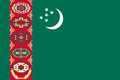
General
Turkmenistan covers an area of 488,100 square kilometres and borders Kazakhstan, Uzbekistan, Afghanistan and Iran, with a coastline along the Caspian Sea. It has a population of 7.7 million. According to official estimates, Turkmens account for around 85 per cent of the population, followed by Uzbeks (5 per cent), Russians (4 per cent) and other minority groups.
Turkmenistan's official language is Turkmen, however Russian and Uzbek are also widely spoken. Cyrillic script was replaced by the Latin alphabet in 1993, and Russian lost its status as the language of inter-ethnic communication in 1996.
Approximately 93 per cent of Turkmenistan's population is Sunni Muslim and six per cent Christian. Religious practices are often intertwined with Turkmen cultural traditions, including celebrations, rituals and social customs.
Political overview
Turkmenistan declared independence on 27 October 1991. It is a presidential republic, with the President serving as both head of state and head of government. Despite early commitments to democratic and market-based reforms, Turkmenistan developed into a highly centralised political system under its first president, Saparmurat Niyazov, who remained in office until his death in 2006.
Gurbanguly Berdimuhamedow became the country's second president in 2007 and was succeeded by his son, Serdar Berdimuhamedow, in 2022. However, Gurbanguly Berdimuhamedow continues to hold considerable influence as Chairperson of the People's Council of Turkmenistan and 'National Leader of the Turkmen People'. The People's Council is designated the supreme representative body of state authority, and its chairperson is regularly received by foreign heads of state.
Turkmenistan's foreign policy emphasises neutrality and peaceful coexistence with neighbouring states.
Economic overview
Turkmenistan's GDP was USD 49.8 billion in 2025, with GDP per capita USD 6,540 (World Bank). The public sector plays a dominant role in economic activity and private sector development. The Turkmenistan economy is heavily dependent on the production and export of natural gas, fertilisers, oil, petrochemicals and textiles.
Turkmenistan is a resource-rich nation, holding approximately 10 per cent of global proven global natural gas reserves (the fourth largest in the world). It exports the majority of its gas to China and smaller volumes to Uzbekistan and Kazakhstan. Turkmenistan is seeking new export markets for its hydrocarbon reserves.
Australia's relationship with Turkmenistan
Australia and Turkmenistan have a modest economic relationship. In 2025 Australia’s exports to Turkmenistan were valued at $6.4 million, led by electrical and telecommunications equipment and education-related travel. Imports from Turkmenistan were limited, totalling $0.5 million and consisting primarily of fertilisers.
Australia established diplomatic relations with Turkmenistan in May 1992. The Australian Ambassador to the Russian Federation holds non-resident accreditation to Turkmenistan. Turkmenistan's Ambassador to Japan holds non-resident accreditation to Australia.