

1.1(9) Trade development and policy coordination
Overview
The global economy strengthened in 2013, with growth for the year reaching 3 per cent. The Australian economy was in transition, rebalancing from growth led by investment in resources to broader-based drivers of activity. Improving global economic conditions helped boost Australia’s trade and investment and total trade reached over $647 billion in 2013. Foreign investment in Australia (stocks) was 11.3 per cent higher from the previous year and Australian investment abroad (stocks) also grew significantly.
In support of Australia’s 2014 G20 presidency, the department worked with the Department of the Prime Minister and Cabinet, Treasury and other agencies, to promote policies for global economic growth and job creation. The department maximised Australia’s trade and economic opportunities through active participation in APEC and the OECD.
The department supported the establishment of the Trade and Investment Policy Advisory Council (TIPAC) in June 2014 to provide Minister Robb with expert advice and unique perspectives on trade and investment issues across key sectors in the Australian economy.
The department monitored the global economy and provided regular analysis of the outlook as well as advice on trends, risks and opportunities to advance Australia’s economic interests. Focusing on Australia’s major trading partners, we assessed the impact of geopolitical, international financial and commodity markets and domestic policy developments on Australia, global economic growth and financial stability. The department also informed wider policy considerations through the provision of economic analysis of specific geopolitical events.
Figure 15: Total foreign investment in Australia, 2013
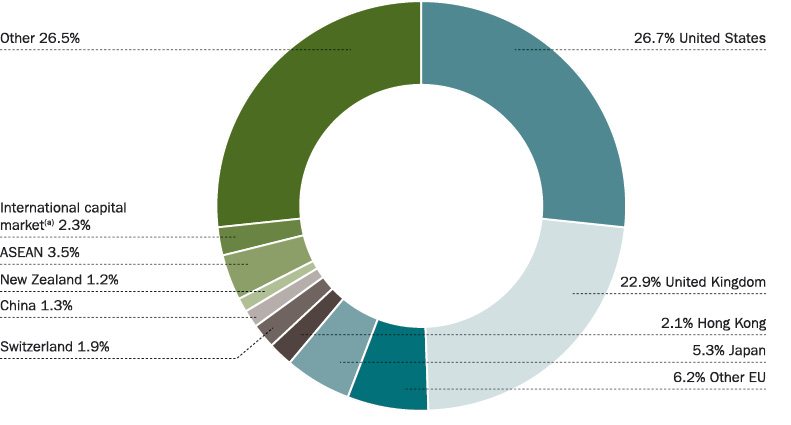
(a) Includes the Euro Bond. Market.
Source: ABS catalogue 5352.0 – International Investment Position, Australia: Supplementary Statistics, 2013.
Figure 16: Total Australian investment abroad, 2013
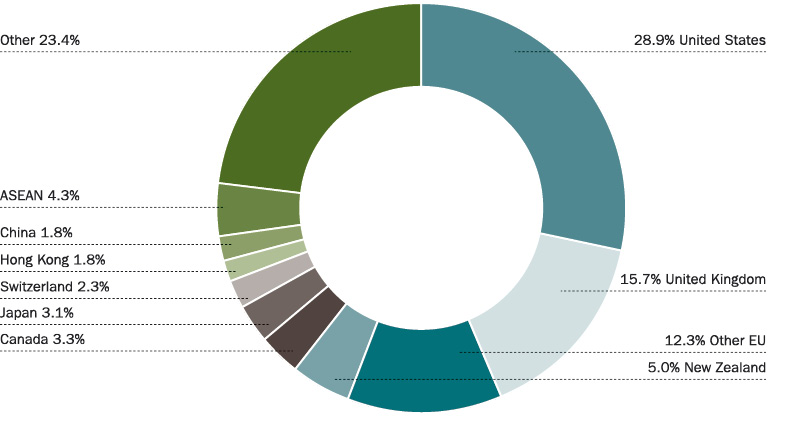
Source: ABS catalogue 5352.0 – International Investment Position, Australia: Supplementary Statistics, 2013.
Investment
Mr Robb’s role as Investment Minister is to encourage productive foreign investment into Australia, support Australian businesses to develop international markets for their products, including through investment overseas, and oversee investment policy as it relates to bilateral, regional/plurilateral or multilateral agreements.
Investment is a key component of the Government’s economic diplomacy agenda, and the department supported the Government’s investment objectives in various ways. Posts and Canberra divisions provided support to Australian investment proposals and promoted Australia as an attractive investment destination. We provided advice on the Industry Investment and Competitiveness Agenda Taskforce, and analysed trends and data to inform investment-related policy. We also led negotiations on investment-related chapters in bilateral and regional free trade agreements being negotiated (China, the Regional Comprehensive Economic Partnership, and the Trans-Pacific Partnership), as well as those concluded with the Republic of Korea and Japan. We provided legal advice on the interpretation and application of existing investment treaty obligations.
G20
In the lead up to and during the first half of Australia’s presidency, the department provided policy analysis and recommendations on trade, development and energy issues. Our advice focused on practical actions in support of the G20’s objectives to lift economic growth and employment outcomes and to build global economic resilience. We supported portfolio ministers in their G20 advocacy, including through events and speeches. The department used our G20 special representative and network of overseas posts to lead broader international outreach on the role and agenda of the G20, particularly to non-members.
We pressed members to commit to actions that would boost trade and contribute to lifting economic growth across the G20 by more than 2 per cent above the current trajectory over the next five years. We encouraged countries to look at domestic initiatives that could lower the cost of doing business, improve regulation and liberalise trade and worked across government to identify Australian actions to the same ends.
The department worked in support of Mr Robb’s hosting of the G20 Trade Ministers meeting on 19 July 2014 in Sydney, which will provide an opportunity to advance Australia’s G20 and broader trade agenda.
The department led the policy agenda and management of the G20 Development Working Group, which works to ensure that developing countries can participate in, and benefit from, the G20’s employment and economic growth agenda. We shaped consensus around practical actions in five priority areas of investment: infrastructure; taxation (domestic resource mobilisation); access to formal financial services (financial inclusion) and remittances; food security; and human resource development.
)%20-%20G20%20outreach.jpg)
Special Representative to the G20, Daniel Sloper (left), talks with the Secretary General of the International Organisation for the Francophone Countries, Abdou Diouf, as part of the G20 outreach program, Paris, 12 February 2014. [Cyril Bailleul/OIF]
Outreach is a central element of Australia’s responsibilities as G20 host, to ensure that non-member views are also considered by the G20. In 2013–14, through our overseas network and G20 special representative, the department’s advocacy and outreach activities explained the G20’s work, its link to growth in the global economy and employment, and provided opportunities to listen to views on the group’s agenda. We conducted regular outreach with formal G20 engagement groups and with counterparts in our region and beyond. Through 2014, we engaged closely with Turkey, as the incoming G20 2015 president, to build continuity and to support the implementation of outcomes from the Brisbane Summit in November.
APEC
APEC is the primary forum for deepening Australia’s economic integration with the Asia–Pacific region, encouraging unilateral reform and facilitating practical collaboration between officials, business and academic experts in support of open and transparent markets, regulatory cooperation and sustainable growth. APEC’s 21 member economies account for over 70 per cent of Australia’s total trade. Mr Sam Gerovich was appointed as Australia’s Ambassador for APEC in September 2013.
Australia helped shape two key APEC deliverables in 2013—on private financing of infrastructure and education cooperation. APEC Leaders agreed in October in Bali to establish a pilot Public Private Partnership (PPP) centre for infrastructure in Indonesia under the guidance of a PPP Experts Advisory Panel. On cross-border education, Australia led the development of a work plan to boost student, provider and researcher mobility in line with Leaders’ instructions in 2012. Under the plan, impediments to provider mobility will be addressed and a database of scholarships to support APEC’s target of one million university-level student exchanges per year by 2020 will be established.
We convened a seminar of officials, business practitioners and academic experts to identify good practice regulation for trade and investment in higher education services. This event was part of a broader seminar series led by Australia aimed at promoting market-oriented services reforms in the region. Australia also led a workshop in June to assist APEC developing economies implement their structural reform plans, including competition policy reform, infrastructure investment and good regulatory practices.
On emergency preparedness, we spearheaded work aimed at mitigating the economic impact of disasters through business continuity planning, particularly for small and medium-sized enterprises. We published a report to promote greater awareness of terrorist financing risks among non-financial businesses and professions. On financial market integration, we collaborated with Treasury to advance the Asia Region Funds Passport initiative, a scheme that will facilitate greater cross-border trading of financial products among participating APEC economies (Australia, Korea, New Zealand, Philippines, Singapore, and Thailand).
The department worked closely with Papua New Guinea to support its preparations to host APEC in 2018. We hosted a delegation of senior officials in April in Canberra and Brisbane to discuss PNG’s plans for APEC and share Australia’s experience hosting major international meetings including security, logistics and policy issues.
The department supported the participation of the Ambassador for Women and Girls in the annual APEC Women and Economy Summit. The ambassador advocated Australia’s priorities of addressing violence against women and girls, supporting women’s leadership and promoting women’s economic empowerment. Ms Stott Despoja announced Australia’s initiative to improve the capacity of trade promotion authorities in the region to assist women exporters. (See 1.1(10).)
)%20-%20Trade%20website%20tweet.jpg)
The department contributed funding to improve the APEC Secretariat’s management and effectiveness, underpin economic policy research and support Secretariat projects benefiting developing economies.
We supported Mr Robb’s participation in the APEC Ministers Responsible for Trade (MRT) meeting in Qingdao in May 2014. The MRT issued a statement of support for the multilateral trading system, including a call for early implementation of the WTO Agreement on Trade Facilitation and an extension of the standstill on protectionism from 2016 to 2018. Trade Ministers agreed on actions to advance APEC’s goal of a Free Trade Area of the Asia–Pacific and on a strategic blueprint for strengthening cooperation on global value chains. Mr Robb announced an Australian contribution of $500 000 to APEC’s capacity building work to promote faster and less costly movement of goods along regional supply chains, in line with the WTO Agreement on Trade Facilitation.
MIKTA
The department played a key role in the establishment of a new mechanism for strengthening bilateral ties and increasing consultation and cooperation among a group of significant and growing economies: Mexico, Indonesia, Korea, Turkey and Australia. These ‘MIKTA’ countries all share a similar perspective on many international issues including trade liberalisation. We supported the Foreign Minister’s participation in MIKTA meetings in New York and in Mexico City and will carry forward the agreed work program from those meetings.
OECD
The OECD plays a leading role in developing strategies to combat tax avoidance and evasion, a high priority for Australia’s G20 presidency. The organisation’s analytical work on trade, employment and investment is also highly relevant for the G20.
We strengthened ties with the OECD, including through support for Mr Robb’s participation in the OECD Ministerial Council Meeting (MCM) in Paris in May 2014. At a meeting of WTO trade ministers in the margins of the MCM, the Minister urged members to quickly implement the WTO Trade Facilitation Agreement, open trade and boost economic growth. He also noted the importance of policies that help business connect to the global economy and the vital role of the services sector in facilitating international trade. We welcomed the launch at the MCM of the Southeast Asia Regional Programme, largely in response to Australian advocacy on the need for closer cooperation between the OECD and the region.
We also encouraged continued strong engagement by the OECD with other important economic partners, including Brazil, China, India, Indonesia and South Africa.
Trade finance
The department works closely with other government agencies in providing policy advice on the Export Finance and Insurance Corporation (EFIC), a statutory body that offers trade finance and insurance services to support Australian exporters. The restoration of EFIC’s capital base in the 2014–15 Budget will deliver an additional $200 million for export assistance to support Australian exporters.
The department represented Australia in the OECD’s Working Party on Export Credits and Credit Guarantees and at the negotiations led by the International Working Group on Export Credits on sectoral-based text for new guidelines on trade finance.
Economic Diplomacy
The use of Australia’s diplomatic assets, including the aid program, to build Australia’s prosperity and global prosperity through increasing trade, supporting economic growth, encouraging investment and assisting business.
The department is leading the implementation of the Government’s economic diplomacy agenda, working with portfolio partners (Austrade, ACIAR, Tourism Australia, EFIC) and key economic agencies in our overseas posts.
The department’s economic diplomacy work includes concluding free trade agreements, supporting Australian business overseas, encouraging private sector-led growth in developing countries, finding new investors in Australia, promoting tourism and building linkages in agricultural research.
This builds on our longstanding efforts to strengthen Australia’s economy and international competitiveness, both through Australia’s bilateral and regional relationships and engagement with international economic forums.
Case Studies
Free trade agreements
Our network of free trade agreements supported global and regional and bilateral trade liberalisation by removing tariffs and other barriers to cross-border trade. Agreements with ASEAN, Chile, Malaysia, New Zealand, Singapore, Thailand and the United States provided Australian producers with a competitive advantage in these markets, which between them cover 28 per cent of Australia’s total trade. Recently negotiated agreements with the Republic of Korea and Japan will help Australian exporters remain competitive while delivering savings to Australian consumers on high-value imports, including cars and consumer electronics.
Agricultural trade and Indonesian food security
The department supported growth in agricultural trade with Indonesia and contributed to Indonesia’s food security agenda. Advocacy programs run from the Jakarta embassy are positioning Australia as a food supplier of choice. Through the aid program we worked with agribusinesses to improve farmer practices and strengthen access to agricultural markets. The ACIAR’s initiatives helped enhance productivity and food quality. In the red meat and cattle sector, the Indonesia–Australia Partnership for Food Security, a joint government and industry initiative, also supported increased investment and agricultural cooperation.
Promoting investment and tourism with the United States and India
We promoted Australian investment and tourism opportunities in established and emerging markets. G’Day USA, supported by the department, Austrade, Tourism Australia, state and territory governments, Qantas and other Australian businesses, grows bigger every year—in 2013 reaching over 100 million people in the United States and Australia through targeted media engagement. In India, we worked with Tourism Australia and state tourism offices to promote Australia as a preferred leisure destination for the country’s burgeoning middle class. Tourism Australia’s India 2020 Strategic Plan set a foundation for the future when long haul leisure travel by middle-class Indians becomes more common. It also highlighted the potential from cricket tourism.
Private sector assistance and financial inclusion in the Pacific
Driving private sector growth and improving access to financial services for our development country partners is a key priority. Around 80 per cent of Pacific Islanders do not have access to basic financial services, like a bank account. We have used the aid program to provide over 500 000 people, including over 200 000 women, with access to mobile money in Papua New Guinea, Vanuatu, Samoa and Fiji.
Through the Pacific Private Sector Development Initiative we reformed business legislation in Samoa, Solomon Islands and Tonga, doubling the number of newly incorporated companies. In Solomon Islands, registering a business now takes one day and the country has jumped 38 places on the World Bank’s Ease of Starting a Business indicator.
Economic diplomacy and competition policy
Under the framework of the ASEAN–Australia–New Zealand FTA, the department worked to help strengthen competition in the region. Together with the Australian Competition and Consumer Commission, ASEAN and New Zealand, we undertook a major capacity building initiative—the Competition Law Implementation Program—to support ASEAN member states to introduce and implement national competition laws and policies in line with ASEAN’s regional economic integration objectives. Expanding regional cooperation on competition is a priority as the positive benefits flowing from removal of barriers to trade and investment can be negated by anti-competitive practices such as the misuse of market power to lock out market entrants from new business opportunities.
International tourism policy and engagement
As part of the Government’s economic diplomacy agenda, the department worked to strengthen bilateral tourism relationships with major source countries. The department increased engagement in key multilateral tourism forums, such as the APEC Tourism Working Group and the OECD Tourism Committee, and promoted positions in line with Australia’s ‘Tourism 2020’ objectives. (See also 1.14.)
Working with business
The department collaborated closely with the Australian business community on trade, investment and deregulation issues and supported the new 20-member Trade and Investment Policy Advisory Council (TIPAC). The council, which convened for the first time in June 2014, is an important source of advice to the Government as it advances its trade and investment agenda. TIPAC’s members include industry leaders from the key growth sectors of resources and energy, food and agribusiness, banking and finance, international education, tourism and hospitality and health and medical research. The council discussed trade and investment opportunities, cutting red and green tape and leveraging Australia’s natural advantages to attract more foreign investment.
Drawing on its international network, the department contributed to two white paper processes—Developing Northern Australia and Agricultural Competitiveness. These papers will provide a policy platform to support the growth of Australian businesses in northern Australia while identifying ways to boost agriculture’s contribution to economic growth and productivity.
)%20-%20TIPAC%20meeting.jpg)
Secretary, Peter Varghese AO (seated: second left), with Minister for Trade and Investment, Andrew Robb AO (seated: third left), with officials, academics and business leaders at the first TIPAC meeting, Canberra, 6 June 2014. [AUSPIC/Howard Moffatt]
The department also supported private sector and infrastructure development initiatives, throughout the Asia–Pacific region, recognising that these are key to economic growth and a proven pathway to development. (See also Aid overview and outlook.)
Sustainable mining
The department reinforced Australia’s position as a leader in sustainable mining through initiatives to support international governance in the resources sector. This included Australia’s support for the Extractives Industry Transparency Initiative and the International Mining for Development Centre. The department’s engagement with resource-rich developing countries in the Indo–Pacific region helped to strengthen relationships between government and private sector, improve governance, standards and revenue management and build technical skills (see 1.9(4)).
Figure 17: Direction of Australia’s exports, 2013 (a) (b)
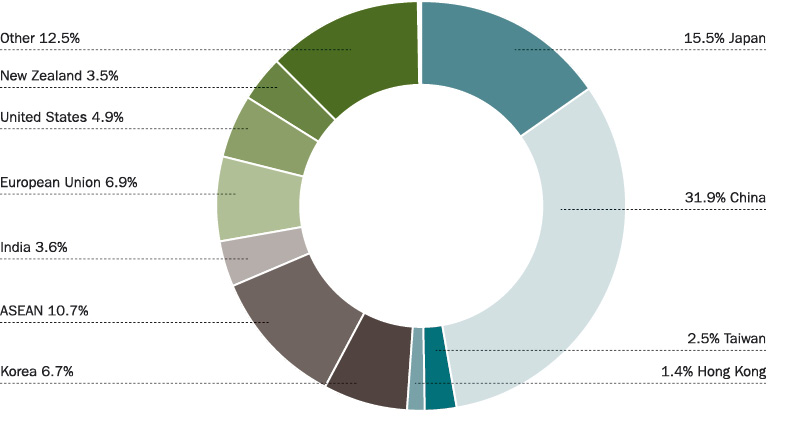
(a) Goods data on a recorded trade basis, services data on a balance of payments basis.
(b) Includes actual export totals for Argentina, Belgium, Brazil, Canada, China, France, Germany, India, Indonesia, Italy, Japan, Korea, Malaysia, Netherlands, New Zealand, Saudi Arabia, South Africa, Taiwan, Thailand, United Kingdom and United States. Excludes selected confidential export commodities from other partner country totals and country groups from June 2013 onwards.
Based on DFAT STARS database, ABS catalogue 5368.0.55.004 and ABS unpublished data.
Outlook
After a bumpy start to 2014, the global economic recovery is expected to continue, led by improvements in advanced economies and solid growth in emerging and developing economies. However, the outlook remains fragile and there are appreciable downside risks. These include: elevated geopolitical risks associated with the situation in Ukraine and Russia and in Iraq; the ongoing impact of crisis legacies in advanced economies and capacity constraints in emerging markets; risks associated with the normalisation of monetary policy in advanced economies; the possibility of a long period of very low inflation in the euro area; and unexpected deviations in China’s growth trajectory.
The department will continue to engage with Turkey, as the incoming G20 2015 president, to build continuity and support the implementation of outcomes from the Brisbane Summit in November 2014. We will work with APEC economies in the pursuit of further trade liberalisation, regulatory coherence, stronger supply chains and enhanced people-to-people linkages.
In leading the Government’s economic diplomacy agenda, the department will help deliver greater prosperity for Australia, the region and the world by implementing activities that support the four pillars of trade, growth, investment and business.

