

Asia-Pacific Economic Cooperation (APEC) is a forum of 21 Asia-Pacific economies. APEC's member economies are home to around 3 billion people and make up almost 60 per cent of global GDP. APEC partners make up over 73 per cent of Australia's total trade in goods and services. In 2024-2025, total trade in goods and services with APEC economies accounted for almost AUD $1 trillion ($933.2 billion). In 2025, APEC partners* brought $2.3 billion in foreign investment (stocks) into Australia. Closer regional economic integration contributes to Australian economic growth and prosperity.
(*excluding Chile and Peru, as figures are not published)
About APEC
Australia was a founding member of APEC in 1989.
APEC was formed to encourage a growing and prosperous regional economy through:
- trade and investment liberalisation and facilitation – at the border, across the border and behind the border
- reduced costs of cross-border trade to assist businesses
- economic and technical cooperation
- exchanges of best practice information on trade and investment
- simplified regulatory and administrative processes
- improved institutional capacity to implement and take advantage of the benefits of trade and investment reform.
APEC's work is guided by the APEC Putrajaya Vision 2040, which is for an open, dynamic, resilient and peaceful Asia-Pacific community by 2040. This will be achieved by pursuing three economic drivers:
- trade and investment
- innovation and digitalisation
- strong, balanced, secure, sustainable and inclusive growth.
In 2021, the 21 APEC member economies developed the Aotearoa Plan of Action, a plan for implementing the Putrajaya Vision 2040.
APEC decisions are reached by consensus, and commitments are made on a voluntary basis.
APEC members
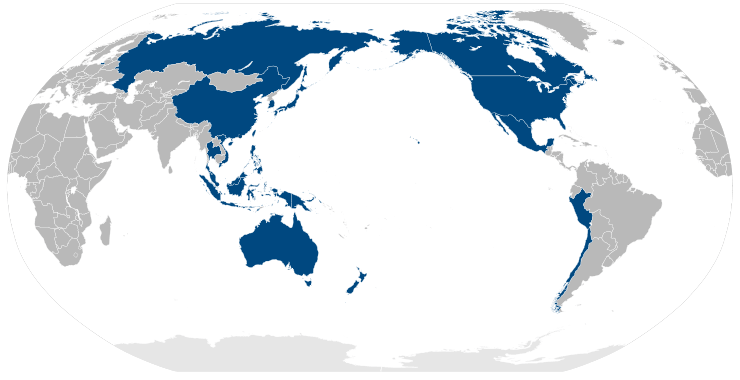
APEC's 21 member economies are:
- Australia
- Brunei Darussalam
- Canada
- Chile
- Hong Kong, China
- Indonesia
- Japan
- Malaysia
- Mexico
- New Zealand
- Papua New Guinea
- People's Republic of China
- Peru
- Republic of Korea
- The Republic of the Philippines
- The Russian Federation
- Singapore
- Chinese Taipei
- Thailand
- United States of America
- Vietnam
Recent APEC Leaders' Declarations and Ministerial-level Statements
- 2026 APEC Ministers Responsible for Trade Joint Statement
- 2025 APEC Leaders’ Gyeongju Declaration
- APEC Ministerial Statement - 1 November 2025
- APEC Ministers Responsible for Trade Joint Statement – 16 May 2025
- 2024 APEC Leaders' Machu Picchu Declaration
- APEC Ministerial Statement – 16 November 2024
- APEC Ministers Responsible for Trade Joint Statement 2024 – 18 May 2024
Statements prior to 2024 can be found on the APEC website.
Hosting APEC
Each year a different member economy hosts the major APEC meetings. This year’s and future hosting economies are:
- 2026 – China
- 2027 – Vietnam
- 2028 – Mexico
- 2029 – TBC
- 2030 – Singapore
- 2031 – Japan
- 2032 – Chile
- 2033 – Papua New Guinea
- 2034 – Peru
Australia in APEC
Through APEC, Australia works to drive economic growth within the region by promoting the advancement of regional economic integration and making progress on achieving free and open trade and investment in the Asia-Pacific.
Australia supports economic cooperation and capacity-building activities to benefit APEC developing economies by:
- funding projects that target APEC priorities
- supporting APEC economic policy research and analysis
- supporting project management reforms within the APEC Secretariat to improve APEC effectiveness.
Australia's 2026 APEC Priorities
Australia's 2026 APEC priorities include:
- Building a resilient region
- Advancing paperless trade
- Advancing APEC’s services competitiveness agenda
- Supporting APEC’s inclusive growth agenda
- Advancing the Free Trade Area of the Asia-Pacific (FTAAP) Agenda
- Enhancing the region’s investment environment
- Strengthening APEC governance, financial sustainability and communications
APEC Study Centre Consortium (ASCC)
The APEC Study Centre Consortium (ASCC) is a group of more than 50 institutions undertaking research and academic discussions to support APEC goals for regional economic integration. Australia has two APEC Study Centres:
- APEC Study Centre – Griffith University, Queensland
- APEC Study Centre – RMIT, Victoria.
APEC and business
The APEC Business Advisory Council (ABAC) was formed in 1995. Each of the 21 member economies has up to three business representatives appointed by APEC Leaders. The annual APEC CEO Summit and regular events give APEC Business Advisory Council (ABAC) members opportunities to provide recommendations to APEC Leaders on key regional issues. Further details on ABAC Australia and its business representatives can be found on the ABAC Australia website.
ABAC reports
- Bridge Business Beyond – Report_to_APEC_Economic_Leaders_2025 [PDF]
- People Business Prosperity – Report to APEC Leaders 2024 [PDF]
- Equity Sustainability Opportunity – Report to APEC Leaders 2023 [PDF]
- Embrace, Engage, Enable – Report to APEC Leaders 2022 [PDF]
- People, Place and Prosperity – Report to APEC Leaders 2021 [PDF]
- 2021 Mid-Term review of the APEC Services Competitiveness Roadmap [PDF]
- Improving Resiliency for MSME’s Promoting Timely Payments [PDF]
- Artificial Intelligence in APEC: Progress, Preparedness and Priorities [PDF]
- Previous ABAC reports
Australia's APEC Support Program (AASP)
Australia's APEC Support Program (AASP) provides technical cooperation and targeted capacity-building support to ODA eligible APEC developing economies to enhance their capacities to adopt and implement inclusive, sustainable and growth-generating economic and trade policies.
AASP supports projects in developing APEC economies including Papua New Guinea, Indonesia and Viet Nam on a range of key economic issues such as: services and structural reform, women's economic empowerment, paperless trade, food safety and Indigenous business, among others. Some examples include:
Case study: Marine Debris

This project contributed to awareness raising and capacity building of developing economies in APEC to participate in regional and global efforts to promote investment, trade, and market creation in industries and activities involved in marine debris management, prevention, and clean-up.
Download the full case study
Case study: Growing Indigenous Business Through Trade

Australia's Growing Indigenous Business Through Trade project successfully enhanced Indigenous entrepreneurs' ability to engage in international trade through capacity-building, knowledge sharing, networking, and practical support.
Download the full case study
- Growing Indigenous business through trade [DOCX 22 KB]
- Growing Indigenous business through trade [PDF 927 KB]
Case study: Women in Science, Technology, Engineering and Mathematics (STEM)
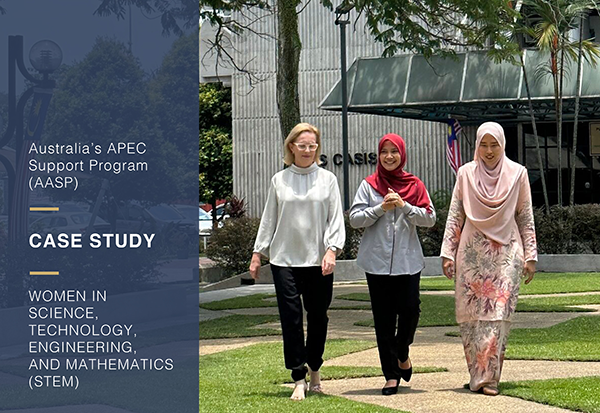
This project supported the mobility of women researchers in STEM and facilitated knowledge transfer between Australia and developing APEC economies, which has led to enhanced capabilities in the targeted STEM fields in the respective developing economies. The project demonstrated Australia's strong commitment to promoting women in STEM for regional economic development.
Download the full case study
- Women in Science, Technology, Engineering and Mathematics [DOCX 30 KB]
- Women in Science, Technology, Engineering and Mathematics [PDF 842 KB]
Case study: Supporting APEC Professional Services and Mutual Recognition Agreements (MRAs)
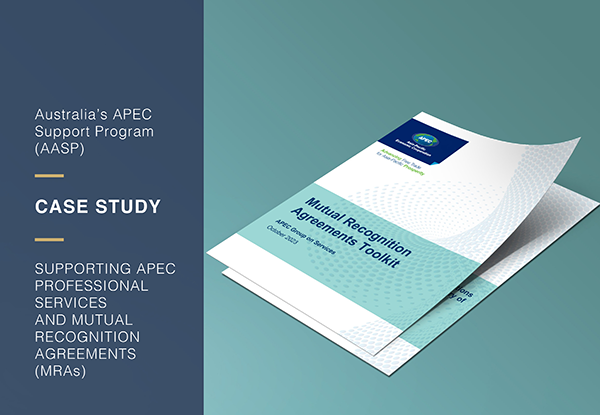
This project built on Australia's long-standing leadership in Mutual Recognition Agreements (MRAs) in the APEC region. The project aimed to enhance mobility of professional services suppliers across APEC economies, including developing economies, through MRAs, and included the development of a useful toolkit on MRAs.
Download the full case study
- Supporting APEC Professional Services and Mutual Recognition Agreements [DOCX 32 KB]
- Supporting APEC Professional Services and Mutual Recognition Agreements [PDF 638 KB]
Australia’s APEC Support Program Independent Monitoring and Evaluation
A mid-term review of the Australia’s APEC Support Program (AASP) was commissioned in 2024 to measure the effectiveness of the projects implemented between June 2022 and July 2024. The review assessed the overall performance of the first two years of the AASP as effective and efficient, and identified areas for improvement over the remaining period. Most of the recommendations have already been actioned or are underway, and DFAT has committed to implementing a number of recommendations through the design process of the next phase of the program.
Download the full report
- Mid-Term Review of Australia's APEC Support Program [DOCX 400 KB]
- Mid-Term Review of Australia's APEC Support Program [PDF 1.5 MB]
Download the management response
- AASP Independent Monitoring and Evaluation - Management response [DOCX 29 KB]
- AASP Independent Monitoring and Evaluation - Management response [PDF 239 KB]
Key publications
- Key APEC publications
- Bangkok Goals on the Bio-Circular-Green Economy
- The Aotearoa Plan of Action
- Bogor Goals
- APEC Leaders' Declarations
- APEC Annual Ministerial Meetings
APEC Business Travel Card (ABTC)
The Asia Pacific Economic Cooperation (APEC) Business Travel Card (ABTC) facilitates short-term business travel within the APEC region by streamlining the entry process into APEC economies.
Successful applicants from fully participating economies are issued with a virtual five-year card that serves as the entry authority to other fully participating economies that have granted pre-clearance for short-term business travel of up to 60 or 90 days. The card also enables holders to fast-track immigration processing at each economy’s major international airports.
For more information about the eligibility criteria for Australian applicants, and to determine if you are eligible for an ABTC, please refer to Business Travel Card for Australian citizens.
The APEC Business Travel Card is managed by the Department of Home Affairs, for further inquiries please contact ABTC@homeaffairs.gov.au.