

1.9(1) South and West Asia
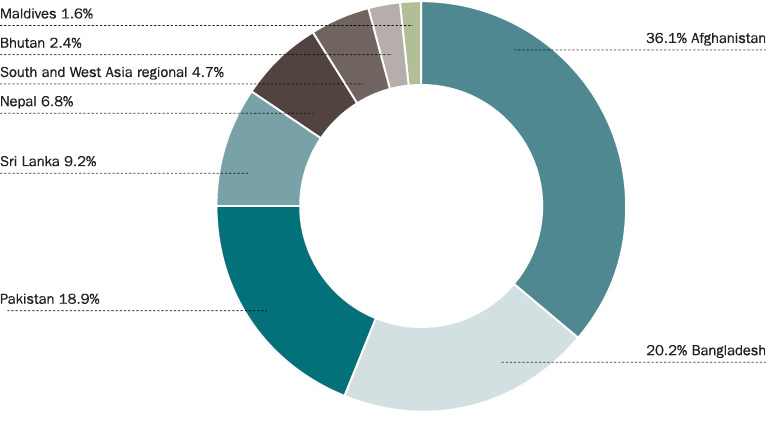
Figure 23: Estimated department ODA to South and West Asia, 2013–14
Afghanistan
Country statistics*
*data sources for statistics used in this section: HDI–UNDP; GDP–World Bank; Australian ODA–OECD/DAC
| Item | Measure |
|---|---|
| HDI rank (2013) | 169 |
| GDP per capita, PPP (current int’l $) (2013) | 1990 |
| Australian ODA as a % of total ODA (2012) | 3.5% |
In 2013–14, the department managed bilateral aid of $130.8 million to Afghanistan. Other assistance through regional and global programs brought our total ODA to an estimated $138.4 million. Afghanistan is a difficult environment in which to deliver aid. Ongoing conflict, corruption and weak capacity constrain development efforts. We worked closely with the Afghanistan Government and the international community to deliver a program focused on health, education (particularly for girls), infrastructure, mine clearance and public financial management.
The department’s work helped to significantly increase school enrolments and improve access to basic health, particularly for pregnant women and children. Our programs supported family planning, antenatal care, postnatal care and vaccinations, and helped to deliver health services to more than 1 825 000 Afghans. We contributed to the rehabilitation and maintenance of more than 12 800 kilometres of rural roads.
Support for the construction of the first strategic grain reserve facility in Kabul helped to address food security challenges. The department also supported mine clearance activities.
Our public service training activities reached 720 civil servants and contributed to increased expenditure on development by four key ministries.
Bangladesh
| Item | Measure |
|---|---|
| HDI rank (2013) | 142 |
| GDP per capita, PPP (current int’l $) (2013) | 2557 |
| Australian ODA as a % of total ODA (2012) | 4.1% |
The department managed bilateral aid of $61.4 million to Bangladesh. Other assistance through regional and global programs brought our total ODA to an estimated $77.6 million. The department’s work provided support for education and increased economic opportunities for the poor, especially women.
To maximise the impact of our aid in education, the department supported non-government partners to deliver immediate high quality results and worked with government to improve the quality of service delivery systems over the long term. Our assistance helped 550 000 children enrol in school and trained over 12 000 teachers. (See also 1.1(5).)
%20-%20DAP%20boat%20in%20Bangladesh.jpg)
Counsellor (Development Cooperation) in Dacca, Priya Powell (back, second left), visits a DAP-funded boat school, bringing education to children in inaccessible areas, Sylhet district, Bangladesh, April 2014. [DFAT]
The department supported programs which provide assistance and greater access to services for women. In partnership with the United Kingdom and BRAC (one of the world’s largest NGOs), the department enabled over 112 000 extremely poor Bangladeshis to receive financial assistance and training. We also provided humanitarian services to vulnerable communities and helped 4000 female victims of domestic violence access legal and medical assistance.
We awarded 134 scholarships for postgraduate studies and short courses in Australia and supported Australian Volunteers for International Development to address Bangladesh’s education, livelihood and other development needs. (See also 1.13.)
Staff Profile
Jade Cooper
Graduate Trainee, Canberra
%20-%20Jade%20Cooper.jpg)
I joined the former AusAID in 2013 as a graduate, and have had the privilege of working with and learning from incredibly passionate, knowledgeable and skilled colleagues in the Disability, Law and Justice, South Asia Bilateral and Poverty and Social Transfers sections. Highlights have included coordinating Australian Government input into UN Human Rights Council statements and resolutions, assisting our aid program in Bangladesh design a new social protection program, co-facilitating Mekong Poverty and Social Analysis training, and engaging in scoping missions and analysis of the social inclusiveness of the department’s Mekong investments during a short term mission with the Mekong Regional Hub in Hanoi.
Beyond the work of my sections I have enjoyed the opportunity to engage in a number of roles across the development and foreign policy portfolios, including sitting on the Secretary’s reading pack editorial committee, assisting at a G20 Development Working Group meeting, and co-managing the former InnovAid and now ‘Foreign Ideas’ forum for staff to pitch new and innovative ideas within the department.
Prior to joining the department I worked in the social development sector with UNHCR Japan, UNHCR Malaysia, the Japan Institute of International Affairs and the Commonwealth Human Rights Initiative’s Ghana office.
Pakistan
| Item | Measure |
|---|---|
| HDI rank (2013) | 146 |
| GDP per capita, PPP (current int’l $) (2013) | 4699 |
| Australian ODA as a % of total ODA (2012) | 3.0% |
The department managed bilateral aid of $63.4 million to Pakistan. Other assistance through regional and global programs brought our total ODA to an estimated $72.6 million. Programs focused on economic growth, education and health and particularly promoted gender equality and women’s economic empowerment. (See also 1.1(5).)
%20-%20Pakistan%20food%20security.jpg)
Deputy High Commissioner to Pakistan, Paul Molloy OAM (kneeling), and UN Food and Agricultural Organization (FAO) project leader, David Doolan (left), visit an Australian–FAO supported agricultural development project, teaching women farmers market gardening skills and marketing techniques, Quetta, 10 June 2014. [DFAT]
Our programs helped improve agriculture productivity and the sharing of Australian scientific expertise in water resource management. The department helped promote growth and jobs by providing: 1441 women and 410 men with access to microfinance and business development training; 7600 farmers with better agricultural supplies; and 8500 farmers with training, improved livestock and crop production technologies and practices. Our community infrastructure programs, vocational training activities and Australia Awards (115 awards) were key investments in human resource development.
The department’s contribution to early childhood care and education resulted in additional school enrolments, the building or refurbishing of 991 classrooms and the training of 4538 teachers and administrators. Our programs supported improvements in maternal and child health (33 818 additional births attended by a skilled birth attendant), as well as reductions in child malnutrition (food deliveries to 61 321 malnourished children) and the incidence of blindness (10 000 eyesight saving surgeries).
Sri Lanka
| Item | Measure |
|---|---|
| HDI rank (2013) | 73 |
| GDP per capita, PPP (current int’l $) (2013) | 9736 |
| Australian ODA as a % of total ODA (2012) | 4.5% |
The department worked closely with the Sri Lankan Government, other donors and Australian government agencies to deliver bilateral aid of $31.9 million. Other assistance through regional and global programs brought total ODA to an estimated $35.2 million. The program focused on improving education, livelihoods, access to basic services and community rehabilitation.
The department helped build 345 classrooms, and train school officials and 4600 primary and secondary teachers. We provided 65 Australia Awards in priority areas such as education and sustainable economic development.
The department supported forestry and community rehabilitation programs which increased incomes for more than 4300 poor women and men, and increased access to financial services for over 10 400 Sri Lankans. The provision of new production technologies and training on improved practices and techniques benefited more than 16 700 low-income workers in the agricultural sector.
Reconciliation and accountability remain important to maintaining peace and stability following the conflict in Sri Lanka. The department supported the formation or strengthening of 107 civil society organisations; funded the provision of counselling and support services for 326 women survivors of violence; and strengthened the capacity of local government and non-government organisations to undertake de-mining activities. (See also 1.1(5).)
Regional and other South Asian countries
The department managed $18 million in regional South Asia to promote regional economic integration and cross-border cooperation on water, food and energy security.
We helped to identify priority policy and regulatory trade reforms; strengthen the structure and processes of the South Asian Association for Regional Cooperation; and enhance the capacity of small and medium enterprises in Bangladesh, Bhutan, India, Nepal and Sri Lanka led and owned by women. In line with our economic diplomacy objectives, we also strengthened key institutions such as chambers of commerce.
The department contributed to efforts to close the infrastructure gap in South Asia by funding pre-feasibility work for large scale projects in the transport and energy sectors, such as the Augmentation of Inland Water Transport System project in India. We promoted improved water resource management and enhanced agricultural practices, drawing in Australia’s expertise in these areas through ACIAR and CSIRO.
We delivered $26.1 million in development assistance to Nepal. Programs focused on micro-enterprise development (especially for women), job creation and improving access to quality education and health services. We directly supported additional enrolment of approximately 55,000 students in basic education, delivered more than 300,000 textbooks and provided 39 Australia Awards Scholarships.
In the Maldives, the department contributed $6.3 million in aid. We provided 33 Australia Awards Scholarships, improved the quality of primary and secondary education and supported the UNDP-led Integrated Governance Program. We delivered $9.4 million in aid for Bhutan, awarding 46 Australia Awards Scholarships and helping to build the research capacity of the Royal Institute of Management. (See also 1.1(5).)
Micro Enterprise Development Programme
Since 1998, the Australian-funded Micro Enterprise Development Programme (MEDEP) in Nepal has assisted more than 40 000 female micro-entrepreneurs.
One of those entrepreneurs was Kesha Kumari Damini who received MEDEP support to build her tailoring business. She now chairs the 60 000-member National Micro-entrepreneurs’ Federation of Nepal and is a recipient of the Oslo Business for Peace Awards 2014. The annual award, chosen by a committee of Nobel Laureates in Peace and Economics, is given to individual business leaders who have fostered peace and stability through private enterprise, ethical business practices and creating shared value for society.
The department works with the Nepal Ministry of Industry and UNDP to fund and implement the MEDEP which aims to expand employment opportunities and alleviate poverty of the ultra-poor and socially marginalised. Since its establishment, MEDEP has helped directly create more than 70 000 micro-entrepreneurs and 75 000 jobs, with about 60 per cent going to women.

