

Program 1.10: ODA emergency, humanitarian and refugee program
| Objective |
|---|
To assist developing countries to respond to emergencies and assist refugees. |
| Deliverable | 2013–14 result | Reporting |
|---|---|---|
To assist developing countries to respond to emergencies and assist refugees. |
met | below |
| Key performance indicators | 2013–14 result | Reporting |
|---|---|---|
Achievement of significant development results.* |
met | below & App. 5 |
Demonstrated organisational effectiveness.* |
met | below & App. 5 |
* Program 1.10 KPIs were revised over the course of the 2013–14 reporting period. In the Portfolio Budget Statements 2013–2014, the KPIs of then AusAID program 1.4 included a reference to tier 2 and tier 3 headline results under the Comprehensive Aid Policy Framework (CAPF). The Portfolio Additional Estimates Statements 2013–2014 subsequently indicated that a revised set of KPIs for the Australian Aid Program was under development. Revised performance information was published in the Portfolio Budget Statements 2014–2015. A new aid policy and performance framework was launched on 18 June (see Aid overview). In line with the Requirements for Annual Reports, the department has reported against the former and current performance information for the entirety of the reporting period. Aggregate reporting of performance over the year against tier 2 and tier 3 CAPF headline results is at App. 5.
Overview
In 2013–14, the department provided an estimated $271.5 million to deliver life-saving assistance to over 13 million people.
We responded to emergencies in 24 countries. Our humanitarian assistance helped communities struck by disasters, such as Typhoon Haiyan in the Philippines in November 2013 and flooding in Solomon Islands in April 2014. We also provided critical relief to people who were displaced by conflict, persecution or armed violence across the Indo–Pacific, the Middle East and Africa.
The department used proven and effective partnerships with Australian Government, non-government and international agencies to deliver humanitarian assistance. Through the department’s Humanitarian Partnership Arrangement with Australian NGOs, we worked with CARE, Caritas, Oxfam, Plan, Save the Children and World Vision to deliver emergency responses in the Philippines, Solomon Islands and Syria.
The department supported national governments in the Indo–Pacific to increase their disaster response capacities. For example, an Australian Civilian Corps (ACC) regional deployment over the 2013–14 cyclone season assisted national disaster agencies in Fiji, Tonga, Samoa and Vanuatu to improve contingency and risk management plans.
The department worked with international partners to build the disaster resilience of vulnerable countries in the Indo–Pacific. Our partnership with the UN Office for Disaster Risk Reduction promoted a 35 per cent increase in the number of countries allocating national funding to disaster risk reduction and increased the number of policies and legislation on disaster risk reduction in the region.
%20-%20Mason%20in%20Solomon%20Islands%20relief.jpg)
Emergency Manager, Ray Bojczuk (left), briefs Parliamentary Secretary Brett Mason on the emergency stock, part of Australia’s response to the Solomon Islands flooding, Honiara, 11 April 2014. [DFAT]
Responding to emergencies
The department maintained its capacity to respond quickly to humanitarian emergencies, including through fielding its own Rapid Response Teams to the Philippines and Solomon Islands and through the provision of pre-positioned relief supplies.
We continued our investment in the Australian Medical Assistance Team (AUSMAT)—made up of qualified medical professionals from a national register managed by the Department of Health. AUSMAT delivers emergency medical care in the aftermath of a disaster. We deployed AUSMAT teams as part of Australia’s response to Typhoon Haiyan and also following the Solomon Island floods.
The department also supported a specialist urban search and rescue capability able to be deployed at short notice where large structural collapses have occurred. We maintained two deployable teams from the Queensland Fire and Emergency Services and Fire and Rescue NSW.
The department supported the RedR stand-by deployment capability. Funded by the department, RedR deployed 93 humanitarian specialists (including engineers, protection officers and water, sanitation and public health specialists) to UN humanitarian operations in 18 countries.
Responding to Typhoon Haiyan
Typhoon Haiyan struck the Philippines in November 2013. More than 14 million people were affected, with an estimated four million left homeless. Over 6000 lives were lost.
The department activated its crisis response mechanisms to respond to the consular and humanitarian crises. We issued updated travel advisories and regular travel bulletins alerting Australians to the typhoon and providing advice as to how they might leave affected areas. The department’s emergency call centre handled more than 2800 calls and confirmed the safety of about 2250 Australians.
We pre-positioned two departmental emergency response specialists in Manila and, once the typhoon had passed, deployed disaster response teams to manage the whole-of-government response and to assist the Philippine Government with its coordination and relief operations.
Working with international partners, we evacuated more than 3000 people to safety, including 27 Australians. With the help of the Australian Defence Force, the Attorney-General’s Department and the Department of Health, the department deployed two 37-member AUSMAT teams. AUSMAT established a 50-bed field hospital with surgical capability at Tacloban Airport. The AUSMAT field hospital treated 3281 patients and performed 238 surgeries.
The department provided a total of $38.8 million in immediate humanitarian assistance and continues to support recovery and reconstruction efforts through our development program. In addition, Australia has deployed seven Australian Civilian Corps specialists to support the planning, implementation and coordination of recovery activities.
%20-%20Typhoon%20Haiyan%20AUSMAT.jpg)
AUSMAT officers, Wendy Rogers – operating nurse Royal Darwin Hospital (left), and Tracy Callan – paramedic South Australia, arrive to assist in the relief efforts following Typhoon Haiyan, Philippines, 15 November 2013. [DFAT]
Working with our partners
The department’s humanitarian partnerships are based on mutual commitments to deliver timely humanitarian responses to the most vulnerable and improve the quality of the humanitarian system, with a focus on the Indo–Pacific. By working through high performing international organisations, we are able to extend our global reach to deliver effective humanitarian assistance to those most in need.
UN World Food Programme (WFP)
In 2013–14, the department contributed $112 million towards WFP’s 2013 operations, including $36 million in core funding and $10 million for school feeding programs. WFP is an important partner for the department, operating as it does in 14 countries in the Indo–Pacific, where under-nutrition is prevalent.
We also contributed $10 million to WFP in Pakistan to increase food security and nutrition among vulnerable populations and to deliver technical support to the Pakistani Government to address under-nutrition. In the Philippines, the department provided $5 million to WFP to deliver emergency food assistance in the wake of Typhoon Haiyan. The department’s partnership with WFP supported nutrition assistance in Bangladesh, Bhutan, Cambodia, Laos, Burma and Timor-Leste. We played an active role on the WFP Executive Board, pressing for the improvement of gender policies and an increased focus of WFP operations in the Indo–Pacific.
%20-%20World%20Food%20Program.jpg)
Staff from the High Commission in Nairobi, Solomon Ngari (left), Caroline Mbuguga (centre) and Josef Rafalowicz, visit one of the Australian-supported WFP School Feeding Program sites, Nairobi, 17 October 2013. [DFAT]
UN Office for the Coordination of Humanitarian Affairs (OCHA)
In 2013–14 the department provided a total of $12.35 million to UN OCHA—$9 million in core funding and $3.35 million for its regional and country operations, including $2.35 million in the Indo–Pacific region.
The department worked closely with OCHA in its stewardship of the Transformative Agenda, which is reforming the international humanitarian system to improve leadership, coordination and accountability.
Central Emergency Response Fund (CERF)
The department contributed $16 million to the UN CERF in 2013–14. CERF plays an important role in kick-starting rapid response in new and sudden humanitarian crises and in ensuring that on-going humanitarian crises continue to receive critical funding. Our investment helped CERF deliver funding to disasters in 45 countries, including the Philippines, Burma, Pakistan, Syria and South Sudan.
We used our role as Chair of the CERF Advisory Board to guide where, how and when this humanitarian fund provides emergency or gap funding to humanitarian crises.
United Nation High Commissioner for Refugees (UNHCR)
In 2013–14, the department provided $39.8 million, including $18 million in core funding, to support the international humanitarian work of UNHCR. Our assistance helped provide shelter, water, food, health care and humanitarian protection to 39.7 million refugees and other persons displaced by armed violence or natural disasters across 123 countries. We also supported UNHCR in its search for lasting solutions to displacement.
In line with our focus on improving education outcomes for children, the department provided $9 million to UNHCR in Jordan to support education and psycho-social services for Syrian and Jordanian children affected by the humanitarian crisis in Syria.
International Committee of the Red Cross (ICRC)
Australia was the ninth largest donor to the ICRC, the department providing $42 million in 2013–14, including a core contribution of $22 million.
The ICRC is a proven and highly-valued humanitarian partner. It is the lead international organisation for promoting international humanitarian law, through its humanitarian action and advocacy.
Protection in humanitarian action—responding to sexual and gender-based violence
Sexual and gender-based violence (SGBV) is a serious humanitarian protection issue and its prevention is an important element of the aid program’s focus on women and girls. In 2013–14, the department worked to prevent and respond to SGBV in emergencies. We provided $1 million t`o support delivery of UNHCR’s Sexual and Gender Based Violence Strategy and $4 million for the ICRC’s Special Appeal for strengthening the international response to sexual violence.
The department supported global and regional humanitarian protection programs. We provided $750,000 to support the Gender Standby Capacity and the Protection Standby Capacity Projects deploying protection and gender specialists to work with global humanitarian organisations in emergencies.
The department was a strong advocate for the consideration of protection issues in emergency responses within the Indo–Pacific region and supported the Sexual and Reproductive Health Programme in Crisis and Post-Crisis settings (SPRINT) initiative. In the aftermath of Typhoon Haiyan and the flooding in Solomon Islands, SPRINT worked with vulnerable girls and women to prevent and manage incidence of sexual violence.
Disability-inclusive humanitarian assistance
The inclusion of the particular needs of people with disabilities during emergencies is a priority. The department worked with the Women’s Refugee Council (WRC) to strengthen disability-inclusive programming in refugee settings. Our support enabled the development and distribution of guidance on Working with Persons with Disabilities in Forced Displacement. This guidance was based on extensive field assessments and consultation with over 770 refugees with disabilities.
We also assisted the WRC deliver technical support and training on the inclusion of disability in humanitarian action to UNHCR country offices and disability organisations in eight countries. A ground-breaking WRC report, Disability Inclusion: Translating Policy into Practice in Humanitarian Action, providing practical guidance for humanitarian actors on disability inclusive humanitarian action was released on 22 April 2014.
Reducing risk and building resilience
Risk management approaches that anticipate, mitigate and prepare for natural disasters reduce the impact of shocks when they occur. In the aftermath of catastrophic events, there is an opportunity to rebuild more resilient systems, communities and households, better able to withstand future disasters and crises.
The department delivered $100 million in disaster risk reduction expenditure, mostly through country development programs. We focused on decreasing the vulnerability of critical service delivery systems, including health and education, and on building resilience in communities in the Indo–Pacific. For example, we supported the Pacific Risk Resilience Program (PRRP), to strengthen links between governments and communities in Fiji, Solomon Islands, Tonga and Vanuatu on disaster risk reduction. In Solomon Islands, the PRRP built community knowledge of food stocks and farming that is more resilient to natural disasters.
The department partnered with the World Bank’s Global Facility for Disaster Reduction and Recovery to design and implement the Global Program for School Safety (GPSS). Where a country committed to invest in its national education sector, the GPSS provided support to build disaster-safe schools.
Australian Civilian Corps
The department manages the Australian Civilian Corps (ACC) register of specialists, and their deployment. The register is made up of experienced specialists who can deploy into crisis or disaster affected situations as Commonwealth employees. The ACC register has more than 500 specialists and since its inception in 2011 the ACC has undertaken more than 100 deployments.
In 2013–14, the ACC deployed 50 specialists to 17 countries, providing 215 person-months of assistance. The ACC supported credible election processes in Nepal and Papua New Guinea and elections preparations in Fiji; provided assistance to national disaster management offices in Timor-Leste, Tonga, Vanuatu and Fiji; supported recovery after Cyclone Evan in Samoa; and assisted the peace process in Mindanao in the Philippines.
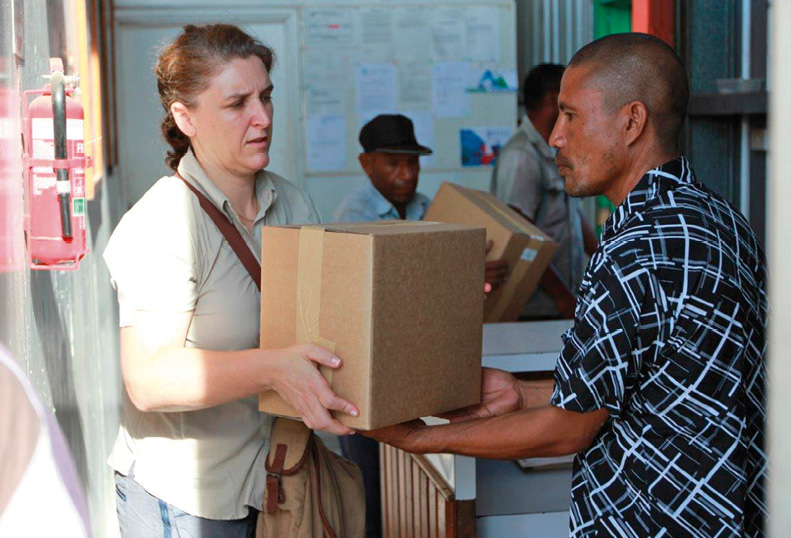
ACC electoral officer, Julie Green, assisting with the transfer of local government election ballot papers, Port Moresby, July 2013. [DFAT]

