

Program 1.5: New Colombo Plan
| Objective |
|---|
|
To foster closer people-to-people and institutional links between Australia and the Indo–Pacific by contributing to an overall increase in the number of Australian undergraduate students undertaking study and internships in the region. |
| Deliverables | 2013–14 result | Reporting |
|---|---|---|
|
Implementation of the New Colombo Plan (NCP) pilot phase in Indonesia, Hong Kong, Singapore and Japan in 2014 |
met | below |
|
Successful design and implementation of the wider rollout of the NCP across the Indo-Pacific region from 2015, informed by a robust evaluation of the pilot phase. |
met | below |
| Key performance indicators* | 2013–14 result | Reporting |
|---|---|---|
|
Provision of around 40 scholarships and a mobility grants programme that will benefit more than 700 Australian undergraduate students during the pilot phase. |
met | below |
|
A substantial number of New Colombo Plan awardees undertake an internship, mentorship or other similar arrangement as part of their New Colombo Plan experience. |
met | below |
|
Satisfaction of undergraduate students and universities participating in the New Colombo Plan. |
met | below |
|
New Colombo Plan students, universities and other stakeholders are engaged in public diplomacy and outreach. |
met | below |
*The Portfolio Additional Estimates Statements 2013–2014 notes: ‘The Key Performance Indicators for Program 1.5 reflect the metrics developed for the New Colombo Plan pilot phase. These indicators will be reviewed in 2014 at the conclusion of the pilot phase.’
Overview
The New Colombo Plan (NCP), launched in December 2013, is a signature foreign policy initiative of the Government which supports Australian undergraduates to undertake study and internships in the Indo–Pacific region. The pilot phase is running in Indonesia, Japan, Singapore and Hong Kong SAR.
The department established the NCP Secretariat in September 2013 to lead the program’s implementation. With the Department of Education and universities, the department worked to deliver a range of student grants for study and internships, through a scholarships program and a flexible mobility grants program. The department’s advocacy during the pilot phase encouraged Australian universities and students to consider the Indo–Pacific as a destination of choice for undergraduate study, helping to build a greater two-way flow of students in the region. Through outreach and implementation activities, the department fostered greater links between students, universities, businesses and partner governments, and generated significant interest from other locations in the region to participate in the NCP from 2015.
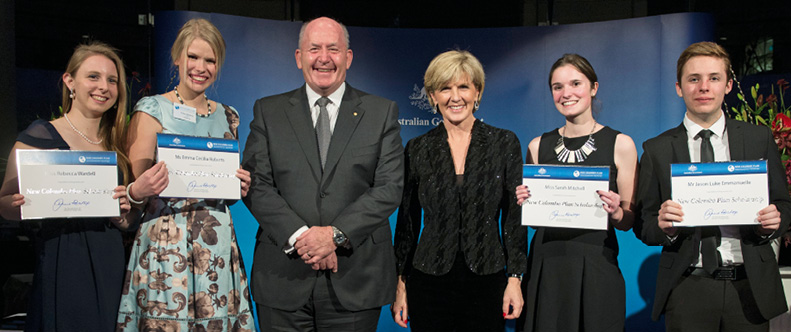
Governor-General Sir Peter Cosgrove AK MC (third left) and Minister for Foreign Affairs, Julie Bishop, with New Colombo Plan scholarship fellows, Canberra, 25 June 2014. Left to right: Rebecca Wardell, Emma Roberts, Sarah Mitchell and Jason Emmanuelle. [DFAT]
Key facts: New Colombo Plan pilot phase
- 4 pilot phase locations—Indonesia, Japan, Singapore and Hong Kong SAR
- 1300 Australian undergraduate students undertaking NCP mobility programs
- tranche one mobility grants supporting 300 students from 24 Australian universities
- tranche two mobility grants supporting around 1000 students from 38 Australian universities and 2 university consortia
- 40 prestigious New Colombo Plan scholarships awarded to undergraduate students
- 38 of 41 Australian universities participating in the pilot phase across all Australian states and territories
Outreach
The department built domestic and regional support for the program through public diplomacy and outreach to universities and business. We promoted the NCP at domestic and international events, such as the International Education Association of Australia Outbound Mobility Forum. Through posts, the department hosted or participated in NCP working groups to coordinate implementation of the program with partner governments and stakeholders. The department hosted pre-departure events for NCP mobility students in five Australian states, held official launches in Japan and Hong Kong, and coordinated the visit of Parliamentary Secretary Senator Brett Mason to Indonesia, Singapore and Hong Kong in May to advance the NCP. The department organised the inaugural NCP scholarships award event in June, hosted by the Foreign Minister and attended by the Governor-General as Patron of the NCP, members of the diplomatic corps, university and business representatives.
Scholarships and mobility programs
The department coordinated closely with the Department of Education to deliver the range of awards under the NCP, including scholarships and mobility programs. A rigorous selection process for the scholarships involved shortlisting of candidates and individual interviews with expert panels for each pilot location. Forty scholars were announced in June. This included nomination of a fellow for each location, in recognition of the top scholar. Over 140 NCP mobility grant applications were assessed covering short and longer-term study, internships, practicums and research. Following a selection process, grants were made to universities supporting some 1300 Australian undergraduate students to undertake a range of mobility programs in the pilot phase. Early feedback from universities and students has indicated a high level of enthusiasm and support for the program and the opportunities it affords the sector.
%20-%20Secretary%20signs%20MOU.jpg)
Secretary, Peter Varghese AO, and Secretary, Department of Education, Lisa Paul AO PSM, sign the New Colombo Plan Memorandum of Understanding, Canberra, 14 April 2014. [DFAT]
Thirty-eight of Australia’s 41 universities are participating in the pilot phase and they are expected to partner with a wide range of universities in the pilot locations to provide opportunities for NCP students. The governments of pilot locations have responded positively, with active engagement at ministerial and officials’ level to successfully implement the program. This has strengthened bilateral engagement on education cooperation and is promoting a more genuine two-way flow of students in the region.
Reference Group
The department supported the establishment and work of the NCP Reference Group, a high-level advisory body chaired by the Secretary of the department. The implementation and further development of the NCP is being informed by expert opinion from the education and business sector representatives in the group.
Internships and alumni
To garner support for internships, which are an integral component of the program, the department consulted businesses and other organisations in Australia and overseas. The response was positive and many expressed interest in hosting NCP interns and mentees. Work is ongoing to connect host organisations with Australian universities and their students to facilitate internships. To support ongoing connections and the legacy of the NCP, the department has commenced work on a long-term alumni strategy for the program.
Outlook
The NCP will scale up and be implemented more widely in up to 38 locations across the Indo–Pacific region from 2015. The program has been well received by regional locations beyond the pilot destinations. Approximately 60 scholarships and $8 million in mobility grants will be offered in 2015. Facilitating the internship component of the program and engaging NCP students in alumni activities and networks will be priorities.
Mobility programs
The New Colombo Plan pilot phase has supported student mobility experiences across a wide range of disciplines, as demonstrated by the snapshots below.
Curtin University students in Indonesia
Ten engineering students from Curtin University participated in industry site visits, university lectures, laboratory and field work and industry placements over a four-week period in Indonesia. The students worked with Telekom University, Institut Teknologi Bandung, Universitas Gadjah Mada and Universitas Indonesia. The program exposed students to an international curriculum and provided direct industry experience. Participating companies included PT Telkom, PT Krakatau Steel, Chevron, Pertamina and Aneka Tambang.
Semester-length study in Japan
The University of Melbourne, Monash University, University of Queensland and the University of Technology, Sydney were among Australian universities to receive mobility grants for semester-based study in Japan. The grants are supporting students across a range of disciplines, including language studies, arts, social sciences, science, health and design. Some of the funded students participated in the launch of the New Colombo Plan in Japan during Prime Minister Abbott’s visit to Tokyo.
La Trobe University students in Singapore
Twelve nanotechnology students from La Trobe University undertook a nanotechnology study program in Singapore. Activities included laboratory visits and presentations at the National University of Singapore and Nanyang Technological University, and visits to leading Singapore research organisations, including the Institute for Materials Research and Engineering, SIMTech, the Institute for Medical Biology and the Singapore-MIT Alliance for Research and Technology at CREATE.
University of Wollongong students in Hong Kong
Fifteen University of Wollongong students enrolled in a Bachelor of Primary Education undertook an intensive study program working with Hong Kong students to develop research-based solutions to problems in the primary education sector.
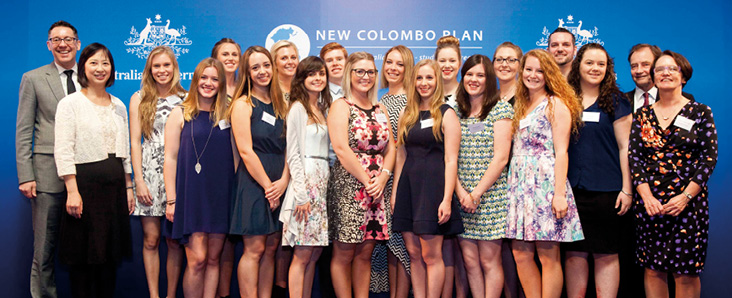
Parliamentary Secretary Brett Mason (left) with New Colombo Plan mobility grant recipients, NCP launch, Hong Kong, May 2014. [DFAT]

