

1.1(3) Americas
Overview
High-level exchanges furthered Australia’s foreign, trade and development objectives with the United States. The annual Australia – United States Ministerial (AUSMIN) consultations reinforced the value of the ANZUS alliance to our security interests and the importance of ongoing dialogue with US counterparts on regional and global strategic challenges. Minister-led activities and ongoing implementation of our free trade arrangements promoted Australian investment interests and brought economic diplomacy closer to the centre of our engagement with the United States.
Our relationships with Canada, Latin America and the Caribbean were strengthened through high-level visits, engagement with business, institutions and state governments, and officials-level consultations. The department’s aid program focused on capacity building and institutional links, primarily through Australia Awards (see 1.9(5)).
United States
The 2013 AUSMIN in Washington between Foreign Minister Bishop, Defence Minister Johnston and their US counterparts strengthened the bilateral alliance. Ministers agreed to a Statement of Principles on joint force posture initiatives, reaffirmed intent to conclude a high-quality comprehensive Trans-Pacific Partnership (TPP) agreement and committed to work together as the United States rebalances to the region. We supported Ms Bishop’s meetings in Washington, in January 2014, with senior Administration, congressional and business figures, at which she reaffirmed foreign policy and economic priorities. While in the United States she delivered two speeches on the alliance and Australia’s business policies.
The department organised Trade and Investment Minister Robb’s three visits to the United States (October 2013, January and June 2014) to promote the strengths of the Australian economy and Australia’s attractiveness for trade and investment. In June, Mr Robb accompanied the Prime Minister and a CEO-level business delegation. During this visit, Australia agreed to open a consulate-general in Houston, including to maximise trade and investment opportunities from the US energy revolution.
)%20-%20Bishop%20and%20US%20Secretary%20of%20State%20Kerry.jpg)
Minister for Foreign Affairs, Julie Bishop, meets with US Secretary of State, John Kerry, New York, 27 September 2013. [DFAT]
The department supported the Prime Minister’s June visit and his engagement with President Obama and senior Administration and congressional figures on international and regional security matters, economic and energy issues, the TPP and the G20 agenda. The leaders announced conclusion of a bilateral force posture agreement.
The department also assisted with visits by the Treasurer, Attorney-General, Speaker of the House of Representatives, Ambassador for Women and Girls and the former Home Affairs and Justice Minister. We facilitated ministerial and parliamentary participation at the Australian American Leadership Dialogue and Alliance 21 conferences in Australia and the United States.
The department cooperated with the United States in responding to regional and global challenges. On the UN Security Council we worked closely to respond to the ongoing conflict and humanitarian crisis in Syria, and to counter international terrorist threats and regional weapons proliferation. We maintained a close dialogue on our G20 presidency.
Our partnerships with the Department of State and USAID grew as a result of staff exchanges and cooperation on development programs such as the All Children Reading Grand Challenge, which aims to improve reading skills in developing countries in partnership with World Vision. A senior officials’ meeting on development cooperation agreed on collaboration to strengthen global growth through private sector development and innovation.
The United States is the largest foreign investor in Australia and our most important destination for investment abroad. The department continued implementation of the Australia – United States Free Trade Agreement (AUSFTA), and held bilateral discussions on agriculture market access in May 2014. We responded to hundreds of AUSFTA-related inquiries to help Australian business take advantage of the agreement.
The department maintained close engagement with respective chambers of commerce, and analysed developments in US fiscal policy, emerging energy independence, and legislative proposals on immigration and the Farm Bill. In June, we hosted a seven-member trade policy-focussed congressional staff delegation.
We helped shape the 2014 G’Day USA program, bringing together Australian and US government and business leaders, policy makers and academics, to promote and grow Australian tourism, trade and investment, public policy and research outcomes.
The department sustained engagement with the Australian–American Fulbright Commission through sponsorship of an annual Fulbright Professional Scholarship in Australia–US Alliance Studies and representation on the Fulbright Board.
Figure 11: Australia’s trade in goods and services with the United States (a)
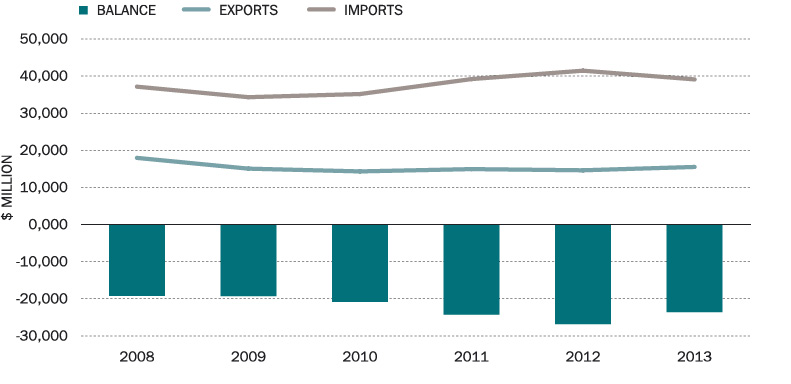
(a) Goods data on a recorded trade basis, services data on a balance of payments basis.
Based on DFAT STARS database, ABS catalogue 5368.0.55.004 and unpublished ABS data.
Canada
The department reinforced wide-ranging engagement with Canada. Prime Minister Abbott’s June 2014 visit, accompanied by Mr Robb and a CEO-level business delegation, was a highlight—sending a clear signal that Australia is ‘open for business’. We held regular and productive exchanges at officials’ level, covering issues such as strategic cooperation, the rise of Asia, trade and investment and consular cooperation.
Enhanced public policy dialogue was a core element of our relationship, including through the Canada–Australia Public Policy Initiative. The Secretary of the Department of Prime Minister and Cabinet led an Australian delegation of 13 senior APS officials in discussions with Canadian counterparts.
The department was heavily involved in the third Australia–Canada Economic Leadership Forum in Melbourne in February 2014. Over 140 senior representatives from business, politics, public service, academia, media and other non-government leaders discussed the strengths and new opportunities in the relationship. Prime Minister Abbott delivered the keynote address and senior Australian ministers made presentations with their Canadian counterparts.
We boosted our development cooperation relationship with Canada through working-level coordination and the senior officials-level Development Dialogue. Our bilateral aid partnership focused on increasing the role of the private sector in promoting food security, maximising the development potential of the extractives sector, supporting disaster and emergency management in the Caribbean and improving health care in South Sudan.
Latin America and the Caribbean
The department promoted growing links with Latin America with a focus on business and education. Two hundred and sixty Australian companies are active in the region and Brazil and Colombia are both top-ten international sources of student enrolments in Australia. We used domestic advocacy, including through the Australia Latin America Business Council (ALABC) Networking Day at Parliament House, to highlight trade and investment opportunities. The department helped organise and facilitate this event in November 2013, during which Foreign Minister Bishop and Trade and Investment Minister Robb outlined the Government’s priorities for Latin America.
In April, we supported Ms Bishop’s visit to Mexico to attend the MIKTA (Mexico, Indonesia, Korea, Turkey and Australia) Foreign Ministers’ retreat and hold bilateral meetings, including with President Peña Nieto. She also led the Australian delegation to the First High-Level Meeting of the Global Partnership for Effective Development Co-operation, discussing aid effectiveness with UN Secretary-General Ban Ki-moon and USAID Administrator Shah. We held Senior Officials’ Talks with Mexico in June 2014.
Staff Profile
Quinton Devlin
Deputy Head of Mission, Brasilia
)%20-%20Quinton%20Devlin.jpg)
As Deputy Head of Mission in Brasilia, I have had the privilege this year of working with a great team to maximise public diplomacy opportunities and provide consular support during the world’s largest sporting event: the 2014 FIFA World Cup. I have also enjoyed engaging one of the emerging global players on G20 and UNSC issues in support of Australia’s leadership roles in these organisations.
Working in Brasilia is a far cry from my previous role as Director of the Media Liaison Section, which spanned the Arab Spring and numerous high profile consular cases, disasters and crises. But that is what is so great about working at DFAT—an entirely new job and new challenges every few years.
Prior to being a departmental media spokesperson, for example, I co-chaired the APEC Task Force on Emergency Preparedness and was Australia’s representative on the APEC Counter Terrorism Task Force. I also helped manage the department’s response to the H1N1 (swine flu) pandemic and coordinate counter-terrorism cooperation in the Philippines. Previously with the Department of Defence, I joined the department in 2002 and cut my teeth on the Timor-Leste desk during the nation’s first years of independence.
Given our trade and investment focus, we used the Special Visits Program to support the participation of delegates from Bolivia, Brazil and Paraguay at the Latin America Down Under (LADU) mining conference. We also organised a LADU-related international media visit with economic journalists from Brazil, Colombia and Peru.
)%20-%20Australia-Chile%20university%20agreement.jpg)
Ambassador to Chile, Tim Kane (back centre), joins University of Queensland Deputy Vice-Chancellor (International), Professor Monique Skidmore, and Vice President of Chile’s Production Development Corporation, Dr Eduardo Bitran, as they sign an agreement on an International Centre of Excellence in Sustainable Mining, Santiago, June 2014. The embassy worked closely with the University of Queensland, Chile’s University of Concepcion and the Chilean Government to finalise the agreement. [DFAT]
The department encouraged increased state government and university engagement with the region, including through a visit to Brazil and Chile by the Queensland Deputy Premier; the annual University of Queensland Latin America Colloquium; and a Victoria Latin America Education Symposium. The department also partnered with the Queensland, Victorian and Western Australian Governments to hold seminars on the trade-liberalising, Asia-oriented Pacific Alliance (Chile, Colombia, Mexico and Peru) to which Australia is an observer.
The Council on Australia Latin America Relations (COALAR) supported 16 major activities, including the inaugural Australia–Mexico Second Track Dialogue and a seminar series on Australia’s vocational education model in Argentina, Brazil, Chile, Colombia, Mexico and Peru. COALAR’s annual board visit to Latin America focussed on improving air service and tourism links, with calls on transport and tourism authorities in Argentina, Brazil, Chile, Colombia, Peru and Uruguay. COALAR supported Latin Finance to hold its inaugural Latin America Australia Investors Forum in Sydney in July 2014, leading to several Latin American bond raisings on Australian financial markets.
Latin America Down Under, Sydney 2014
The LADU mining conference attracted participation from Bolivia, Brazil, Colombia, Mexico, Nicaragua, Paraguay, Peru and Venezuela. Supported by the department and COALAR, LADU underscored the importance that economic diplomacy plays in building Australia’s links with the dynamic economies of Latin America. A commercially-run annual event, LADU showcases opportunities for Australian mining ‘juniors’ whose expertise is keenly sought by Latin American governments and potential commercial partners.
Ms Bishop delivered a keynote address at the event, emphasising the strong reputation of Australian miners and researchers in sustainability and community engagement. Departmental officers and Australian heads of mission gave formal presentations to the conference and also supported the Austrade networking lounge which helped to facilitate over 99 meetings between visiting Latin American participants and Australian business, officials and university representatives.
Through its project partner TAFE Directors Australia, COALAR highlighted the type of hands-on skills Australian education models could offer Latin American economies.
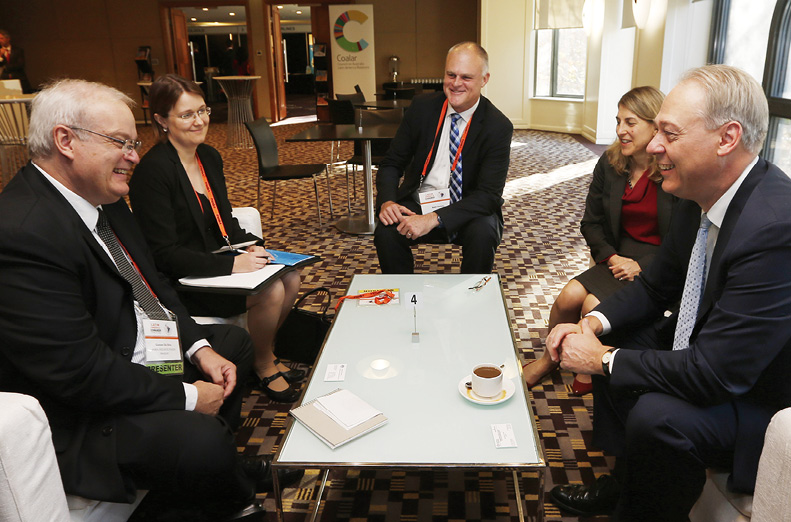
First Assistant Secretary Americas Division, Dr Brendon Hammer (right), with Ambassador to Argentina (with accreditation to Paraguay), Patricia Holmes (second right), and Assistant Secretary Brett Hackett (centre), discuss opportunities for Australia in Paraguay’s minerals sector with Paraguayan delegation leader Gustavo da Silva and colleague (left), Latin America Down Under, Sydney, May 2014. [Bryan Charlton]
We delivered $21.5 million in aid to the region, focused on capacity building through Australia Awards (see 1.9(3)).
The department promoted stronger people-to-people and cultural links in the region including through an active Facebook campaign—most successful in Brazil (17 000 ‘likes’)—and support for a tour by the Sydney Dance Company to Colombia, Ecuador, Mexico and Peru. We promoted the ‘Gold and the Incas’ exhibition at the National Gallery of Australia and the ‘Aztecs’ exhibition at the Melbourne Museum.
Our ambassadors represented Australia at presidential inaugurations in Chile, Costa Rica, El Salvador, Honduras, Panama and Venezuela helping to drive high-level political links. The department also attended the Central American Integration System summits in Panama in December and the Dominican Republic in June. We held senior officials’ talks with Colombia in November and also met twice with Pacific Alliance senior officials.
We actively promoted stronger parliamentary links assisting a Speaker-led parliamentary delegation visit to Mexico for the Asia–Pacific Parliamentary Forum and a visit by the Speaker to Trinidad and Tobago. We facilitated a Peruvian parliamentary delegation visit to Australia in May 2014.
The department supported a February 2014 visit to Chile by the Vice Chief of the Defence Force during which the two countries agreed to develop a modest program of defence cooperation.
We assisted the Foreign Minister in her engagement with Caribbean counterparts in the margins of CHOGM in Sri Lanka.
| Exports | Exports | Imports | Imports | |||
|---|---|---|---|---|---|---|
| Goods and services | 2012 | 2013 | Trend growth 2008–2013 | 2012 | 2013 | Trend growth 2008–2013 |
| $m | $m | % | $m | $m | % | |
| Total Americas (b) (d) (g) | 21,284 | 21,062 | –2.1 | 51,333 | 48,761 | 2.7 |
| United States (c) (e) | 14,627 | 15,531 | –2.2 | 41,462 | 39,111 | 2.7 |
| Canada (c) (d) | 2,469 | 2,187 | 0.4 | 3,308 | 3,043 | –1.6 |
| Mexico (b) (d) | 936 | 456 | –5.0 | 2,062 | 2,198 | 11.4 |
| Total NAFTA (b) (d) (g) | 18,032 | 18,174 | –1.9 | 46,832 | 44,352 | 2.7 |
| Central America & Caribbean (b) (d) (f) | 250 | 256 | –7.9 | 1,199 | 1,060 | 2.8 |
| Brazil (c) (d) | 1,419 | 1,228 | –6.9 | 738 | 704 | –8.8 |
| Chile (b) (d) | 597 | 527 | 4.6 | 1,429 | 1,222 | 7.6 |
| Argentina (c) (d) | 328 | 255 | –1.8 | 739 | 954 | 14.0 |
| Total South America (b) (d) (g) | 3,002 | 2,630 | –2.8 | 3,303 | 3,349 | 3.4 |
(a) Goods data on a recorded trade basis, services data on a balance of payments basis.
(b) Excludes selected confidential export commodities from partner country totals from June 2013 onwards. Therefore movements in the confidentialised country totals may not reflect the true pattern of trade.
(c) Actual export total for 2013 based on unpublished ABS data.
(d) Excludes selected confidential import commodities from partner country totals from September 2008 onwards. Therefore movements in the confidentialised country totals may not reflect the true pattern of trade.
(e) Actual import total for 2008 to 2013 based on unpublished ABS data.
(f) Excluding Mexico.
(g) Totals include actual export totals for 2013 for Argentina, Brazil, Canada and the United States. Totals includes actual import total for 2008 to 2013 for the United States.
Based on DFAT STARS database, ABS catalogue 5368.0.55.004 and unpublished ABS data.
Outlook
Deepening the bilateral alliance with the United States, including through AUSMIN 2014, will be a priority. We will pursue Australia’s trade and investment objectives, including through the implementation of the AUSFTA and mutual engagement in TPP negotiations.
Policy dialogue, trade and investment promotion and development assistance cooperation will be core elements of our engagement with Canada. We will support the Prospectors and Developers Association of Canada convention and the fourth Australia–Canada Economic Leadership Dialogue.
The department will facilitate the inaugural Latin America parliamentary delegation visit to Australia to coincide with the 2014 ALABC Networking Day. We will help shape the inaugural Australia–Chile Economic Leadership Forum to be held in Santiago; advance relations with Pacific Alliance countries; prepare for the promotion of Australia in Brazil in conjunction with the 2016 Olympics; and advocate for further Australian business interest in Mexico to take advantage of the country’s economic reform.

