

1.1(10) Multilateral policy, legal and environment
Overview
The department promoted Australia’s international standing and helped address international security, human rights and environmental challenges through strong engagement in multilateral forums, including the United Nations and the Commonwealth.
In the first 18 months of Australia’s term on the UN Security Council (UNSC), we drove outcomes that built the UNSC’s capacity to address international peace and security issues. We led negotiations on the first-ever Council resolution on small arms and light weapons, delivered a breakthrough resolution on humanitarian access in Syria and established a basis for UN support to Afghanistan beyond 2014.
As chair of three UNSC sanctions committees, Australia worked to improve the effectiveness and responsiveness of the council’s sanctions as a tool to address threats to international peace and security.
The department supported Australia’s participation in the Commonwealth Heads of Government Meeting (CHOGM) in Colombo in November 2013, handing over our Chair-in-Office role to Sri Lanka.
The appointment of Natasha Stott Despoja as Ambassador for Women and Girls and the integration of AusAID strengthened the department’s work in advancing gender equality and women’s empowerment, including in multilateral and regional forums.
The department provided legal advice to the Commonwealth on issues of public international law, including international humanitarian, human rights and criminal law. We provided legal advice on law of the sea and environmental law issues; contributing to successful legal action against Japanese whaling, continuing Australia’s defence of Timor-Leste’s legal actions, and supporting regional efforts to reduce tensions in the South China Sea.
The department’s advocacy helped secure the election of an Australian as Chair of the Committee for Environmental Protection under the Antarctic treaty regime and resulted in Australia’s re-election to councils of three other international bodies.
The department advanced regional cooperation on counter people smuggling and trafficking in persons, including by assisting implementation of Operation Sovereign Borders and co-chairing the Bali Process on People Smuggling, Trafficking in Persons and Related Transnational Crime (the Bali Process).
United Nations
The department participated in major international negotiations and debates and supported the Foreign Minister at the UN General Assembly Leaders’ Week in September 2013 and other multilateral forums.
Our advocacy delivered success for Australian candidacies. Dr Francis Gurry was re-elected as Director General of the World Intellectual Property Organization and Australia was re-elected to Councils of the International Maritime Organisation, the International Civil Aviation Organization and the Universal Postal Union. Peter Drennan was appointed as the UN Under-Secretary General for Safety and Security.
We pushed for wider acceptance of the Responsibility to Protect (R2P) principle. We funded the UN Joint Office of the Special Adviser on the Prevention of Genocide and R2P, the Global Centre for R2P, and the Asia–Pacific Centre for R2P to support its further development and application. Australia’s R2P Focal Point lobbied for better coordination and understanding of atrocity prevention measures which was influential in the convening of the inaugural Global Action Against Mass Atrocity Crimes meeting in Costa Rica and fourth Global Network of R2P Focal Points meeting in Botswana.
The department engaged with the UN Educational, Scientific and Cultural Organization (UNESCO), including at the 37th Biennial General Conference in November 2013, and supported the Australian National Commission for UNESCO. Australia positively influenced the work of the organisation with a particular focus on education, cyber ethics and piracy, resource allocation for the Pacific and institutional reform. Working closely with the Department of the Environment, we advanced Australia’s interests in world heritage issues on the Great Barrier Reef and Tasmanian Wilderness at the 38th Session of the World Heritage Committee in June 2014.
The department worked with a range of specialised UN agencies to address global development challenges. We particularly promoted greater harmonisation of multi-donor efforts in response to humanitarian crises and emergency situations. (See also 1.10 & 1.12.)
United Nations Security Council
The department played an active role in the UN Security Council to deliver outcomes that enhanced Australia’s security and development environment. We chaired 35 meetings of council committees, and participated in 385 council meetings, including 189 closed meetings for members only. Australia was closely involved in negotiating all 56 resolutions and 24 presidential statements adopted during the period, including initiating four resolutions and a presidential statement.
A high point in Australia’s September 2013 presidency was an Australia-led initiative that saw the council adopt its first resolution solely dedicated to small arms and light weapons. Among other things, the resolution strengthens implementation of UNSC arms embargoes and better secures and manages arms stockpiles.
As policy coordinator on Afghanistan, Australia facilitated mandate renewals for the International Security Assistance Force in October 2013 and the UN mission in Afghanistan in March 2014. Unanimous UNSC support reflected the international community’s continuing commitment to Afghanistan and its people at a pivotal time for the country. The renewals provided a further twelve months of UN assistance, a blueprint for support after 2014, and safeguarded important gains made through transition, in particular protecting the rights of women and children and strengthening human rights institutions.
Australia was a strong voice on humanitarian issues in response to the conflict in Syria. In October 2013, together with Luxembourg we secured a united call for immediate and unhindered humanitarian access in Syria. In February 2014, working with Luxembourg and Jordan, we steered the unanimous passage of a UNSC resolution which set out critical steps the parties to the conflict, and particularly the Syrian regime, must take to protect civilians and allow humanitarian access. A pivotal resolution was also adopted during Australia’s September 2013 presidency which imposed a timeline for the destruction of Syria’s chemical weapons stockpile and chemical weapons production facilities.
)%20-%20Quinlan%20in%20UNSC.jpg)
Ambassador and Permanent Representative to the United Nations, Gary Quinlan, addressing the Security Council during the debate on chemical weapons in Syria, New York, 27 September 2013. [UN Photo/Paulo Filgueiras]
Australia advocated for strong responses from the Security Council to the threat posed by North Korea to regional security and international non-proliferation efforts. Australia supported the UN’s Commission of Inquiry on Human Rights in the Democratic People’s Republic of Korea, ensuring the commission’s comprehensive, evidence-based report was brought before the council.
We led calls for the establishment of a Commission of Inquiry into human rights violations in Central African Republic. Australia pressed for an end to impunity for serious violations of humanitarian and human rights law during conflicts, including through referral to the International Criminal Court (ICC). Australia co-sponsored the Security Council’s first resolution on security sector reform, which recognised that a professional and accountable security sector is a prerequisite for achieving peacekeeping and peacebuilding objectives.
Australia collaborated with council members to include operative provisions in UN peacekeeping and peacebuilding mandates which strengthen the protection of civilians, especially women and children, safeguard human rights and promote women’s participation in conflict prevention, conflict resolution and peacebuilding. In May 2014, we secured inclusion of such provisions in the UN peacekeeping mission in South Sudan.
Australia hosted several UNSC events, including an interactive panel on women’s participation in peacebuilding (during our September 2013 presidency) and an event on the impact of the unregulated flow of small arms on the rates of sexual violence in the Democratic Republic of Congo (August 2013). In June 2014, Australia hosted a panel discussion on the role of UN police peacekeepers in addressing conflict-related sexual violence.
Australia in the UN Security Council: smarter sanctions – safer world
Sanctions are a critical lever in the collective security regime established by the Charter of the United Nations. Australia is a leader in seeking to improve their implementation and effectiveness.
Sanctions are measures not involving the use of armed force that are imposed in situations of international concern, including the grave repression of human rights, the proliferation of weapons of mass destruction or their means of delivery, or armed conflict. They impose restrictions on activities that relate to particular countries, goods and services, or persons and entities.
Australia chaired the Council’s committees responsible for administering sanctions in relation to Al-Qaida, Iran’s proliferation-sensitive nuclear and missile programs, and the Taliban. Australia was also a member of the Council’s 12 other sanctions committees. As Chair, Australia set the agenda and articulated key messages, both to the Council and broader UN membership. During 2013–14, Australia’s Ambassador to the United Nations, Gary Quinlan, delivered seven reports to the Council in open session on the work of the committees Australia chaired and presided over 25 meetings of those committees.
Australia brought a greater operational focus to committee work to ensure that sanctions responded to developments in the situations that they address. We promoted transparency in the Council’s sanctions work through open and interactive briefings with the broader UN membership and through the direct involvement of relevant non-Council members in committee meetings. In December 2013, for example, Australia invited countries from the Sahel and Maghreb to an Al-Qaida committee meeting to discuss terrorism in Africa.
Australia also ensured that the committees collaborated with one another, as well as non-UN entities working in the same field, to take advantage of synergies and avoid duplication of effort. We initiated stronger cooperation between the Financial Action Task Force, which sets global standards on countering the financing of terrorism and proliferation, and relevant committees.
Australia was one of four countries leading a high-level review of UN sanctions. We convened council members and all relevant parts of the UN Secretariat in a working group to develop a blueprint on how best to work together to give effect to sanctions. The findings of the review will be reported to the UN membership in late 2014.
Commonwealth
The department supported the Foreign Minister as Chair of the Commonwealth Foreign Ministers Meeting in New York in September 2013 and in the Commonwealth Ministerial Action Group (CMAG) meetings in September and November 2013. CMAG continued to monitor the situation in the Maldives and encourage Fiji’s return to democracy. We also facilitated the Prime Minister and Foreign Minister’s participation in the Colombo CHOGM in November 2013.
Although Australia passed its Commonwealth Chair-in-Office role to Sri Lanka, we continued to play an integral role as Chair of the Executive Committee of the Board of Governors of the Commonwealth Secretariat. The department steered implementation of leaders’ commitments to reform and strengthen the Commonwealth to better meet today’s challenges. We supported the appointment of Gary Dunn as the Commonwealth Deputy Secretary-General for Corporate Affairs.
Through the Australian aid program, the department assisted Commonwealth activities in line with its strategic plan (see 1.12).
Human rights
The department promoted human rights bilaterally, through multilateral forums and with the aid program.
UN forums are important venues for progressing Australia’s national interest in a peaceful, stable region. Australia is seen as a valuable and constructive player on human rights issues in the UN General Assembly resolutions on human rights. In September 2013, the Foreign Minister used her address to the UN General Assembly to highlight the need to ensure that all people around the world are free to exercise fully their economic, civil and political rights.
The department continued to engage strongly with the HRC’s Universal Periodic Review (UPR) process which reviews the human rights records of all UN member states. We participated in all 43 UPRs held from July 2013 to July 2014, recommending reforms to national approaches to human rights to ensure countries fully respect and implement all human rights and fundamental freedoms.
An Australian delegation participated in the Seventh Conference of States Parties to the Convention on the Rights of Persons with Disabilities in June 2014 and an indigenous officer participated as a member of Australia’s delegation to the UN Permanent Forum on Indigenous Issues in May 2014. (See also Section 3.)
We led the Australian delegation in the 15th Australia–China Human Rights Dialogue in February 2014 in Beijing. Discussions addressed issues such as freedom of speech, association, religion and the media; the death penalty; organ harvesting; and specific cases of concern. Civil society welcomed our ongoing engagement with them on the China Dialogue, including inviting written submissions and providing a debrief on discussions.
We supported the protection and promotion of human rights through the aid program, helping children access education, empowering women to participate in decision-making and building the institutional capacity of national human rights bodies. The department provided core funding of $0.65 million to the Asia Pacific Forum of National Human Rights Institutions.
Gender equality
The department played an active role in promoting gender equality and the empowerment of women and girls, particularly through the aid program, our UN engagement—including as a member of the Security Council—and the extensive advocacy work of our Ambassador for Women and Girls, Natasha Stott Despoja.
In the six months following her appointment, the ambassador travelled extensively in the Asia–Pacific region. Her representation at multilateral, bilateral and regional meetings strengthened Australia’s international credentials as an active advocate for the rights of women and girls.
Of the department’s aid investments, $2.2 billion addressed gender equality and women’s empowerment as a principal or significant objective. We focused on advancing equal access to health care and education; promoting women’s economic empowerment; enhancing women’s roles in decision-making, leadership and peacebuilding; and ending violence against women. The new aid policy reflects the priority of gender equality and women’s empowerment across the program.
To promote women’s economic empowerment, the department collaborated at a global level with the World Bank, UN Women and the Asian Development Bank. Regionally, the department and the US Agency for International Development worked with Visa and the Global System for Mobile Communications Association (GSMA) to launch the GSMA mWomen Programme in the Pacific in early 2014. This program will increase women’s access to, and use of, mobile phones and services in developing markets.
As part of the Pacific Women Shaping Pacific Development Program, the department supported the Papua New Guinea Business Coalition to work with the private sector to increase the number of women business leaders and to develop policies and practices that enable women to succeed at work.
Through the Pacific Women’s Parliamentary Partnership Program, the department addressed the low representation of women in Pacific parliaments by facilitating dialogue, exchanges, mentoring and training between Australian and Pacific Islands women Members of Parliament and parliamentary staff. The department coordinated exchange visits and assessed the needs of female parliamentarians in Cook Islands, Samoa and Vanuatu.
Australian aid helped 66 349 women survivors of violence access critical services such as emergency shelters, counselling and legal advice. The department committed new funding to support the Afghan Women’s Network and member organisations strengthen their advocacy and leadership efforts as part of our focus on ending violence against women in Afghanistan. The department provided support to the UN Regional Joint Program, Partners for Prevention (P4P) Phase I, to undertake an unprecedented survey on men’s use of violence against women in Asia and the Pacific.
At the ASEAN Commission on the Promotion and Protection of the Rights of Women and Children in Indonesia, in February 2014, the Ambassador for Women and Girls promoted Australia’s work internationally and domestically to address violence against women and end trafficking of women and girls.
The ambassador led Australia’s delegation to the UK-hosted Global Summit to End Sexual Violence in Conflict in London in June 2014. The summit saw the launch, with Australian support, of an International Protocol on the Documentation and Investigation of Sexual Violence in Conflict. The Foreign Minister is a champion of the UK’s Preventing Sexual Violence in Conflict Initiative and in the lead up to the summit, Ms Bishop co-hosted, with the British High Commissioner, an Australian Dialogue on Preventing Sexual Violence in Conflict. The dialogue brought together diplomatic, aid, military, policing, academic and civil society experts to shape Australia’s work on eliminating sexual violence and delivered new commitments by Australia to end the use of sexual violence as a weapon of war, to end impunity for perpetrators and to support survivors.
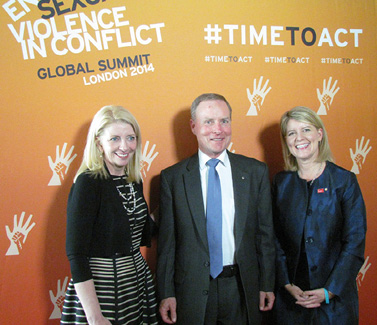
Ambassador for Women and Girls, Natasha Stott Despoja (right), with US Ambassador at Large for Global Women’s Issues, Cathy Russell (left), and Chief of Army, Lieutenant General David Morrison AO, Global Summit to End Sexual Violence in Conflict, London, 12 June 2014. [DFAT]
The department played a key role in Australia’s multilateral engagement on gender equality, including in discussions on the post–2015 development agenda and at the 58th Session of the Commission on the Status of Women in March 2014.
Ambassador for Women and Girls
Women’s participation in the economy is essential to growth and prosperity, so a key pillar of the Ambassador for Women and Girls’ international advocacy is the promotion of women’s economic empowerment.
The ambassador represented Australia at the APEC Women and the Economy Forum in Beijing in May 2014 and announced new funding to build the capacity of trade promotion agencies in APEC economies to connect women’s businesses to export markets. She led Australia’s negotiations to secure strong APEC commitments to integrate gender considerations across all APEC activities, recognising that training women for employment, building their capacity and challenging barriers to their participation will add an estimated US$89 billion per annum to the Asia–Pacific economy.
The ambassador’s meetings with Australian-supported women entrepreneurs participating in microfinance programs in Indonesia in February 2014, and with beneficiaries of Australian funded programs to support women in Papua New Guinea’s coffee industry in April 2014, reinforced the vital role played by the region’s women in driving economic growth and creating pathways out of poverty.
)%20-%20Ambassador%20for%20Women%20and%20Girls.jpg)
Director of the Office of the Ambassador for Women and Girls, Felicity Volk (fourth left), with the ambassador, Natasha Stott Despoja (right), and beneficiaries of the Australian-supported microfinance programs, Jakarta, 17 February 2014. [DFAT]
People smuggling, refugees, asylum and immigration
The department contributed to whole-of-government efforts bilaterally and regionally to counter people smuggling. We finalised negotiations with Papua New Guinea on resettlement arrangements and ongoing bilateral cooperation against people smuggling.
From September 2013, the department supported implementation of Operation Sovereign Borders (OSB), a whole-of-government effort to combat people smuggling and protect Australia’s borders. We advocated OSB with key international and regional partners. The department seconded officers to the OSB Joint Agency Task Force (JATF) and engaged JATF leadership through the Ambassador for People Smuggling Issues. The department also established a People Smuggling Task Force.
We spearheaded efforts to advance regional cooperation on asylum seeker issues leading negotiations with Cambodia on an MOU covering resettlement of refugees from Nauru. We also provided policy and logistical support to the Minister for Immigration and Border Protection in relation to his overseas engagements.
Working with the JATF and through our overseas posts, our comprehensive advocacy of Australia’s counter people smuggling policies to potential illegal immigrants, host governments, community leaders and persons of influence contributed to the reduction in illegal boat arrivals outcome.
As co-chairs of the Bali Process, Australia and Indonesia progressed the outcomes of the 2013 Ministerial Conference. We established an agreement between the Bali Process Regional Support Office and Jakarta Centre for Law Enforcement Cooperation on capacity building in law enforcement and border management for member countries, and developed a practical policy guide to assist member countries criminalise people smuggling.
The department participated in Indonesia’s Special Conference on Irregular Movement of Persons in August 2013 and follow-up workshop in April 2014. At the 23rd session of the UN Commission on Crime Prevention and Criminal Justice, we sponsored a resolution on strengthened criminal justice responses to combat people smuggling.
Country information reports
In July 2013, the department assumed responsibility for preparing unclassified Country Information Reports to assist Australian decision-makers determine protection status in accordance with the 1951 Refugee Convention. Decision-makers are directed to consider these reports under Section 499 of the Migration Act 1958. The reports are factual and updated as necessary to ensure they remain current.
The department’s fourteen reports were prepared with regard to the existing caseload for decision-makers and focused on particular cohorts seeking protection in Australia at the time of writing.
The reports drew on the department’s extensive in-country knowledge and other credible sources, including open source publications and interviews with community representatives and locally-based organisations.
Environment and sustainable development
Sea law, environment law and Antarctic policy
The department, working closely with other domestic agencies, advanced Australia’s strategic, economic and environmental interests in Antarctica, the Southern Ocean and the Indo–Pacific.
We worked closely with other agencies in the Government’s successful action against Japanese whaling in the International Court of Justice (ICJ) and contributed to the defence of legal action initiated by Timor-Leste in relation to Timor Sea treaty arrangements.
We supported regional confidence building measures to reduce tensions in the South China Sea and co-chaired with the Philippines the second ASEAN Regional Forum Seminar on the UN Convention on the Law of the Sea in May 2014. Our efforts contributed to greater recognition in the region of the importance of the rule of law and the peaceful settlement of maritime disputes.
The successful election of Australia’s candidate, Ewan McIvor, to Chair the Committee for Environmental Protection under the Antarctic Treaty system will bolster our efforts to improve environmental protection and management in Antarctica.
Australia wins whaling case in the International Court of Justice
The International Court of Justice in The Hague delivered its judgment in the case concerning Japanese Whaling in the Antarctic on 31 March 2014.
Australia argued that Japan’s whaling program in the Southern Ocean was in breach of various provisions of the International Convention for the Regulation of Whaling (ICRW).
The ICJ found that Japan had not acted in conformity with obligations under the ICRW prohibiting commercial whaling and ordered that Japan revoke existing permits. The court’s judgment was the culmination of a four-year, whole-of-government effort involving the department, the Attorney-General’s Department, international and local legal counsel, and scientific experts from the Australian Antarctic Division within the Department of the Environment.
)%20-%20ICJ%20Whaling%20Case.jpg)
Then Senior Legal Advisor, Richard Rowe (left), with Agent of Australia, Bill Campbell QC, at the ICJ, The Hague, July 2013. [DFAT]
Climate change
Following machinery of government changes, the department became responsible for development and co-ordination of international climate change policy. For the department’s advocacy of Australia’s climate change interests internationally, see Program 1.4.
Sanctions
The department continued to promote the rigorous and effective implementation and administration of UNSC and Australian autonomous sanctions regimes.
We represented Australia in all 15 UN Security Council Sanctions Committees and oversaw the amendment of Australian sanction laws to implement new sanctions regimes in relation to the Central African Republic, Ukraine and Yemen. We implemented amendments to the existing sanctions regimes in relation to Côte d’Ivoire, the Democratic People’s Republic of Korea, Iran, Libyan Arab Jamahiriya, Somalia, Sudan, the Former Yugoslavia and Zimbabwe.
As the Australian Government’s sanctions regulator, the department received over 300 informal inquiries and over 550 formal applications relating to sanctions permits. We effectively balanced proper administration of Australian sanction laws with our broader trade facilitation objectives.
The department raised awareness of Australian sanction laws. We held public seminars for businesses, financial institutions and universities in all Australian states and conducted tailored outreach to individual businesses and sectors particularly affected by the laws.
Transnational crime and counter-terrorism financing
Corruption and transnational crime are serious threats to regional security and prosperity with an estimated US$90 billion generated annually from illicit markets in the Asia–Pacific region. The department worked closely with government agencies, civil society and the private sector to strengthen regional and international responses to transnational crime.
The department supported Australia’s co-chairing of the G20 Anti-Corruption Working Group, including the group’s first meeting in 2014 in Sydney, and contributed to the development of the action plan for 2015–16.
The department referred allegations of foreign bribery and extra-territorial offences to the Australian Federal Police. We conducted outreach to the private sector on Australia’s anti-corruption and bribery obligations and ensured effective training of departmental staff on foreign bribery and other extra-territorial offences.
The department led the Australian delegation to the 23rd Session of the UN Commission on Crime Prevention and Criminal Justice and co-sponsored the commission’s first resolution on migrant smuggling. The resolution urges all UN member states to strengthen national, bilateral, regional and international criminal justice responses to prevent and combat people smuggling.
We sustained our strong counter-narcotics engagement, chairing the Mini Dublin Group of donor countries supporting counter-narcotics efforts in Southeast Asia and China. We were also involved, with the Department of Health, in the 57th Session of the UN Commission on Narcotic Drugs (CND) where we co-sponsored resolutions on new psychoactive substances and drug use prevention. We co-hosted a CND side-event highlighting global inequality and barriers to access for internationally controlled medicines, especially for pain relief and palliative care.
We participated in a UN Counter-Terrorism Committee Executive Director workshop in Southeast Asia dealing with asset freezing and delivered presentations on Australia’s implementation of targeted financial sanctions against terrorism financing.
International law
The department provided legal advice to the Commonwealth, pursuant to its mandate under the Legal Services Directions, on issues of public international law, including international humanitarian, human rights and criminal law.
We contributed to the successful conclusion of a range of international instruments, including the International Code of Conduct for Private Security Service Providers, and provided advice on the implementation and interpretation of Australia’s treaty obligations. We offered legal advice in support of Australia’s UN Security Council engagement, in relation to situations of armed violence and conflict, and on arms control, nuclear non-proliferation and people smuggling. The department also contributed to reform of Australia’s inter-country adoption architecture.
We supported Australia’s work as Chair of the UN Group of Governmental Experts on Developments in the Field of Information and Telecommunications in the Context of International Security, which adopted a consensus report affirming the application of international law to states’ use of cyberspace. We led the process that resulted in the passage of the International Organisations (Privileges and Immunities) Amendment Act 2013 which will facilitate the extension of privileges and immunities to the International Committee of the Red Cross (ICRC) and the ICC. We also provided legal support for an Organisation for the Prohibition of Chemical Weapons workshop for Pacific Island countries and Timor-Leste to strengthen their implementation of the Chemical Weapons Convention.
The department supported the Australian Red Cross in hosting the Statutory Meetings of the International Red Cross and Red Crescent Movement in Sydney in November 2013. We co-hosted with the ICRC an expert workshop on promoting military operational practice that ensures safe access to, and delivery of, health care in armed conflict and other situations of violence.
We continued efforts to end impunity for the most serious crimes of concern to the international community, including through our support for the ICC and the Extraordinary Chambers in the Courts of Cambodia (see also 1.1(2)).
The department helped raise awareness of international law issues through direct engagement with academic and non-governmental stakeholders and contributions to seminars, conferences and academic publications.
Treaties
The department tabled 16 new or amended treaties in Parliament for review by the Joint Standing Committee on Treaties. We facilitated the signing of 12 treaties, including the free trade agreement with the Republic of Korea, and led the process for Australia’s early ratification of the historic Arms Trade Treaty (see 1.1(11)). We enabled consultation with Australian states and territories on treaties under negotiation, consideration and review, and advised government agencies on treaty policy and procedure, including through our annual training seminar for government officials (see also 1.1(14) & App. 6).
Outlook
The department’s support for Australia’s term on the UN Security Council will continue to build Australia’s reputation as a constructive and strategic member of the international community. We will focus on increasing UNSC transparency and accountability through outreach to regional partners, open meetings and informal events.
The department will promote the effective implementation and administration of sanctions internationally. We will engage with the business community on Australian sanctions, anti-bribery and corruption laws to strengthen the private sector’s capacity to trade and invest abroad with confidence.
Advancing Australian interests in the United Nations, the Commonwealth and other multilateral forums will be a priority. We will work closely with Malta to ensure strong outcomes from CHOGM in 2015 and progress Australian objectives in the UN Secretary-General’s Summit on Climate Change and the World Conference on Indigenous Peoples.
The department will develop its gender equality strategy to guide diplomatic efforts and scale up attention to gender throughout the Australian aid program. We will be strong contributors on the 20-year review of the Beijing Platform for Action and the post–2015 framework.
The department will continue to advocate for international agreement to the Australia–France–EU proposal to establish a network of marine protected areas in East Antarctica, which was not adopted by the Commission for the Conservation of Antarctic Living Marine Resources (CCAMLR) in 2013. We will continue to promote the conservation and sustainable use of biodiversity, including through our support for the commencement of negotiations for a new instrument under the Law of the Sea Convention relating to the management and conservation of areas beyond national jurisdiction. The department will engage with the International Whaling Commission, support ongoing regional efforts to manage tensions in the South China Sea and contribute to our ongoing Timor litigation defence.
The department will provide public international legal advice to advance our national interests within a strong international rules-based order. We will promote the universalisation of the Arms Trade Treaty and the Rome Statute of the ICC. Our efforts to end impunity for serious international crimes will continue.
The department will support the implementation of OSB and continue cooperative regional and international approaches to combat people smuggling and human trafficking. In consultation with Indonesia, we will implement a new Bali Process strategy on capacity building and cooperation activities, including immigration management, border integrity and law enforcement.

