

1.1(5) South and West Asia
Overview
Elections in India, Afghanistan and Pakistan provided opportunities to strengthen relationships. The department’s efforts will enable positive engagement with the new leaders. We were active in the Indian Ocean region including through our role as Chair of the Indian Ocean Rim Association (IORA—formerly the Indian Ocean Rim Association for Regional Cooperation). Deepening Australia’s strategic partnership with India was a priority.
The department used our development partnerships in South and West Asia to address barriers to economic participation and productivity. We formulated and commenced implementation of an economic diplomacy strategy which aims to increase and liberalise trade, facilitate business-to-business links, encourage investment, promote women’s economic empowerment and stimulate economic growth and development.
The department encouraged stability in the region, leading Australia’s whole-of-government effort to advance security, economic and political transition in Afghanistan. Our engagement with Pakistan focused on supporting the democratic process, encouraging economic reform and security issues.
India
The department continued to add depth to the strategic partnership with India—Australia’s fifth largest export market, the world’s most populous democracy, and a country with which our interests are increasingly converging.
In October 2013, we supported Ms Bishop’s co-chairing of the 9th round of the Foreign Ministers’ Framework Dialogue in Perth. Ministers discussed ways to strengthen the strategic partnership, including by expanding cooperation on terrorism, transnational crime, and cyber security. Ms Bishop stressed the value of working together on shared priorities in the G20 during Australia’s host year.
The department arranged Ms Bishop’s visit to India in November 2013 where she expressed support for India’s membership of the Nuclear Suppliers Group. With renewed political commitment from respective foreign ministers, the department made good progress on a bilateral civil nuclear cooperation agreement, holding four rounds of negotiations. We also hosted the inaugural meeting of the India–Australia Disarmament and Non-Proliferation Dialogue in February 2014.
We facilitated Mr Robb’s engagement with his Indian counterpart in January 2014 during which ministers underlined the importance of concluding a high-quality comprehensive economic cooperation agreement. Such an agreement would assist in boosting investment flows and two-way trade—which exceeded $15 billion in 2013. We developed an economic diplomacy strategy that focuses on assisting Australian companies in their commercial engagement with India and promotes Australia as a major investment destination.
In December 2013, the department supported the third meeting of the Australia–India CEO Forum. CEOs agreed to focus efforts on four core areas of bilateral commercial opportunity: resources and energy; financial services; infrastructure, including logistics; and agribusiness.
The department reinforced closer people-to-people links between India and Australia with strong promotion of tourism and education. In recognition of the extensive community ties, Mr Robb delivered a keynote address at the regional Pravasi Bharatiya Divas (Overseas Indians Day) convention in Sydney—the first time the Indian Government had hosted the conference in Australia.
Figure 13: Australia’s trade in goods and services with India (a) (b)
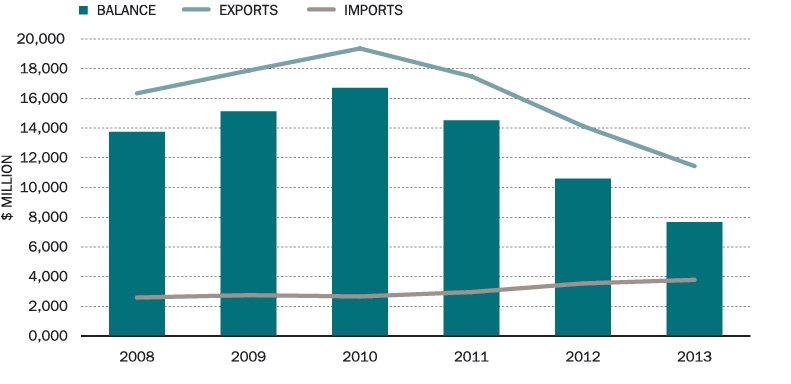
(a) Goods data on a recorded trade basis, services data on a balance of payments basis.
(b) Excludes selected confidential import commodities from September 2008 onwards.
Based on DFAT STARS database, ABS catalogue 5368.0.55.004 and unpublished ABS data.
Afghanistan
The department led the multinational Provincial Reconstruction Team (PRT) in Tarin Kowt, Uruzgan, which helped strengthen provincial administration and infrastructure and engage political leaders in a peaceful transition. We assumed the lead in August 2010, coordinating participation from the Australian Civilian Corps, Australian Defence Force personnel and the Australian Federal Police. In October 2013, we arranged Prime Minister Abbott’s attendance at the ceremony to mark the PRT’s closure.
The department played a leading role in the renewal of mandates for the International Security Assistance Force in October 2013 and the UN Assistance Mission in Afghanistan in March 2014. (See also 1.1(10).)
Our $138.4 million aid program promoted education, health, rural development and livelihoods and the status of women and girls. The program also supported the presidential elections by funding election observers, building media capacity and raising civic awareness. (See 1.9(1).)
Under our economic diplomacy strategy, we supported the establishment of the Australian–Afghan Business Council launched by Mr Robb in December 2013.
)%20-%20Prime%20Minister%20visit%20to%20Uruzgan.jpg)
Provincial Reconstruction Team (PRT) Director, David Windsor, with Prime Minister Abbott, Tarin Kowt, 28 October 2013. [DFAT]
Pakistan
The department led whole-of-government efforts to engage with Pakistan following its first successful democratic transition. Through political and official-level dialogues we promoted security and stability in Pakistan, whose borders with India and Afghanistan are among the world’s most volatile. The department’s advocacy focused on promoting democracy, peace and a rules-based approach, while also emphasising trade and investment ties.
The department supported a visit to Pakistan by Senator Mason in November 2013 and senior-level official participation in the annual Pakistan–Australia Bilateral Political Consultations. We worked to grow, as appropriate, our defence, counter terrorism, irregular migration, transnational crime and nuclear non-proliferation engagement with Pakistan. As part of our economic diplomacy strategy we conducted stakeholder outreach to identify ways to increase the bilateral trade and investment relationship—including in energy, agriculture and education. We promoted economic reforms in Pakistan and greater regional economic integration.
The department’s $72.6 million aid program promoted economic growth and income generation, education and health, with a particular focus on gender equality and women’s economic empowerment (see 1.9(1)).
Sri Lanka, Bangladesh, Maldives, Nepal and Bhutan
The department advanced Australia’s relationship with Sri Lanka by strengthening cooperation on people smuggling, engaging constructively to promote human rights and reconciliation, promoting stronger trade and investment ties, and using our development partnership to expand economic participation and productivity in Sri Lanka.
We facilitated the participation of Foreign Minister Bishop and Prime Minister Abbott in CHOGM in November, along with a bilateral program of meetings with Sri Lankan government, opposition, business and development partners. In May 2014 we supported the Sri Lankan External Affairs Minister’s bilateral discussions in Australia.
| Exports | Exports | Imports | Imports | |||
|---|---|---|---|---|---|---|
| Goods and services | 2012 | 2013 | Trend growth 2008–2013 |
2012 | 2013 | Trend growth 2008–2013 |
| $m | $m | % | $m | $m | % | |
| India (c) (d) | 14,133 | 11,438 | –7.1 | 3,542 | 3,780 | 8.2 |
| Bangladesh (b) (d) (e) | 490 | 567 | 13.8 | 375 | 465 | 49.6 |
| Pakistan (b) (d) (e) | 695 | 402 | 0.6 | 183 | 194 | 3.2 |
| Other South Asia (b) (d) (e) (f) | 251 | 242 | –2.4 | 135 | 163 | 7.2 |
| Total South Asia (b) (d) (g) | 15,569 | 12,649 | –6.3 | 4,235 | 4,602 | 9.7 |
(a) Goods data on a recorded trade basis, services data on a balance of payments basis.
(b) Excludes selected confidential export commodities from partner country totals from June 2013 onwards. Therefore movements in the confidentialised country totals may not reflect the true pattern of trade.
(c) Actual export total for 2013 based on unpublished ABS data.
(d) Excludes selected confidential import commodities from partner country totals from September 2008 onwards. Therefore movements in the confidentialised country totals may not reflect the true pattern of trade.
(e) Goods data only. Services data is not published by the ABS for these countries.
(f) Other South Asia comprises Bhutan, Maldives, Nepal and Sri Lanka.
(g) Total includes actual export total for 2013 for India.
Based on DFAT STARS database, ABS catalogue 5368.0.55.004 and unpublished ABS data.
Bangladesh was the second largest market for Australian exports to South Asia, with two-way trade worth $990 million. The department focused senior officials’ talks in Dhaka in March 2014 on increasing two-way trade and investment flows. We supported a visit by the Prime Minister’s Special Envoy for Operation Sovereign Borders, to advance our counter people smuggling cooperation. In the lead up to Bangladesh’s parliamentary elections in January 2014, we engaged the Government and opposition to promote free, fair and fully-inclusive elections.
The department facilitated the participation of two Australian Senate observers for Constituent Assembly elections in Nepal in November 2013. We coordinated closely with the Commonwealth and like-minded countries to encourage inclusive, free and fair elections in the Maldives and the continued implementation of necessary reforms recommended by the Maldives Commission of National Inquiry.
We provided development assistance to all five countries. The department’s $77.6 million aid program to Bangladesh focused on strengthening education and women’s economic empowerment. In Sri Lanka ($35.2 million) the program boosted school enrolment, farming and forestry activity and assisted communities to recover from conflict. Our aid program in Nepal ($26.1 million) targeted micro-enterprise development, job creation, improving access to quality health and education services, and strengthening financial management systems. In Bhutan, our aid ($9.4 million) centred on the higher education sector. We focused on enhancing the skills of recipients and building the capacity of institutions to advance Bhutan’s development objectives. (See also 1.9(1).)
Indian Ocean Rim Association
The department led efforts to build IORA’s international profile and organisational capacity, promoting closer cooperation and greater economic integration across the Indian Ocean region.
We supported Ms Bishop at the IORA Council of Ministers’ meeting in Perth in November at which Australia became Chair of the organisation. The IORA Declaration outlined principles for peaceful, productive and sustainable use of the Indian Ocean and its resources.
We worked to encourage greater participation in IORA activities. The department delivered capacity-building initiatives to strengthen cooperation in the priority areas of trade and investment facilitation, maritime safety and security, fisheries management, science and technology and disaster risk reduction. As chair, we injected into IORA programs a greater emphasis on gender and the role it plays in fostering economic development.
)%20-%20Bishop%20at%20IORA.jpg)
First Assistant Secretary South and West Asia Division, Paul Robilliard (centre), supports Minister for Foreign Affairs Julie Bishop chairing the IORA plenary meeting, Perth, 1 November 2013. [DFAT]
Central Asia
The department focused on growing trade and investment links with Central Asia—Kazakhstan, Kyrgyzstan, Tajikistan, Turkmenistan and Uzbekistan. We facilitated outreach with the academic and business communities to investigate ways to strengthen bilateral relationships in the region and assisted Kazakhstan in its appointment of an honorary consul in Melbourne. We supported the Parliamentary Secretary to the Treasurer’s attendance at the Asian Development Bank Annual Meeting in Kazakhstan.
Outlook
The department will strengthen Australia’s relations with South and West Asia, supporting high-level visits, increased trade and investment and closer education, business and people-to-people links, including through the New Colombo Plan.
We will further expand Australia’s strategic partnership with India, including through close links with the new Government. We will work to deepen political dialogue, grow trade and investment flows, and increase people-to-people links, including through the Australia–India Council.
We will lead whole-of-government efforts in Afghanistan. Working with the Afghan Government, international partners and through the UN Security Council, we will support political, development, security and economic objectives in the post–2014 transition process. The department will explore closer engagement with Pakistan, including by enhancing trade and investment opportunities.
The department will build on the close cooperation with Sri Lanka—particularly on people smuggling and transnational crime and trade and investment—and support the Sri Lankan Government and other stakeholders to promote reconciliation.
We will work to build IORA’s profile, including at the Council of Ministers meeting in October 2014, and encourage greater cooperation in the Indian Ocean region.
Visits: driving Australia’s engagement with the world
The department’s facilitation of high-level overseas visits is core business. During 2013–14, we supported more than 127 high-level visits, including by the Governor-General, Prime Minister, portfolio ministers and parliamentary secretaries, other ministers and parliamentarians (see 1.1 – 1.12).
Visits are an important tool for advancing Australia’s foreign, trade, investment and development interests. They enable senior government officials to advocate these interests directly with their foreign counterparts. Building on the work of our overseas posts, visits help invest foreign officials in our priorities. And they generate the high-level engagement that is often necessary to secure the bilateral, regional and multilateral cooperation we seek.
Visits can help emphasise the value we place on a relationship or a particular objective. They can support our economic diplomacy priorities, including by promoting trade and investment and by opening up commercial opportunities for Australian business. Overseas visits also provide a valuable platform for public diplomacy.
Each visit program engages the department in extensive preparation. In close consultation with ministers’ offices we define visit objectives, set the strategies for achieving them and lead the associated policy work. We coordinate with other agencies, particularly on overseas visits of non-portfolio ministers and parliamentarians. Our posts work with host governments and others to ensure visit outcomes (or ‘deliverables’) are sufficiently advanced to warrant ministerial consideration. Posts ensure visit programs are targeted and effective, and it is our posts that manage the often complex in-country logistics.
The department also facilitates a range of visits to Australia. In 2013–14, these included 33 visits of emerging leaders and opinion-makers under the Special Visits Program and the visits of 45 journalists under the international media visits program (see 1.1(14)).

